
CyberGhost vs NordVPN 2026: Beginner Friendly Meets Best Overall
Beginner friendly against best overall: CyberGhost’s 4.5 meets NordVPN’s 4.8 in the closest thing this site has to a styles matchup. Twelve rounds below score privacy, speed, streaming, gaming, and price in the open, with honest ties where the evidence lands. CyberGhost genuinely wins apps, pricing, and its 45-day refund window; NordVPN takes the harder rounds. With 75 combined refund days, you can test both sequentially at no risk, and the plan is inside.
Why this matchup matters, and the short answer by use case
Our number one against our beginner pick, interrogated properly.
- Why buyers shortlist these two. Rankings, ours included, put Nord at the top while beginner guides, ours included, keep recommending CyberGhost, and shoppers reasonably ask whether the friendly option costs them something real. This page answers that round by round.
- The one-line character split. Nord is the toolkit that rewards attention: speciality servers, a security suite, a protocol built for pace. CyberGhost is the concierge that removes decisions: task-sorted servers labelled by what you want to do, and a big friendly button.
- Ownership, disclosed on both sides. CyberGhost operates under Kape Technologies alongside ExpressVPN; NordVPN operates under Nord Security alongside Surfshark, and our reviews disclose both structures wherever relevant. Neither umbrella has shown practical bearing on the audited policies.
| If you want… | Pick | Because |
|---|---|---|
| Best overall performance | NordVPN | NordLynx pace, densest audits |
| Easiest first VPN | CyberGhost | Task-sorted servers, friendliest apps |
| Longest proving window | CyberGhost | 45 days against the standard 30 |
| Security suite beyond the tunnel | NordVPN | Threat Protection, Meshnet, Dark Web Monitor |
| Lower bill of the two | CyberGhost | Budget pricing on long plans |
| Streaming reliability | Tie | Both strong; different strengths |
The two cards, side by side
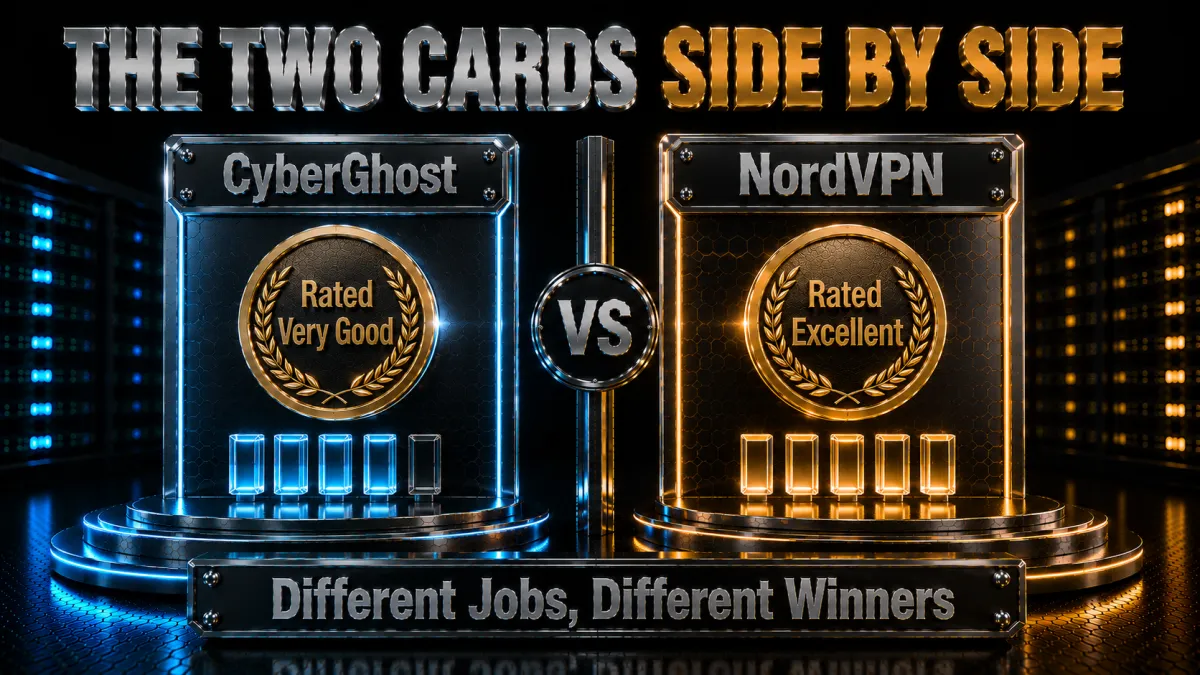
The market’s strongest overall package: NordLynx throughput leading the industry pattern, a Panama base with the densest audit rhythm we track, RAM-only infrastructure, speciality routes from Double VPN to obfuscated servers, and a suite, Threat Protection, Dark Web Monitor, Meshnet, that reads like separate products bundled. Ten slots and a premium-mid price frame a case that wins five rounds below.
| Jurisdiction | Panama |
| Protocol | NordLynx (WireGuard-based) |
| Devices | 10 |
| Money-back | 30 days |
The friendliest on-ramp in the category: task-sorted servers labelled For Streaming and For Gaming so the app makes the expert choice for you, one of the market’s largest raw fleets, a Romania base with an audited no-logs policy and transparency reports, and the 45-day money-back window nobody else matches. Budget long-term pricing and seven slots complete a case built for first-timers rather than tinkerers.
| Jurisdiction | Romania |
| Protocol | WireGuard |
| Devices | 7 |
| Money-back | 45 days (long plans) |
Round 1: Privacy, jurisdiction, and audits
The trust foundations, compared directly.
- Jurisdictions: both genuinely good. Panama sits outside the intelligence alliances entirely; Romania sits inside the EU but with courts that have repeatedly struck down data-retention regimes, making it one of Europe’s friendlier VPN homes. This sub-round is closer than most buyers assume.
- Audit records: Nord by cadence. Both services hold independent no-logs examinations; Nord’s multi-year rhythm of repeated audits remains the densest we track, while CyberGhost pairs its audit record with regular transparency reports listing legal requests. Different transparency styles, with Nord’s the deeper verification.
- Infrastructure. Nord runs RAM-only fleet-wide; CyberGhost operates a large fleet including NoSpy servers housed in its own Romanian facility for the supply-chain cautious. Both architectures are serious; Nord’s diskless uniformity is the cleaner story.
- The honest bottom line. Everyday-privacy buyers clear the bar comfortably with either; verification-first buyers tilt Nord on cadence, per the same logic every matchup on this site applies. No scare stories are needed either way.
Round winner: NordVPN, on audit cadence, with Romania a genuinely respectable second flag.
Round 2: Security architecture
The machinery, held to the same bar.
- Encryption: modern on both. Current-standard ciphers under NordLynx and CyberGhost’s WireGuard alike, perfect forward secrecy throughout. The mathematics separates nothing.
- Kill switches: both dependable. Engaged on drops as designed across desktop and mobile in sustained use on both sides. Configure and verify day one either way, per the standing guidance.
- Leak protection: clean records. Private DNS in-tunnel on both, clean leak-suite results in our sustained use. Verify per device regardless; one minute each.
- The differentiators. Nord fields Double VPN, Onion-over-VPN, and obfuscated servers; CyberGhost answers with its content blocker and NoSpy tier but lacks any dedicated obfuscation mode, the honest gap our full review names. Layered options tilt Nord.
Round winner: Tie on fundamentals, with Nord’s obfuscation and layered routes noted for the buyers who need them; the gaming and features rounds price those properly.
Round 3: Speed, patterns not fictions
No fabricated Mbps tables, per the standing policy; the reproducible shape instead.
- The shared floor. Both cost a modest slice of baseline to a nearby server that browsing, streaming, and calls rarely notice. Usability is not the question; edges are.
- Nord’s edge. NordLynx holds peak throughput and long-haul consistency ahead in matching conditions, the same pattern our reviews and broad testing consensus describe. The step is real and repeatable.
- CyberGhost’s honest position. Well-implemented WireGuard lands in the market’s capable middle: entirely sufficient for 4K evenings and calls, a step behind the leaders at peaks and on long hauls. Most beginners would never identify the gap blind.
- Your test outranks ours. A 45-day window on one side and 30 on the other leave ample room for the ten-minute method on both, your real evening hour, your real servers. The parallel plan below converts this round into your own numbers.
Round winner: NordVPN, on peak pattern and long-haul consistency.
Round 4: Apps and everyday experience
The round CyberGhost was designed to win.
- Task-sorted genius. CyberGhost’s server list is organised by intent, For Streaming, For Gaming, For Torrenting, with the app making the expert choice behind a plain label: the single most beginner-friendly design decision in the category. First-timers feel competent in minutes, which is precisely the point.
- The big-button philosophy. One prominent connect action, sensible defaults, and settings that stay out of the way until sought; the desktop and mobile apps carry the same warmth. Friendly without being patronising.
- Nord’s capable density. The map-and-list interface is polished and rewards exploration, with the suite and speciality servers within reach; it asks slightly more of a first-timer and pays it back in capability. Excellent, differently aimed.
- The honest margin. For the buyer this round exists to serve, the newcomer, CyberGhost’s design wins plainly; for the tinkerer, Nord’s depth serves better. We score rounds by execution of purpose, and CyberGhost executes its purpose best in class.
Round winner: CyberGhost, for the friendliest, most self-explaining apps in the category.
Round 5: Streaming reliability
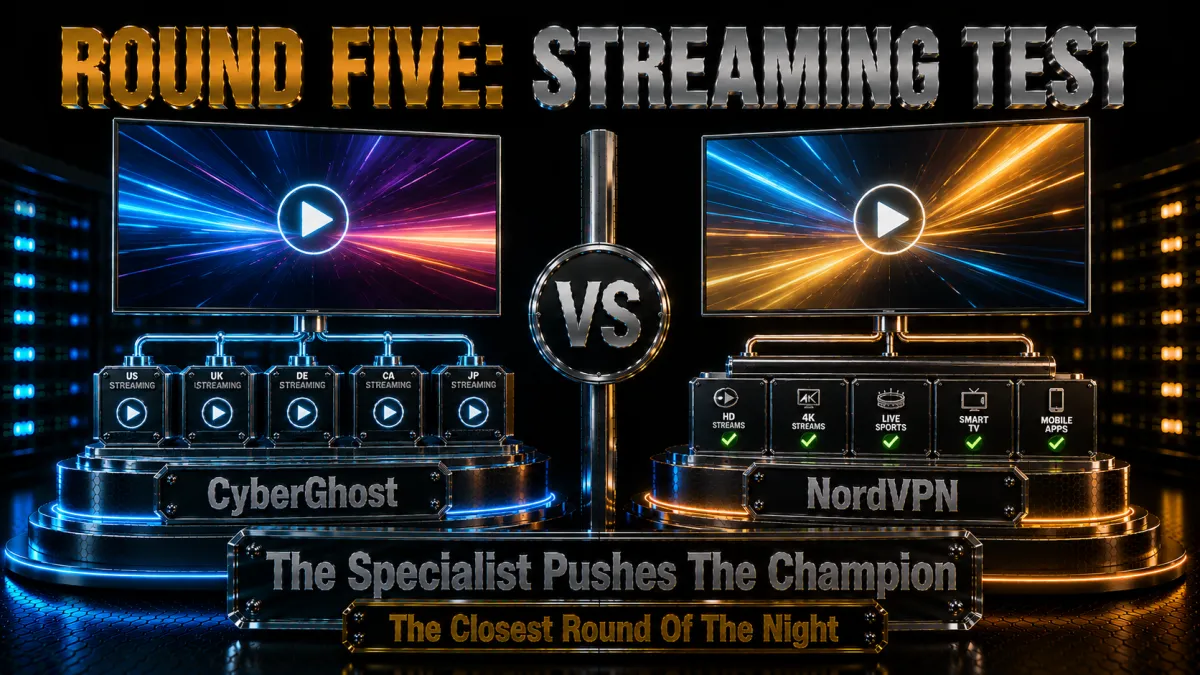
The quiet main use case, compared honestly.
- Both strong, differently. Major platforms have worked through both in sustained use, with the hop-and-retry habit needed occasionally on either side. Nord’s depth and CyberGhost’s labels attack the same problem from opposite ends.
- CyberGhost’s edge: the labels. Streaming servers named for specific platforms and regions remove the trial-and-error that frustrates newcomers most; pick the label matching your target and the guesswork is gone. Task-sorting shines brightest exactly here.
- Nord’s edge: the alternates. A deep fleet means more escape routes when an endpoint flags at peak hours, streaming resilience as a side effect of scale. Felt on busy evenings, invisible otherwise.
- The standing terms note. Platforms’ terms restrict cross-border catalogue access, and that use rides at your own account risk, the caveat this site attaches everywhere. Mechanics described, terms yours to weigh.
Round winner: Tie. Labels for the newcomer, alternates for the power user: both excellent paths to the same evening.
Round 6: Server networks
The maps, read practically.
- CyberGhost’s raw scale. One of the largest fleets in the consumer market by server count, spread across a hundred-plus countries with load shown per server. Sheer quantity keeps average load low and nearby options plentiful.
- Nord’s depth of kinds. Thousands of servers layered with speciality categories, P2P, obfuscated, Double VPN, dedicated IP, that CyberGhost’s flat fleet does not match. Fewer raw servers than CyberGhost by count, more kinds of server by far.
- Both load-visible. Per-server load in both apps makes the hop habit easy to practise well. Small feature, daily payoff, shared.
- The honest score. Raw count against speciality depth is a genuine trade: the newcomer benefits from CyberGhost’s plentiful ordinary servers; the power user benefits from Nord’s routes. By the numbers that matter to each audience, CyberGhost’s scale edges the round its audience feels.
Round winner: CyberGhost, narrowly, on raw fleet scale, with Nord’s speciality depth scored in the features round.
Round 7: Extra features
The cupboards, inventoried honestly.
- Nord’s suite. Threat Protection working even off-tunnel, Dark Web Monitor breach alerts, Meshnet private networking, Double VPN, and Onion routing: a security toolkit beyond the tunnel that reads like separate products. The premium’s best argument, here as in every Nord matchup.
- CyberGhost’s essentials. A content blocker trimming ads and malicious domains, ID Guard email-breach alerts, NoSpy servers, a privacy-cleanup tool on Windows, and dedicated IP as an add-on: sensible, lighter, honestly labelled in our review as functional rather than deep.
- The gap is real. No mesh networking, no multi-hop, no dedicated obfuscation on the CyberGhost side; buyers who will use those tools have their answer already. Buyers who would never open them are paying Nord for shelf ornaments.
- The value lens. CyberGhost’s lighter cupboard comes at a lower price, which the pricing round scores; this round scores the cupboards themselves, and it is not close.
Round winner: NordVPN, decisively, on suite depth and breadth.
Round 8: Pricing, value, and the 45-day window

No invented price tables; the structures compared instead.
- The positions. CyberGhost prices in the budget band on long plans, undercutting Nord’s premium-mid position consistently, with the gap persisting at renewal where it matters. The cheaper service here is genuinely cheap, not nominally.
- Intro versus renewal, both sides. Headline rates belong to first terms on both; the checkout-page renewal figure is the commitment. Read it before paying, here as everywhere on this site.
- The 45-day card. CyberGhost’s long plans carry the longest money-back window in the mainstream market, half again the standard 30, turning the proving period this site’s whole method depends on into a comfortable six weeks. The short-plan exception applies: monthly billing carries a shorter window, so buy long to get the guarantee that matters.
- Value verdict. Per unit of money, CyberGhost delivers the friendlier experience and the bigger fleet for less; Nord delivers more peak, more suite, and more slots for more. The budget maths favours CyberGhost; the worth-it maths depends on whether you use what Nord adds, the same honest split as every premium-versus-value round we score.
Round winner: CyberGhost, on price and the unmatched proving window together.
Round 9: Support and refunds
The safety nets, compared as users meet them.
- Both offer 24/7 live chat. Round-the-clock chat with competent responses and solid knowledge bases on both sides. The category’s premium support standard, met by both.
- Refund practice. Both honour their guarantees as routine practice in our experience and broad user reports, 45 days on CyberGhost’s long plans against Nord’s 30. Calendar the deadline either way, per the standing habit.
- Documentation for beginners. CyberGhost’s setup content matches its audience: plain steps, screenshots, minimal jargon; Nord’s covers a wider feature set at slightly higher assumed knowledge. Both pair well with our own guides.
- The bot layer. Both route chat through an assistant first; asking for an agent shortens the path on either. Shared, minor friction.
Round winner: Tie. The refund-window difference is scored in the pricing round; support quality itself is level.
Round 10: Gaming performance

Latency, stability, and the evening test.
- Why gamers use a VPN at all. Sidestepping ISP throttling on gaming traffic, protecting against lobby-based harassment exposure, and reaching regional servers or early releases: the legitimate use cases our gaming guides cover. A VPN adds a hop by definition; the question is how small and how stable.
- Nord’s edge: the pattern. NordLynx’s low-overhead design and the deep nearby fleet keep evening ping steadier and reconnections rarer in sustained use, the combination competitive play actually needs. The speed round’s step shows up most where milliseconds are the product.
- CyberGhost’s honest answer. The For Gaming server category picks low-latency endpoints without expertise, entirely serviceable for casual and console play, with the market-middle pace the speed round describes. Casual gamers lose nothing they will feel; competitive players will feel the step.
- Your ping is local. No metric varies more by connection and region than latency; both windows leave ample room to test your real game at your real hour. Numbers over impressions, per the standing method.
Round winner: NordVPN, on latency stability, with CyberGhost’s labels the friendlier casual path.
The full scorecard: twelve rounds tallied

Every round in one table, with devices and the refund window scored inline.
| Round | NordVPN | CyberGhost | Winner |
|---|---|---|---|
| 1. Privacy & audits | Panama, densest cadence | Romania, transparency reports | NordVPN |
| 2. Security architecture | Layered routes | Solid core, no obfuscation | Tie |
| 3. Speed pattern | Peak and consistency | Capable middle | NordVPN |
| 4. Apps | Polished density | Task-sorted friendliness | CyberGhost |
| 5. Streaming | More alternates | Labelled servers | Tie |
| 6. Server network | Speciality depth | Largest raw fleet | CyberGhost |
| 7. Extra features | Full suite | Functional basics | NordVPN |
| 8. Pricing & 45 days | Premium-mid | Budget + longest window | CyberGhost |
| 9. Support | 24/7, honoured | 24/7, honoured | Tie |
| 10. Gaming | Latency stability | Friendly labels | NordVPN |
| 11. Device allowance | 10 slots | 7 slots | NordVPN |
| 12. Beginner onboarding | Sensible defaults | Self-explaining design | CyberGhost |
- Final tally: NordVPN 5, CyberGhost 4, Ties 3. The ranking gap confirmed without embarrassment: Nord’s wins are performance and depth, CyberGhost’s are friendliness, fleet scale, money, and the window. The clusters are the real verdict.
- How to read a 5-4-3. A 4.8 beating a 4.5 by one round is the honest arithmetic of a premium product against a value product that executes its own brief excellently. Buy the cluster that describes you, not the count.
Which should you pick? The decision, made explicit
The clusters, translated into buyers.
- Pick NordVPN if performance and the suite are your life. The fastest pattern, the densest audits, ten slots, and tools from Threat Protection to Meshnet justify the premium for buyers who will use them. Our rankings’ top spot rests on exactly this profile.
- Pick CyberGhost if this is your first VPN. Task-sorted servers, self-explaining apps, and 45 days to change your mind make it the gentlest competent on-ramp in the market, per our full review. Friendliness is a feature, honestly priced in.
- Pick NordVPN if you game competitively or count devices past seven. Latency stability and ten slots settle both questions in the same direction. The gaming round and the inline device round were not close.
- Pick CyberGhost if budget leads. The lower bill buys the bigger raw fleet and the longer window, giving up peak pace and suite depth you may never open. Value with named trade-offs, the way this site prefers it.
- Either way, the safety floor holds. Audited, kill-switch-equipped, refund-backed on both sides: this is a temperament-and-budget decision, not a safety one.
Test both in parallel: the 75-days-of-windows plan
A 45-day window and a 30-day window, one experiment, your connection as referee.
- Day 1: subscribe to both, calendar both deadlines. CyberGhost long plan for the 45-day guarantee, Nord for its 30, renewal rates screenshotted at both checkouts, decision date at day 25 to stay inside the shorter window. The guarantees make the experiment nearly free.
- Day 1: install and verify both. Kill switches on, leak suite per device on each, per our leak-check guide. Same devices, same baseline, fair fight.
- Week 1: alternate days through real life. Nord odd days, CyberGhost even: commutes, evening streams, calls, and one gaming session on each if you play. Note friction, not just numbers.
- Week 2: the ten-minute speed method on each. Baseline, three nearest servers per service, your real evening hour, recorded side by side. Your table outranks ours by definition.
- Week 3: stress the difference-makers. Nord’s suite exercised honestly, Threat Protection, a Double VPN session, Meshnet if you have a use; CyberGhost’s labels doing your streaming picks and its NoSpy tier tried once. Score the rounds your life actually contains.
- Day 25: decide, with a safety margin. Keep the winner, refund the loser inside its window, and note that if Nord loses, CyberGhost’s 45 days still leave you weeks of buffer to be sure. Parallel evidence settles a 5-4-3 better than any reviewer can.
Mistakes buyers make in this matchup
Collected so you can skip them.
- Paying for Nord’s suite you will never open. Threat Protection and Meshnet justify the premium only in use; a connect-and-forget buyer is buying shelf ornaments. Match the price to your actual usage.
- Dismissing CyberGhost as the lesser service outright. It loses the count by one round while winning apps, fleet scale, price, and the window: for its actual audience it is the better purchase. Rankings measure absolute quality; purchases measure fit.
- Forgetting the 45-day fine print. The long window attaches to long plans; monthly billing carries a shorter one. Buy the plan that carries the guarantee you are counting on.
- Deciding on intro price alone. Both renewal figures are the real commitment, and the gap persists there. Checkout-page arithmetic before payment, both sides.
- Skipping the parallel test. Seventy-five combined days of refund windows is the most generous testing runway of any matchup we score. Run the plan; the verdict becomes yours.
Related reading:
Frequently asked questions
Which is better, CyberGhost or NordVPN?
NordVPN wins our twelve rounds five to four with three ties, on audit cadence, speed, features, gaming, and device slots, confirming its 4.8 rating against CyberGhost’s 4.5. CyberGhost wins apps, raw fleet scale, price, and the 45-day window, making it the better purchase for first-timers and budget-led buyers specifically.
Is NordVPN faster than CyberGhost?
Yes, in matching conditions NordLynx holds peak throughput and long-haul consistency ahead of CyberGhost’s capable-middle WireGuard, with the gap felt most at peaks and in competitive gaming. Most everyday use would not spot it blind; run the ten-minute test on both inside the generous windows.
Is CyberGhost good for beginners?
It is the best beginner VPN we have reviewed: task-sorted servers labelled by intent, self-explaining apps, and a 45-day window to change your mind remove the three biggest newcomer frictions at once. The trade-offs, no obfuscation mode, lighter extras, seven slots, are named honestly in our full review.
Are CyberGhost and NordVPN both safe?
Yes: audited no-logs policies, modern encryption, dependable kill switches, and clean leak records on both, from Romania and Panama respectively. Nord’s audit cadence is denser, a step our privacy round scores honestly rather than a tier of safety.
Which is cheaper, CyberGhost or NordVPN?
CyberGhost, consistently, on long plans where its budget pricing and 45-day guarantee both live; Nord holds the premium-mid band its performance case supports. Read both renewal figures at checkout before paying, per the standing advice.
Which has the longer money-back guarantee?
CyberGhost, at 45 days on long plans against the industry-standard 30 Nord offers, the longest mainstream proving window in the market. Note the fine print: CyberGhost’s monthly billing carries a shorter window, so buy long to get the guarantee that matters.
Which is better for streaming, CyberGhost or NordVPN?
We score it a tie: CyberGhost’s labelled streaming servers remove the newcomer’s guesswork, while Nord’s deeper fleet offers more alternates when endpoints flag at peak hours. Platforms’ terms restrict cross-border catalogue access, at your own account risk, per the standing caveat.
Which is better for gaming?
NordVPN, on latency stability and reconnection behaviour where milliseconds are the product; CyberGhost’s For Gaming labels are the friendlier casual path at the market-middle pace. Ping varies by connection more than any other metric; test your real game inside both windows.
Do CyberGhost and NordVPN have the same owner?
No: CyberGhost operates under Kape Technologies alongside ExpressVPN, while NordVPN operates under Nord Security alongside Surfshark, and our reviews disclose both structures wherever relevant. Neither umbrella has shown practical bearing on the audited policies.
How many devices do they allow?
Ten simultaneous connections on NordVPN against seven on CyberGhost, a round Nord wins for larger households; neither matches the unlimited policies of Surfshark or IPVanish, per those reviews. Count your screens before subscribing.
Does CyberGhost have obfuscation like NordVPN?
No dedicated mode: NordVPN offers obfuscated servers for VPN-hostile networks while CyberGhost’s OpenVPN fallback helps only sometimes, the honest gap our full CyberGhost review names. Travellers on filtered networks should weigh this round heavily or read our ExpressVPN coverage.
Can I test CyberGhost and NordVPN before committing?
Yes, with the most generous combined runway of any matchup we score: 45 days on CyberGhost’s long plans plus Nord’s 30, alternating days for three weeks and deciding by day 25. Parallel evidence on your own connection outranks every review, this one included.
Which should a complete beginner choose?
CyberGhost, comfortably: the task-sorted design was built for exactly this buyer, and the 45-day window forgives a change of heart. Choose Nord instead when you know you will grow into the suite and the pace within the first year.
Do CyberGhost and NordVPN both allow torrenting?
Yes: CyberGhost labels dedicated For Torrenting servers in its task-sorted list while Nord routes P2P through dedicated servers automatically, both paired with kill switches and private DNS per our torrenting-safety guidance. The standing legal note applies on both: the tunnel changes network visibility, not the legality of downloads.
What are CyberGhost NoSpy servers, and does NordVPN have an equivalent?
NoSpy servers sit in CyberGhost’s own Romanian facility with hardware it controls end to end, shortening the supply chain for the cautious; Nord’s answer is different in kind, RAM-only architecture fleet-wide plus co-located infrastructure. Both are serious approaches to the same trust question, and neither is a reason to panic about the standard fleets.
The Bottom Line
- NordVPN wins, five rounds to four with three ties. Audits, speed, features, gaming, and slots confirm the 4.8-against-4.5 ranking gap honestly.
- CyberGhost wins its audience’s rounds. The friendliest apps, the largest raw fleet, the lower bill, and the unmatched 45-day window: for first-timers, the better purchase.
- The safety floor is shared. Audited, kill-switch-equipped, refund-backed on both sides: temperament and budget decide, never safety.
- Seventy-five combined days of windows referee for free. The parallel plan above turns this page into your own verdict with weeks to spare.
- Full reviews carry the depth. Our standalone NordVPN and CyberGhost reviews examine each service on its own terms, twelve sections each.
Best overall against best on-ramp ends the honest way: the stronger service wins the count, and the friendlier one keeps the audience it was built for. Buy Nord when you will use what the premium buys; buy CyberGhost when a VPN that explains itself is worth more than pace you may never miss; and let the most generous refund runway in the market prove the choice on your own connection.
Jyoti VPN Expert leads VPN testing at VPN Expert Guide, covering streaming and regional access, speed and latency testing, and leak checks on Windows, Android and router-level setups. Our guides are built from vendor documentation, provider terms and our own connection testing on a residential line in India, and we publish those measurements in full so readers can check them. Every guide is reviewed before publication and dated so you can see how current it is.
Meet our testing team →Last updated: August 25, 2026