
Is VPN Legal in India in 2026? Rules, Risks and Safe Use
Search this question and you will find panic, rumour, and outdated posts in equal measure. The reality is calmer: using a VPN is legal in India, millions do it daily, and the famous 2022 rules were aimed at providers’ record-keeping, not at users. This guide walks through the law as it stands, what CERT-In actually required, what virtual Indian servers mean for you, and which five VPNs handle the Indian situation best.
The short answer, without hedging

Because this question attracts so much noise, here is the position in four clean statements.
- Using a VPN in India is legal. There is no law prohibiting individuals from using VPN services. Downloading a VPN app, connecting to it, and browsing through it are lawful acts.
- Businesses rely on VPNs openly. Corporate VPNs are standard infrastructure across Indian IT, banking, and remote work. The technology itself is mainstream, not fringe.
- What you do through a VPN is judged as itself. Fraud, hacking, accessing banned services, or any other unlawful act remains unlawful whether or not a VPN carried the traffic. The tunnel changes visibility, not legality.
- The 2022 rules targeted providers, not users. No user-facing prohibition was created. The practical effect you notice today is where Indian-IP servers are hosted, explained fully below.
What Indian law actually says

The legal landscape is simpler than the headlines suggested, and worth stating plainly.
- No statute bans VPN use. Indian law contains no general prohibition on individuals using virtual private networks. That is the beginning and the end of the personal-use question.
- The IT Act governs online conduct generally. India’s Information Technology Act and related rules criminalise specific acts, unauthorised access, fraud, and similar, and those apply identically with or without a VPN. Committing an offence through a VPN can add investigation complexity, never legality.
- Blocked content remains blocked content. India orders ISPs to block certain sites and apps. A VPN can technically reach some of them; the block orders and any consequences that flow from specific services’ terms remain what they are. This guide informs; it does not encourage circumventing lawful orders.
- Context matters at the edges. Employers, universities, and specific platforms can set their own VPN policies contractually, and sector rules can apply to regulated industries. Legal-to-use and permitted-everywhere are different claims; know the rules of the networks and services you use.
The 2022 CERT-In directions: what actually happened

This is the event behind every scary headline, and the details matter more than the headlines did.
- CERT-In issued cybersecurity directions in April 2022. India’s Computer Emergency Response Team required various service providers, including VPN providers, to collect and retain customer records, names, contact details, IP addresses assigned, and usage periods, for five years, and to report cyber incidents on tight timelines.
- The duty fell on providers operating in India. The obligation attached to services with Indian infrastructure and operations, which put strict no-logs VPN providers in an impossible position: comply and log, or keep their no-logs promise and leave.
- The major privacy providers chose to leave. NordVPN, ExpressVPN, and Surfshark were among those that removed their physical servers from India in 2022 rather than log users, stating publicly that the requirements were incompatible with their no-logs policies.
- Nothing in the directions criminalised users. The framework regulates providers’ record-keeping and incident reporting. Individual VPN use remained legal throughout, which is the single most misreported fact of the whole episode.
Virtual Indian servers, explained properly

The providers’ answer to CERT-In is the reason your India connection works the way it does today.
- A virtual Indian server gives Indian IPs from hardware abroad. The physical machines sit outside India, commonly in Singapore or Europe, while the addresses they hand out register as Indian, so websites treat you as connecting from India.
- Why this satisfies everyone’s constraints. With no infrastructure inside India, the providers keep their audited no-logs promises intact; with Indian IPs still on the menu, users keep access to India-registered browsing when they want it.
- What it means for performance. Your traffic physically travels to the host country and back, adding some distance versus a true Mumbai server. For most browsing this is unnoticeable; for latency-critical uses, the speed section below covers the smarter server choices.
- How to spot them. Providers label virtual locations in their apps and server lists. All five picks below offer Indian IPs virtually, and none logs your activity to do it, which is precisely the outcome the 2022 exodus was designed to protect.
Legal, everyday reasons Indians use VPNs

The lawful use cases are the boring majority, and they are worth naming because the headlines never do.
- Public Wi-Fi and UPI protection. Airport, cafe, hotel, railway, college, and co-working networks are exactly where encryption earns its keep, especially before banking or UPI sessions.
- Remote and hybrid work. Secure access to employer systems is the single most common VPN use in the country, mandated by the companies themselves.
- Privacy from ISP profiling. Inside the tunnel, your provider sees encrypted traffic to one server rather than a detailed log of your browsing, a legitimate preference, not an evasion.
- Travel continuity. Indians abroad use Indian IPs to reach home banking and services that dislike foreign logins; travellers in India keep their home-country access likewise.
- Safer everyday browsing. Domain-blocking extras on the top picks cut down phishing and malicious sites, a practical bonus unrelated to anything controversial.
What to look for in a VPN for India
The Indian situation adds specific requirements to the usual checklist, in this order.
- Virtual Indian servers that actually work. Since physical Indian hosting means logging under current rules, you want a provider that does virtual Indian IPs well, clearly labelled and reliably registered as India.
- Audited no-logs policies. The entire point of the 2022 exodus was refusing to log. Independent audits turn that stance from claim into evidence; all five picks carry them, with caveats noted honestly.
- Fast nearby infrastructure. Singapore and other regional hubs carry much of the load for Indian users, so strong Southeast Asian server presence translates directly into daily speed.
- Reliability on Indian networks. Mobile data and broadband here vary widely; protocols that reconnect gracefully and a kill switch that holds through drops matter more than in steadier network environments.
- Fair pricing in rupees. Long-term plans on the value picks cost less monthly than a single food delivery, and 30 to 45 day refunds make every choice reversible.
How to choose for your situation
All five picks handle the Indian fundamentals; match one to your priorities.
- Best all-round with strong virtual India support? NordVPN combines audited privacy, speed, and clean virtual Indian IPs.
- Simplest premium experience? ExpressVPN’s effortless apps and reliability suit anyone who never wants to see a setting.
- Whole family on a budget? Surfshark’s unlimited devices at the lowest price is the household answer.
- First VPN, want the longest trial? CyberGhost’s plain-language apps and 45-day window make starting easy.
- Many devices, speed first? IPVanish covers unlimited connections briskly at a fair price.
The 5 best VPNs for users in India in 2026
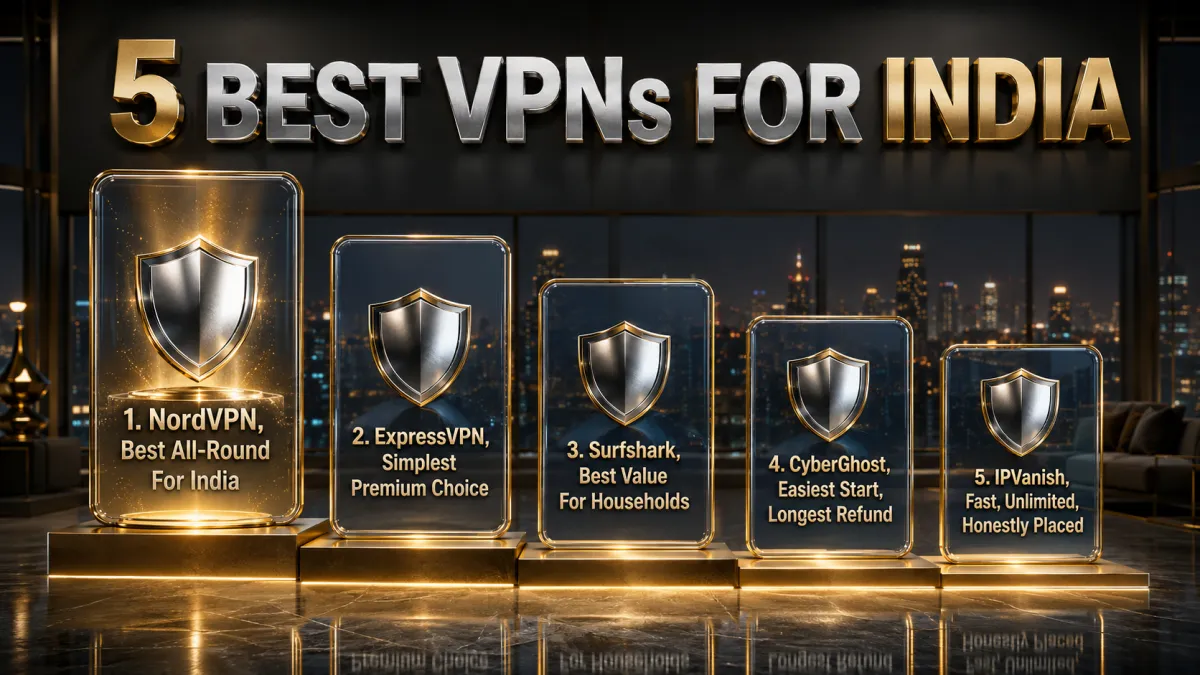
Ranked for the India-specific criteria above: no-logs credibility first, given the whole 2022 story, then virtual India quality, regional speed, and value.
1. NordVPN – Best overall for India
NordVPN was among the providers that removed physical Indian servers in 2022 rather than log users, and its virtual Indian servers have been the smooth replacement since: Indian IPs, clearly labelled, backed by a no-logs policy verified through multiple independent audits and RAM-only infrastructure. For the exact concern this article exists to answer, its credentials are the strongest here.
Daily use is equally strong: NordLynx keeps regional connections fast, Southeast Asian hubs carry Indian traffic well, the kill switch holds through mobile-network wobbles, and Threat Protection trims phishing domains from everyday browsing. Panama jurisdiction keeps the company itself outside data-sharing alliances.
✔ Pros
- Multiple independent no-logs audits
- Clean, labelled virtual Indian servers
- NordLynx speed on regional hubs
- Kill switch reliable on shaky networks
- Threat Protection blocks hostile domains
✘ Cons
- Best price needs a longer plan
- Virtual India adds some physical distance
| Indian IPs | Yes, virtual servers |
| Audited no-logs | Yes, multiple audits |
| Jurisdiction | Panama |
| Kill switch | Yes |
| Devices | 10 |
| Money-back | 30 days |
2. ExpressVPN – Simplest premium choice
ExpressVPN also withdrew physical Indian servers in 2022 to protect its no-logs stance, and serves Indian IPs virtually since, from an architecture that remains the cleanest in the industry: the entire fleet runs in RAM and wipes on reboot, audited, based in the British Virgin Islands. Its one-button apps make it the pick for family members who should never need to open settings.
Lightway connects near-instantly and survives flaky mobile data gracefully, a genuinely relevant virtue on Indian networks. The familiar trade-offs complete the picture: the highest price of the five and an eight-device cap.
✔ Pros
- RAM-only fleet, audited no-logs
- Virtual Indian IPs, clearly labelled
- Effortless apps on every platform
- Lightway handles weak mobile data well
- BVI jurisdiction
✘ Cons
- Most expensive of the five
- 8-device cap is the tightest here
| Indian IPs | Yes, virtual servers |
| Audited no-logs | Yes, audited |
| Jurisdiction | British Virgin Islands |
| Kill switch | Yes, Network Lock |
| Devices | 8 |
| Money-back | 30 days |
3. Surfshark – Best value for Indian households
Surfshark completed the same 2022 choice, virtual Indian servers instead of logging, and wraps it in the best household economics of the five: unlimited simultaneous devices at the lowest long-term price, so every phone, laptop, and the hostel room’s spare tablet ride one plan. The no-logs policy is independently audited, and CleanWeb quietly blocks hostile domains.
Honest placement: regional speeds sit a step behind the top two at peak hours, and its Netherlands base is inside the EU. For most Indian households the price-per-device settles the decision comfortably.
✔ Pros
- Lowest long-term price of the five
- Unlimited simultaneous devices
- Virtual Indian IPs available
- Audited no-logs policy
- CleanWeb domain blocking
✘ Cons
- Peak-hour speeds behind the leaders
- Netherlands base, inside the EU
| Indian IPs | Yes, virtual servers |
| Audited no-logs | Yes, audited |
| Jurisdiction | Netherlands |
| Kill switch | Yes |
| Devices | Unlimited |
| Money-back | 30 days |
4. CyberGhost – Easiest start, longest refund
CyberGhost offers Indian IPs through virtual hosting like the rest, delivered through the plainest-language apps of the five: one connect button, clearly labelled servers, and settings written for humans. Its audited no-logs policy comes with regular transparency reports, and its Romania base sits outside the major alliances.
The 45-day money-back guarantee is the longest here, six weeks to test on your own networks, mobile data included, before any money is truly spent. Power features are lighter than NordVPN’s, which is precisely the appeal for a first-time user.
✔ Pros
- Plainest apps for first-timers
- 45-day refund, longest here
- Virtual Indian IPs available
- Audited no-logs with transparency reports
- Huge server network
✘ Cons
- Lighter advanced feature set
- Speeds good rather than leading
| Indian IPs | Yes, virtual servers |
| Audited no-logs | Yes, audited |
| Jurisdiction | Romania |
| Kill switch | Yes |
| Devices | 7 |
| Money-back | 45 days |
5. IPVanish – Fast, unlimited, honestly placed
IPVanish brings brisk sustained speeds and unlimited simultaneous connections at a fair price, a straightforward workhorse for speed-focused users with many devices. Its regional coverage carries Indian traffic through nearby hubs competently.
Fifth place on this specific page reflects the trust axis the article is about: a US jurisdiction inside the major intelligence alliance and a lighter independent audit history than the four above. For ordinary threat models it remains fair value; for readers here precisely because of the logging story, the four above carry stronger evidence.
✔ Pros
- Consistently brisk speeds
- Unlimited simultaneous connections
- Fair pricing
- Simple apps on every platform
- Kill switch and split tunnelling included
✘ Cons
- US jurisdiction
- Lighter audit history than the leaders
| Indian IPs | Check current server list |
| Audited no-logs | Policy in place, lighter audit history |
| Jurisdiction | United States |
| Kill switch | Yes |
| Devices | Unlimited |
| Money-back | 30 days |
| Feature | NordVPN | ExpressVPN | Surfshark | CyberGhost | IPVanish |
|---|---|---|---|---|---|
| Indian IPs (virtual) | Yes | Yes | Yes | Yes | Check list |
| Audited no-logs | Multiple audits | Audited | Audited | Audited | Lighter history |
| Jurisdiction | Panama | BVI | Netherlands | Romania | United States |
| Regional speed | Excellent | Excellent | Strong | Good | Excellent |
| Devices | 10 | 8 | Unlimited | 7 | Unlimited |
| Money-back | 30 days | 30 days | 30 days | 45 days | 30 days |
Setting up a VPN in India, step by step
Five minutes from download to protected, with the India-specific choices called out.
- Subscribe and download from the provider’s own site or official app stores. Skip modded APKs and third-party download portals entirely; they are the malware channel, and a compromised VPN app defeats the whole purpose.
- Sign in and connect to the nearest fast server. For pure speed, that is often a regional hub the app picks automatically. Let quick-connect choose, and note your baseline.
- Turn the kill switch on. Mobile-data drops and Wi-Fi handoffs are daily events on Indian networks; the kill switch keeps those moments from leaking traffic outside the tunnel.
- Enable auto-connect for untrusted networks. Cafe, airport, and hotel Wi-Fi should raise the tunnel before the first packet, automatically, on phone and laptop both.
- Pick your India setting deliberately. Want Indian-registered browsing? Choose the labelled virtual India location. Want maximum speed? Nearest hub. Favourite both and switch by task.
- Run the provider’s leak test once. Confirm the shown IP is the server’s and DNS resolves through the provider. Thirty seconds now saves months of assuming.
Getting the best speeds from India
Geography changed after 2022, so the speed playbook is worth spelling out.
- Nearby hubs carry the region. With physical Indian servers gone from the majors, Singapore and other Southeast Asian locations typically deliver the fastest general-purpose connections from India: short paths, big capacity.
- Virtual India costs a little distance. Indian-IP browsing routes through the host country’s hardware, adding some latency versus the nearest hub. Use virtual India when you need Indian registration, the nearest hub when you need raw speed.
- Protocol and server load do the rest. WireGuard-class defaults, plus a switch to a quieter server when peak hours crowd one, recover most speed complaints without any deeper tinkering.
- Mobile data benefits from resilient protocols. Options built to survive network changes reconnect faster through signal dips, which is most of what feels like VPN slowness on phones.
What a VPN does and does not hide in India

Clear boundaries keep expectations honest, which this topic needs more than most.
- Hidden from your ISP: destinations and content. Inside the tunnel, your provider sees encrypted traffic to one server rather than your browsing log. That is the core privacy gain, and it is real.
- Hidden from websites: your real IP. Sites see the server’s address, breaking casual IP-based location and identity linking.
- Not hidden: what you log into. Accounts you sign into know who you are regardless of routing, and everything you do inside them is theirs to see.
- Not erased: legal reality. A VPN does not anonymise unlawful conduct into safety, and investigations have more tools than IP addresses. The tunnel is privacy for lawful life, not immunity for anything else.
- Provider trust is the hinge. Whoever runs the tunnel could technically observe it, which is why this page weighted audits and the 2022 no-logs exodus so heavily: pick providers who proved the promise.
Common mistakes Indian users make
Five recurring errors, each cheap to avoid.
- Believing the VPN-is-banned rumour. It never was. Deciding against protection because of a misread headline is the most common and most costly mistake on this topic.
- Treating the VPN as legal cover. The opposite error: nothing illegal becomes legal in the tunnel. Use it for privacy, not permission. This also applies to streaming and gaming accounts, including JioHotstar and BGMI.
- Sideloading cracked VPN apps. A modded APK with network-level access to everything you send is a security disaster in a privacy costume. Official sources only.
- Judging speed from one crowded server. Try the nearest hub and one alternative before concluding anything; load varies hourly.
- Leaving the kill switch off on mobile. Indian networks drop and switch constantly; without the kill switch, each transition browses bare. Turn it on the first day.
Free VPNs in India: the honest verdict

Price pressure makes free options tempting here, so the trade deserves plain words.
- The business model is the problem. Servers cost money; free services historically recover it through logging, ads, and data sales, the exact trade this article’s entire backstory is about refusing.
- The engineering is capped. Data limits, throttled speeds, crowded servers, and missing kill switches make free tiers unfit for daily use, banking above all.
- Reputable freemium tiers are tasters, not tools. A limited free plan from an audited provider is fine to trial the experience; it is not the daily driver.
- The refund route is the real free trial. Thirty to forty-five days on the picks above, used honestly, is a month-plus of full protection at zero net cost, decided at the end.
Related reading:
Frequently Asked Questions
Is using a VPN legal in India in 2026?
Yes. No Indian law prohibits individuals from using a VPN, and everyday uses like public Wi-Fi protection, remote work, and private browsing are ordinary lawful activity. The 2022 CERT-In directions regulated providers’ record-keeping, not users, and using a VPN never became an offence. Illegal acts remain illegal with or without one, and this is general information rather than legal advice.
Is it illegal to use a VPN in India? Is there any punishment?
No. Using a VPN is not illegal in India, and there is no punishment for ordinary personal use such as streaming, gaming, or protecting your privacy. What remains punishable is the underlying activity: anything that is already a crime stays a crime whether or not a VPN is involved. The 2022 CERT-In rules regulate VPN providers, not users, which is why several companies moved their Indian servers abroad rather than log customer data.
Why did NordVPN, ExpressVPN, and Surfshark remove their Indian servers?
The 2022 CERT-In directions required providers operating in India to collect and retain user records, including identities and assigned IPs, for five years. Rather than log users and break their audited no-logs promises, these providers removed physical Indian infrastructure in 2022 and now serve Indian IP addresses from virtual servers hosted abroad.
What is a virtual Indian server?
A server whose hardware sits outside India, commonly in Singapore or Europe, while the IP addresses it assigns register as Indian, so websites treat your connection as coming from India. It lets providers offer Indian-registered browsing without maintaining infrastructure subject to Indian logging requirements, keeping no-logs policies intact.
Can I get in trouble just for having a VPN app on my phone?
No: possessing and using a VPN app is legal in India. Trouble attaches to unlawful conduct, which stays unlawful however it is routed. Separate contexts can have their own rules, an employer or college network policy, for instance, so know the terms of networks you use, but the law does not punish VPN use itself.
Do the CERT-In rules mean my VPN is logging me?
Not if you chose one that restructured to avoid it: the major audited providers removed Indian infrastructure precisely so they would not have to log users, and their no-logs policies are independently verified. The rules bind providers operating in India; the featured picks serve Indian users from abroad without activity logs.
Which VPN is best for India in 2026?
NordVPN overall: multiply audited no-logs, clean virtual Indian servers, and fast regional performance. ExpressVPN is the simplest premium alternative, Surfshark the value pick with unlimited devices, CyberGhost the friendliest starter with a 45-day refund, and IPVanish the speed-focused workhorse with honest caveats about its audit history.
Will a VPN slow my internet in India?
Slightly, and usually imperceptibly: WireGuard-class protocols through nearby regional hubs cost single-digit percentages on decent connections. Virtual Indian servers add a little more distance than the nearest hub; pick by task, hub for speed, virtual India for Indian registration, and switch servers when one gets crowded.
Can I use a VPN for online banking in India?
Yes, and on public Wi-Fi it is exactly the right tool: the encrypted tunnel protects your session from network snooping. Some banks challenge unfamiliar or foreign IPs, so connect through a nearby or Indian-registered server for smoother logins, and keep the app official and updated like any security tool.
Is it legal to access blocked sites with a VPN in India?
This is where careful wording matters: VPN use is legal, while India’s blocking orders and each service’s own terms remain in force, and consequences under them are a separate question from VPN legality. This guide explains the technology honestly and does not encourage circumventing lawful orders; for stakes that matter, ask a qualified professional rather than a blog.
Do companies in India legally use VPNs?
Constantly: corporate VPNs are standard practice across IT, banking, and every remote-work arrangement, mandated by employers themselves to secure access to internal systems. The technology’s mainstream, compliant use across Indian business is one of the clearest signs the personal-use panic was misplaced.
Should I pick servers in India or Singapore for daily use?
Both, for different jobs: the nearest regional hub, often Singapore, usually gives the fastest raw speeds from India, while virtual Indian servers give Indian-registered browsing when a service expects a local connection. Favourite one of each in the app and switch by task rather than choosing once forever.
Do free VPNs make sense in India?
As daily tools, no: caps, throttling, missing kill switches, and monetisation through your data make them the wrong answer, especially for banking. A reputable freemium tier is fine as a taster, and the 30 to 45 day refund windows on the audited picks are the honest way to trial full protection at no net cost.
Did any VPN providers stay in India after the 2022 rules?
The market split: providers built around strict no-logs policies withdrew physical servers, while some other services kept Indian infrastructure under the compliance regime, which entails the record-keeping the rules require. That is why this page weights audited no-logs and the virtual-server approach so heavily: for a privacy-motivated buyer, how a provider responded in 2022 is a direct signal of how seriously it takes the promise.
The Bottom Line
VPNs are legal in India, and the 2026 picture is calmer than the 2022 headlines ever suggested: the CERT-In directions pushed logging duties onto providers, the privacy-focused majors responded by moving Indian IPs onto virtual servers abroad, and the individual user’s position never changed. What remains is ordinary good judgement, the tunnel protects lawful life from unnecessary observation and launders nothing, and ordinary good shopping, because the whole story turned on which providers proved their no-logs promises when it cost them infrastructure. The evidence-backed shortlist is exactly what this page ranked.
The five picks in one line each:
- NordVPN leads with multiply audited no-logs, clean virtual Indian IPs, and regional speed.
- ExpressVPN offers the purest architecture and simplest apps at a premium.
- Surfshark wins household value with unlimited devices at the lowest price.
- CyberGhost is the gentlest start with the longest refund window at 45 days.
- IPVanish serves speed-first users honestly, with lighter audit evidence noted.
Install one, switch the kill switch on, favourite a hub and a virtual India server, and let the question that brought you here retire: the answer was yes, it is legal, and now your connection is simply safer than it was this morning.
Jyoti VPN Expert leads VPN testing at VPN Expert Guide, covering streaming and regional access, speed and latency testing, and leak checks on Windows, Android and router-level setups. Our guides are built from vendor documentation, provider terms and our own connection testing on a residential line in India, and we publish those measurements in full so readers can check them. Every guide is reviewed before publication and dated so you can see how current it is.
Meet our testing team →Last updated: September 22, 2026