
Best VPN for Cryptocurrency Trading in 2026: Security First, Hype Last
Crypto trading concentrates risk in one browser tab: real money, irreversible transactions, and accounts that attackers actively hunt. A VPN will not make you a better trader, but it will close the network-level holes that get exchange accounts drained: snooped logins on public Wi-Fi, tracked IPs, and phishing pages. This guide explains what a VPN honestly does for a crypto trader, what it cannot do, and which five services I would trust between me and an exchange.
Why crypto traders use a VPN

The honest reasons are about security and privacy, not loopholes, and they are stronger than most traders realise.
- Your IP links you to your holdings. Exchanges, portfolio trackers, and blockchain explorers all see your address, and data leaks from crypto services have repeatedly exposed user information to criminals who then target holders directly. Masking your IP breaks the easy link between your identity, your location, and the fact that you hold crypto at all.
- Trading happens everywhere, including bad networks. Markets run around the clock, so positions get checked from cafes, airports, and hotels. A VPN encrypts the whole session, so the network you happen to be on cannot observe that you are logging into an exchange, or interfere with the session.
- Phishing is the number one thief. Most stolen crypto walks out through fake exchange pages and poisoned links, not exotic hacks. VPNs with domain-level blocking, like NordVPN’s Threat Protection and Surfshark’s CleanWeb, stop many known malicious pages from loading at all, a real safety net at 2am.
- ISPs and networks profile crypto users. Without a VPN, your internet provider can log every exchange and wallet service you touch. For something this sensitive and this targeted, keeping that record out of anyone’s logs is plain good hygiene.
Public Wi-Fi and your exchange logins

The scenarios below are exactly how traders get compromised outside their homes, and exactly what full-tunnel encryption prevents.
- Rogue hotspots harvest sessions. A fake network named after the cafe puts its operator between you and the exchange. With a VPN, your traffic is encrypted before it reaches their equipment, so there is nothing to harvest.
- Session token theft skips your password. On exposed networks, attackers can sometimes grab the tokens that keep you logged in, entering your account without ever seeing your password. Keeping those tokens inside an encrypted tunnel removes the opportunity.
- DNS tricks redirect to fake exchanges. A hostile network can answer your request for an exchange’s address with a lookalike page. A VPN routes DNS through its own protected resolvers, so the network’s answers stop mattering.
- The kill switch closes the last gap. If the VPN drops mid-session, a kill switch freezes traffic instead of spilling it onto the open network. For accounts holding money, this is the difference between an annoyance and an exposure.
No-logs policies, audits, and RAM-only servers

Routing your trading traffic through a VPN means trusting that company more than any network you avoid. Trust here has a verifiable anatomy.
- A no-logs policy is a claim; an audit is evidence. Any provider can write “no logs” on a website. What separates the trustworthy ones is independent auditors examining servers and systems and publishing findings, which NordVPN, ExpressVPN, Surfshark, and CyberGhost have all done, repeatedly in the top cases.
- RAM-only servers make retention physically hard. Servers that run entirely in memory wipe completely on every reboot, so there is no disk accumulating history. ExpressVPN pioneered the approach and NordVPN has moved its fleet the same way.
- Jurisdiction decides what can be demanded. A company in Panama or the British Virgin Islands sits outside the major intelligence-sharing alliances, so the legal ground under a no-logs promise is firmer than for a US-based service. For financial traffic, this stops being abstract.
- For traders, this is the whole ballgame. Speed differences between the top five are marginal; the audit-and-architecture differences are not. Rank privacy evidence first and the rest of the choice gets easy.
Speed and latency for active trading
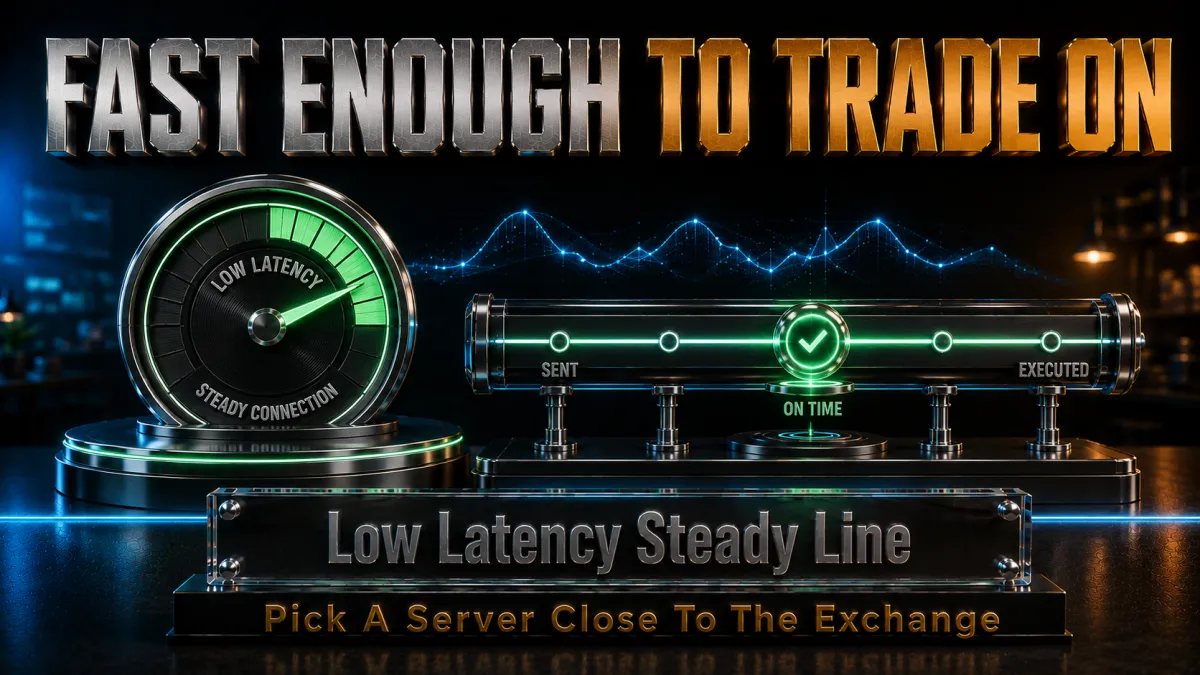
Speed matters differently for trading than for streaming, and knowing the difference saves you from optimising the wrong number.
- Latency beats bandwidth. Order placement and price updates are tiny packets; what you feel is round-trip time. A nearby VPN server adds only milliseconds, invisible for anything short of high-frequency strategies, which do not run through consumer VPNs anyway.
- Stability beats both. A connection that holds for hours matters more than one that benchmarks fast and flickers. Dropped tunnels mid-order are the actual risk, which is why connection stability and the kill switch rank above raw throughput here.
- Modern protocols cost almost nothing. WireGuard-based options like NordLynx deliver encryption overhead low enough that charts, order books, and video streams run indistinguishably from bare connections on any decent line.
- Server choice is the tuning knob. Connect to a server near you for everyday trading. If an exchange session feels sluggish, the fix is almost always a closer or less busy server, not a different provider.
The VPN features that matter most for crypto
Measured against how crypto accounts actually get compromised, these are the features that count, and they shaped the rankings below.
- Audited no-logs, first and always. Verified privacy from independent audits is the foundation; everything else is built on it.
- A kill switch that genuinely holds. Non-negotiable for financial sessions, on every platform you trade from, tested once before you rely on it.
- Phishing and malicious-domain blocking. Because most crypto theft starts with a bad link, network-level blocking of known hostile domains is a working defence, not a gimmick.
- DNS and IP leak protection. Every request must stay inside the tunnel; a VPN that leaks lookups undoes its own purpose. All five picks pass leak tests by default.
- A dedicated IP option. Exchanges watch for logins hopping between shared addresses. One consistent private address keeps your account’s story boring, which is precisely what security systems reward.
The honest limits: KYC, sanctions, and the law
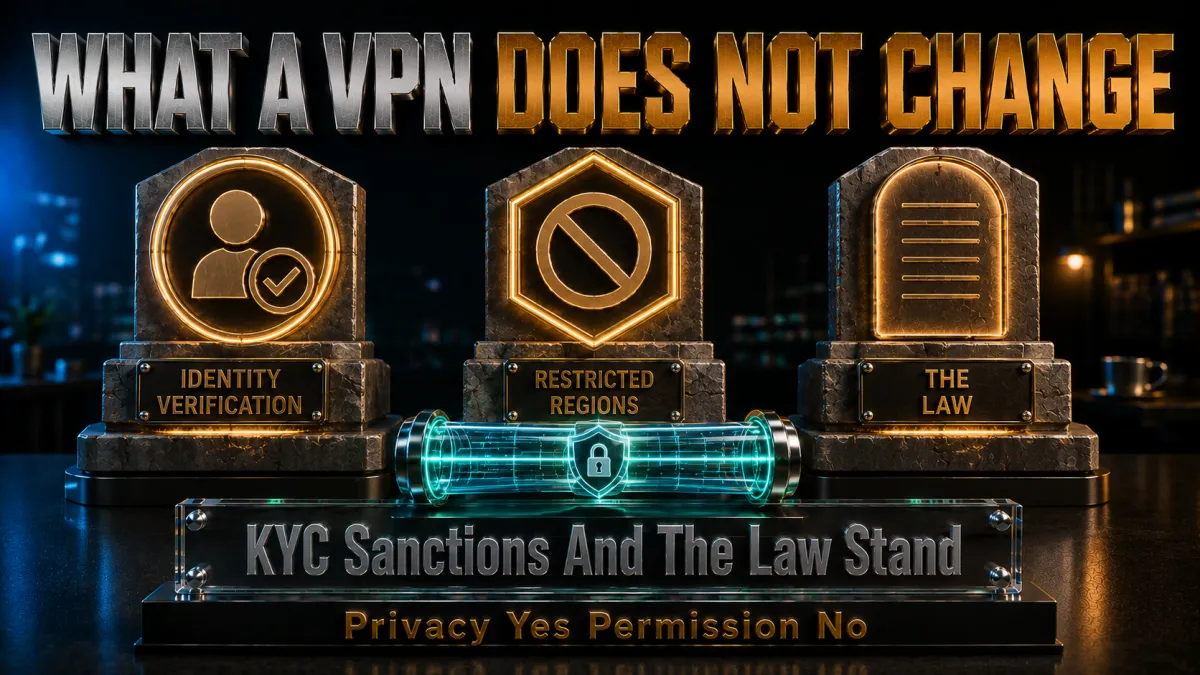
This section exists because skipping it would make the rest of the guide dishonest. The limits are real and worth stating plainly.
- KYC is not a network problem. Identity verification exists by law, and a VPN changes your apparent network location, not your passport. Attempting to trade on exchanges barred from your region using a VPN violates their terms, and discovery typically means frozen funds and permanent bans. The cost-benefit is terrible.
- Sanctions are hard law. Where crypto services are unavailable due to sanctions, routing around them is a legal offence, not a technicality. No privacy tool changes that, and this guide will not help you try.
- Local law governs both crypto and VPNs. Some countries restrict cryptocurrency activity, VPN use, or both. Know the rules where you live and comply with them; a trading edge is worthless against legal exposure.
- Taxes do not disappear into the tunnel. A VPN affects network visibility, not reporting obligations. Trading gains remain taxable under your local rules regardless of how private your connection is, and pretending otherwise ends badly.
How to choose for the way you trade
All five picks clear the security bar; the right one depends on your trading life.
- Serious holdings, daily trading? NordVPN’s audit record, Threat Protection, and Dedicated IP option make it the default for anyone with real money on exchanges.
- Want maximum privacy architecture? ExpressVPN’s RAM-only fleet and BVI base are the strongest pure-privacy story, in the simplest apps.
- Trading from several devices on a budget? Surfshark covers unlimited devices with audited privacy and CleanWeb at the lowest price here.
- New to VPNs entirely? CyberGhost’s one-button simplicity and 45-day refund window make the learning curve gentle and risk-free.
- Speed-focused with many devices? IPVanish delivers consistent throughput and unlimited connections at a fair price, with the honest caveat of a lighter audit history.
The 5 best VPNs for crypto trading in 2026
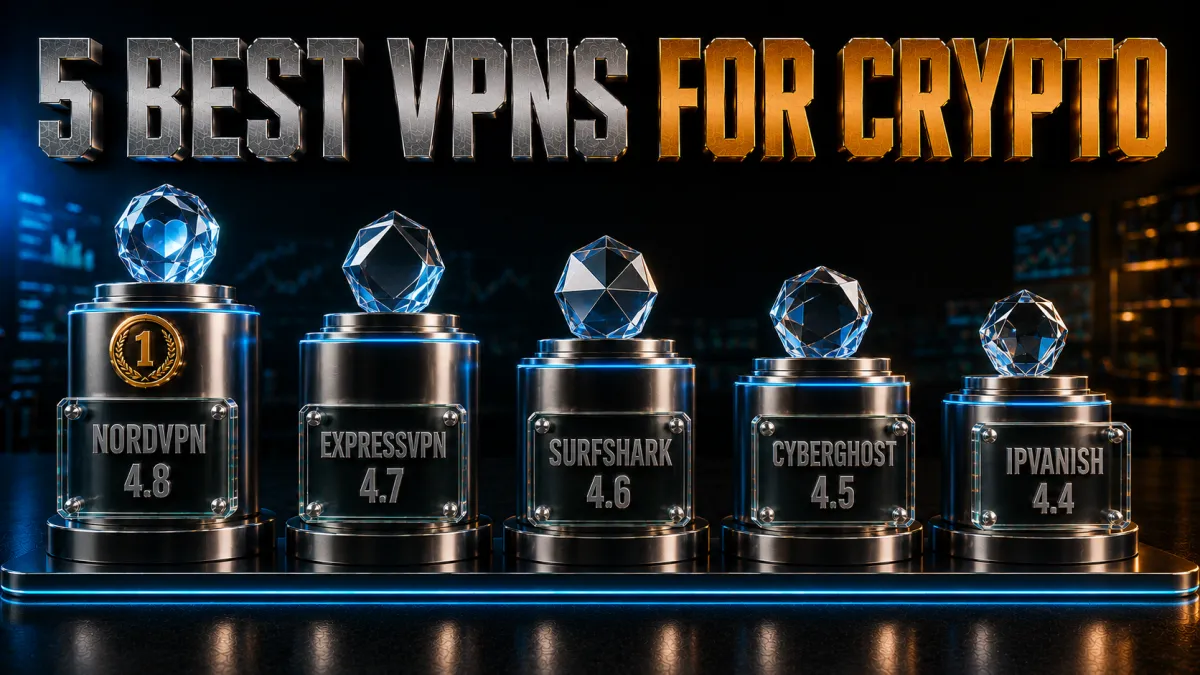
Ranked for what protects a trading account in practice: audit evidence first, then phishing defence, connection stability, dedicated IP options, and value. Speed appears only where it genuinely differs.
1. NordVPN – Best overall for crypto security
NordVPN tops this list because it defends the two doors crypto thieves actually use. Threat Protection blocks known phishing and malicious domains before they load, cutting off the fake-exchange pages behind most theft, and its no-logs policy has passed multiple independent audits from a Panama base outside the major alliances, so the privacy claim rests on evidence rather than marketing.
For daily trading, NordLynx keeps latency negligible and connections hold steadily for long sessions, with a dependable kill switch guarding the gaps. The Dedicated IP add-on gives exchanges one consistent address to trust, which quietly eliminates the flagged-login friction shared servers can cause. It is the most complete security package here.
✔ Pros
- Multiple independent no-logs audits
- Threat Protection blocks phishing and malicious domains
- Stable low-latency connections for long sessions
- Dedicated IP option for consistent exchange logins
- Panama jurisdiction outside major alliances
✘ Cons
- Dedicated IP costs extra
- Best pricing needs a longer plan
| Audited no-logs | Yes, multiple audits |
| Phishing blocking | Threat Protection |
| Dedicated IP | Optional add-on |
| Jurisdiction | Panama |
| Devices | 10 |
| Money-back | 30 days |
2. ExpressVPN – Strongest privacy architecture
ExpressVPN’s case for traders is architectural: its entire fleet runs in RAM, wiping completely on every reboot, so retained data is not merely promised away but made physically impractical. Add the audited no-logs policy and a British Virgin Islands base and you get the strongest pure-privacy story of the five, delivered through the simplest, most reliable apps here.
Connections are stubbornly stable, which traders on marginal networks learn to value, and Threat Manager blocks trackers and known malicious services. The honest gaps: no dedicated IP option for exchanges that prefer one consistent address, the highest price of the five, and an eight-device cap. If privacy architecture outweighs those for you, this is the pick.
✔ Pros
- RAM-only servers wipe on every reboot
- Audited no-logs, BVI jurisdiction
- Exceptionally stable connections
- Simplest, most polished apps
- Threat Manager blocks hostile domains
✘ Cons
- No dedicated IP option
- Most expensive of the five
| Audited no-logs | Yes, audited |
| Phishing blocking | Threat Manager |
| Dedicated IP | No |
| Jurisdiction | British Virgin Islands |
| Devices | 8 |
| Money-back | 30 days |
3. Surfshark – Best value with real protection
Surfshark delivers the crypto essentials at the lowest long-term price of the five: an independently audited no-logs policy, CleanWeb blocking trackers and known malicious domains, a working kill switch everywhere, and a dedicated IP add-on for consistent exchange logins. Unlimited simultaneous devices means the trading desktop, laptop, and both phones ride one plan.
The honest trade-offs are modest: its Netherlands base sits inside the EU rather than offshore, and connection stability, while good, is a half-step behind the top two on rough networks. For a cost-conscious trader covering many devices, the value calculation is decisively in its favour.
✔ Pros
- Lowest long-term price of the five
- Unlimited simultaneous devices
- Audited no-logs policy
- CleanWeb blocks phishing and trackers
- Dedicated IP available as add-on
✘ Cons
- Netherlands base, inside the EU
- Stability a half-step behind the top two
| Audited no-logs | Yes, audited |
| Phishing blocking | CleanWeb |
| Dedicated IP | Optional add-on |
| Jurisdiction | Netherlands |
| Devices | Unlimited |
| Money-back | 30 days |
4. CyberGhost – Easiest secure start
CyberGhost suits the trader installing their first VPN: one prominent connect button, plain-language settings, and a token-based dedicated IP add-on with a clever privacy design where even CyberGhost cannot tie the address to your account. The audited no-logs policy and regular transparency reports cover the trust basics from its Romania base.
The 45-day money-back guarantee, longest of the five, gives six full weeks to run your real trading routine through it before committing. Its extras are lighter than the leaders, without an equivalent of Threat Protection’s depth, and speeds are good rather than exceptional, which for trading matters little. As a gentle, refundable on-ramp it is exactly right.
✔ Pros
- Simplest setup of the five
- 45-day refund, the longest here
- Token-based dedicated IP design
- Audited no-logs with transparency reports
- Large server network
✘ Cons
- Lighter security extras than the top two
- Stability merely good on rough networks
| Audited no-logs | Yes, audited |
| Phishing blocking | Built-in blocker |
| Dedicated IP | Optional, token-based |
| Jurisdiction | Romania |
| Devices | 7 |
| Money-back | 45 days |
5. IPVanish – Fast and unlimited
IPVanish closes the list with consistently quick, stable performance, unlimited simultaneous connections, and a dedicated IP add-on, all at a fair price. For a trader with many devices who wants snappy charts and no connection babysitting, it functions perfectly well day to day.
It ranks fifth on the trust ledger rather than the performance one: a US base inside the major intelligence-sharing alliance and a lighter public audit history than the four above it. The tunnel encrypts your sessions regardless, but when the product is trust around financial traffic, the picks above simply document theirs better.
✔ Pros
- Consistently fast, stable connections
- Unlimited simultaneous devices
- Dedicated IP add-on available
- Fair pricing
- Simple apps everywhere
✘ Cons
- US jurisdiction
- Lighter audit history than the leaders
| Audited no-logs | Policy in place, lighter audit history |
| Phishing blocking | Basic |
| Dedicated IP | Optional add-on |
| Jurisdiction | United States |
| Devices | Unlimited |
| Money-back | 30 days |
| Feature | NordVPN | ExpressVPN | Surfshark | CyberGhost | IPVanish |
|---|---|---|---|---|---|
| Audited no-logs | Multiple audits | Audited | Audited | Audited | Lighter history |
| Phishing blocking | Threat Protection | Threat Manager | CleanWeb | Built in | Basic |
| Dedicated IP | Yes | No | Add-on | Add-on | Add-on |
| RAM-only servers | Yes | Yes | Partial | No | No |
| Devices | 10 | 8 | Unlimited | 7 | Unlimited |
| Money-back | 30 days | 30 days | 30 days | 45 days | 30 days |
Setting up a VPN for safe trading, step by step
Ten minutes of setup, done once, and every future session inherits the protection automatically.
- Install from official sources only. Download the app from the provider’s website or the official app store, on every device you trade from. Crypto users are prime targets for fake VPN apps, so the official-source rule is not pedantry.
- Enable the kill switch first. Before anything else, switch it on in settings on each device. This is the feature protecting your session when the tunnel hiccups, and it usually ships disabled.
- Turn on threat blocking. Activate Threat Protection, Threat Manager, or CleanWeb depending on your pick. This is your standing defence against the phishing domains that drain accounts.
- Set auto-connect for untrusted networks. Protection should engage the moment any device joins unfamiliar Wi-Fi, without depending on your memory at an airport gate.
- Pick a nearby server and make it home. A close server keeps latency negligible. Favourite it and use it consistently, because a stable, boring connection pattern is what exchange security systems like to see.
- Run one leak test. With the VPN on, use a leak-testing site to confirm your real IP and DNS are hidden. All five picks pass by default; thirty seconds of verification buys certainty.
- Then log in and trade normally. VPN first, exchange second, every session. The order is the habit that matters.
Beyond the VPN: the security stack that actually protects funds

A VPN secures the connection. Most crypto theft targets everything except the connection, so honest advice covers the rest of the stack.
- Hardware-backed two-factor authentication. App-based 2FA at minimum, a hardware security key ideally, on the exchange account and the email behind it. Text-message codes can be hijacked through SIM-swap attacks, which specifically target crypto holders.
- Cold storage for what you are not trading. Funds on an exchange carry exchange risk. Holdings you do not actively trade belong in a hardware wallet whose seed phrase exists only offline, written down, never photographed or typed anywhere.
- A dedicated browser or profile for trading. Extensions can read pages and worse. A clean browser profile used only for exchange access, with no casual extensions, removes an entire class of compromise.
- Bookmark the exchange; never follow links. Type or bookmark the real URL once and only enter through it. Links in emails, chats, and search ads are how lookalike sites harvest logins, and the VPN’s domain blocking is your net, not your licence to click.
- Unique passwords in a manager. The exchange password and its email password must exist nowhere else. A password manager makes this effortless, and it quietly refuses to autofill on fake domains, an underrated phishing alarm.
Fixing VPN problems mid-session
When something misbehaves with a position open, calm beats clever. Work down this list.
- Exchange flags or challenges your login. Shared VPN addresses sometimes trigger extra verification. Complete it calmly, keep using one consistent server, and consider a dedicated IP, which makes your address yours alone and ends the flags.
- Charts feel laggy. Switch to a closer or less busy server; latency is nearly always a server-choice issue, not a provider issue. WireGuard-based protocols help further.
- The tunnel drops mid-order. The kill switch freezes traffic, which is it working correctly. Reconnect, verify the order status on the exchange, then resume. Never disable the kill switch to “fix” drops; fix the server or protocol instead.
- The VPN will not connect on hotel or cafe Wi-Fi. Complete the network’s login portal first, then connect. Still stuck: switch to OpenVPN TCP, which travels like ordinary HTTPS, or fall back to mobile data, where the VPN typically connects instantly.
- A site behaves oddly through the VPN. Clear the site’s cookies or try one different server. If an exchange page ever looks wrong, stop, check the URL character by character, and re-enter through your bookmark rather than pushing through.
Common mistakes crypto traders make with VPNs
Each of these appears constantly in the wild, and each is avoidable with one sentence of foresight.
- Using the VPN to fake eligibility on a restricted exchange. The worst mistake on this list because it holds your money hostage: discovery means frozen funds and a permanent ban, and exchanges have gotten good at discovery. Trade where you are legally allowed, full stop.
- Treating the VPN as the whole defence. An encrypted tunnel does not stop a phishing login, a reused password, or a compromised extension. The security stack section above is not optional reading; it is where the actual money is saved.
- Trading through free VPNs. Unknown operators logging financial traffic, injecting content, and leaking under load, between you and your exchange. The free-VPN section below spells out why this inverts the entire purpose.
- Hopping countries between logins. Bouncing your apparent location around the map is exactly what account-takeover looks like to an exchange’s security model. One consistent nearby server keeps your pattern boring and your account unflagged.
- Leaving the kill switch off. The default-off setting that matters most. Without it, every tunnel drop is a silent moment of exposure on whatever network you are on.
- Assuming the VPN handles taxes and law. Network privacy changes nothing about reporting obligations or local rules on crypto and VPN use. Know both, comply with both.
Why free VPNs and crypto do not mix

For casual browsing a free VPN is merely poor. For financial traffic it is actively hazardous, for reasons specific to how free services survive.
- The business model is your data. Servers cost money, and no-subscription providers historically cover it by logging and monetising traffic. Routing exchange sessions through a data-monetisation business is the opposite of financial privacy.
- Weak engineering leaks exactly when it hurts. Free tiers skimp on kill switches, leak protection, and capacity, so failures cluster under load, precisely when a session is live. The gaps sit where traders can least afford them.
- Fake VPN apps hunt crypto users specifically. Free-VPN searches are a documented distribution channel for spyware aimed at wallet credentials and seed phrases. The official-source rule plus a reputable paid provider closes this door completely.
- The honest free option exists. Every pick above refunds within 30 to 45 days. Run your real routine through one for a month at zero net cost; that is the legitimate way to trade protected for free while you decide.
Related reading:
Frequently Asked Questions
Do I really need a VPN for crypto trading?
If you value not broadcasting your exchange habits to networks and your ISP, and you ever trade away from home, yes. A VPN encrypts your sessions, hides the IP that links you to your holdings, and with threat blocking stops many phishing pages outright. It is one inexpensive layer in a stack that should also include strong 2FA and cold storage.
Which VPN is best for cryptocurrency in 2026?
NordVPN leads for crypto: multiple independent no-logs audits, Threat Protection against the phishing domains behind most theft, stable low-latency connections, and a Dedicated IP option for consistent exchange logins. ExpressVPN is the strongest pure-privacy alternative and Surfshark the best value with unlimited devices.
Can a VPN bypass KYC verification on exchanges?
No, and attempting to trade on exchanges restricted in your region via VPN is a serious mistake: it violates their terms, and discovery typically means frozen funds and a permanent ban. Identity verification is a legal requirement, not a network setting. Use a VPN to secure legitimate trading on services available to you.
Will exchanges ban me just for using a VPN?
Using a VPN for security while trading from a region where the exchange legitimately serves you is generally unremarkable, and millions do it. Problems arise from misrepresenting your location to access restricted services, or from erratic country-hopping that looks like account takeover. A consistent nearby server, or a dedicated IP, keeps things smooth.
Does a VPN slow down trading?
On a nearby server with a modern protocol, added latency is a few milliseconds, imperceptible for placing orders and watching charts. Connection stability matters more than raw speed for traders, which is why the kill switch and a reliable provider rank above benchmark numbers. High-frequency algorithmic strategies are a different world that does not run through consumer VPNs anyway.
Is it safe to log into my exchange on public Wi-Fi with a VPN?
With a reputable VPN connected and the kill switch on, public Wi-Fi risks like rogue hotspots, traffic snooping, and DNS tricks are neutralised, making a cafe session roughly as safe as home. Without a VPN, avoid exchange logins on public networks entirely and use mobile data instead.
Should I get a dedicated IP for crypto trading?
If your exchange repeatedly challenges logins from shared VPN addresses, yes: a dedicated IP gives you one consistent address that only you use, which reads as stability to security systems. NordVPN, Surfshark, CyberGhost, and IPVanish all offer it as an add-on; ExpressVPN does not.
Does a VPN protect my crypto wallet?
It protects wallet-related network traffic from snooping and blocks many phishing domains, but it cannot protect keys you expose: a seed phrase typed into a fake site is gone regardless of encryption. Wallet safety lives in hardware wallets, offline seed storage, and never entering recovery phrases online. The VPN is the network layer, not the vault.
Are VPNs and crypto legal to use together?
In most countries both are legal, and using a VPN for security while trading lawfully is fine. Some jurisdictions restrict crypto activity, VPN use, or both, and sanctions law overrides everything. Know your local rules and follow them; this guide is information, not legal advice.
Do I still owe taxes if I trade through a VPN?
Yes. A VPN changes what networks can observe, not what you owe. Trading gains remain taxable under your local rules exactly as before, and exchanges report under their legal obligations regardless of how you connect. Privacy tools and tax obligations are entirely separate things.
What is the single most important VPN setting for traders?
The kill switch. It freezes traffic the instant the tunnel drops, so a flaky network never silently exposes your session. Enable it on every device before your first protected session, then add auto-connect on untrusted Wi-Fi and threat blocking as the supporting cast.
Can I use a free VPN for crypto?
Strongly advised against. Free services commonly log and monetise traffic, lack kill switches and leak protection, and free-VPN app stores are a known channel for wallet-stealing malware aimed at crypto users. The genuinely free route is a reputable provider’s 30 to 45 day money-back window.
The Bottom Line
Crypto trading deserves the same seriousness as online banking, plus extra, because transactions are irreversible and attackers are specialised. A good VPN covers the network layer completely: encrypted sessions on any Wi-Fi, a masked IP that unlinks you from your holdings, blocked phishing domains, and a kill switch over the gaps. Pair it with hardware 2FA, cold storage, bookmarked-only exchange access, and unique passwords, and the realistic attack paths against you narrow dramatically. And stay inside the lines: no KYC games, no restricted exchanges, no sanctions adventures, because the tool is for protecting legitimate trading, not gambling your balance on a ban.
The picks, in one line each:
- NordVPN is the best overall: multi-audited privacy, Threat Protection, stability, and a Dedicated IP option in one package.
- ExpressVPN is the privacy-architecture pick, RAM-only servers and a BVI base in the simplest apps.
- Surfshark is the value pick, audited and phishing-protected across unlimited devices at the lowest price.
- CyberGhost is the gentlest start, with a 45-day window to test your real routine.
- IPVanish is the fast unlimited-device workhorse, with a lighter audit story honestly noted.
Set the kill switch, pick one nearby server, run a leak test, and make VPN-then-exchange the reflex that starts every session. Markets will do what markets do; your security, at least, can be the one variable you fully control.
Jyoti VPN Expert leads VPN testing at VPN Expert Guide, covering streaming and regional access, speed and latency testing, and leak checks on Windows, Android and router-level setups. Our guides are built from vendor documentation, provider terms and our own connection testing on a residential line in India, and we publish those measurements in full so readers can check them. Every guide is reviewed before publication and dated so you can see how current it is.
Meet our testing team →Last updated: September 2, 2026