
Surfshark vs PureVPN 2026: Our Value Pick Against the Outside Challenger
Surfshark sits in our top five and PureVPN does not, and this page exists because readers keep asking whether that placement is fair. So we score it in the open: twelve rounds with the reasoning shown, honest ties, and two rounds PureVPN genuinely wins. Its wide server map and always-on audit get full credit; its 2017 incident and add-on pricing get honest weight. No fabricated speed tables, commission disclosed below, and a parallel test plan closes the case.
Why this matchup exists, and the short answer by use case
A ranked pick against a popular outsider, scored instead of asserted.
- Why buyers shortlist these two. Both live in the budget-premium band, both advertise heavily, and both promise a lot of VPN for little money, so price-led shoppers keep arriving at this exact fork. The difference between them is not the bill; it is what the bill includes and the record behind it.
- Why PureVPN is outside our five. Not scandal and not incompetence: the rounds below show a capable service. The placement reflects the trust round’s history, the consistency gaps, and an add-on model that moves features rivals include into paid extras; the tally either justifies that call or it does not, in the open.
- Ownership and incentives, disclosed. Surfshark operates under Nord Security alongside NordVPN; PureVPN operates under GZ Systems from the British Virgin Islands, relocated there from Hong Kong. Our commission exists on the Surfshark side only, spelled out in the note below, and the rounds are written to survive that scrutiny.
| If you want… | Pick | Because |
|---|---|---|
| Most included per rupee | Surfshark | Extras bundled, not sold as add-ons |
| Widest country map | PureVPN | Genuinely broad location coverage |
| Unlimited devices | Surfshark | No slot counting; PureVPN caps at ten |
| Cleanest trust record | Surfshark | No logging incident in its history |
| Novel audit model | PureVPN | Rolling always-on Big Four arrangement |
| Steadiest streaming | Surfshark | Fewer flagged-server retries needed |
The two cards, side by side

Our ranked value pick: unlimited simultaneous connections honoured without asterisks, well-implemented WireGuard, a RAM-only fleet, an audited no-logs policy with no incident in its history, Camouflage and NoBorders for filtered networks, and an included extras suite, Alternative ID, Alert, CleanWeb, Dynamic MultiHop, that rivals sell piecemeal. The budget-premium bill covers all of it, which is most of this page’s verdict.
| Jurisdiction | Netherlands |
| Protocol | WireGuard |
| Devices | Unlimited |
| Money-back | 30 days |
The outside challenger with real strengths: a genuinely wide country map, budget headline pricing, port forwarding the technical crowd asks for, and a rolling always-on audit arrangement with a Big Four firm that is more ambitious than the industry’s snapshot norm. The honest ledger also carries a documented 2017 case where connection data reached law enforcement despite no-logs marketing, since rebuilt and audited, an add-on model that sells extras rivals include, and consistency a step behind our ranked tier. This page carries no affiliate push for it.
| Jurisdiction | British Virgin Islands |
| Protocol | WireGuard, OpenVPN |
| Devices | 10 |
| Money-back | 31 days |
Round 1: Privacy, trust record, and audits
The round that most explains our rankings, argued rather than asserted.
- The records, side by side. Surfshark’s audited no-logs policy carries no logging incident in its history; PureVPN’s ledger includes a documented 2017 case in which connection data was provided to law enforcement despite no-logs marketing under its earlier policies. The policy has since been rebuilt, relocated to the BVI, and audited, and a careful buyer deserves both halves of that sentence.
- PureVPN’s genuine credit. Its always-on audit arrangement with a Big Four firm, allowing surprise examinations rather than scheduled snapshots, is structurally more ambitious than the industry norm, and this page credits it plainly in its own round below. Innovation after an incident is still innovation.
- Infrastructure. Surfshark runs RAM-only fleet-wide, the diskless design that makes seizures yield nothing persistent; PureVPN has moved substantially in the same direction across its network. Architecture converges; history does not.
- Jurisdictions. The Netherlands is a Nine Eyes member with sound legal process; the British Virgin Islands sit outside the alliances entirely, and on flags alone PureVPN’s home reads better. Records outweigh flags in our scoring, here as everywhere, because a jurisdiction cannot un-produce data.
Round winner: Surfshark, on the record itself, with PureVPN’s flag and audit ambition honestly noted.
Round 2: Security architecture
The machinery, held to the same bar.
- Encryption: modern on both. Current-standard ciphers under both WireGuard implementations, with OpenVPN fallbacks, perfect forward secrecy throughout. The mathematics separates nothing.
- Kill switches: both present and working. Engaged on tunnel drops as designed in our use on both sides, desktop and mobile. Configure and verify day one either way, per the standing guidance.
- Leak protection. Private DNS in-tunnel on both, with clean leak-suite results in our checks; verify per device regardless, one minute each. PureVPN’s IPv6 handling has needed the manual disable step on some platforms historically, worth the extra minute of checking.
- The differentiators. Surfshark fields Dynamic MultiHop, Camouflage, NoBorders, and rotating IP; PureVPN answers with obfuscation on OpenVPN, port forwarding, and DDoS-protected endpoints on its add-on menu. Comparable seriousness, differently packaged, with Surfshark’s versions included in the base bill.
Round winner: Tie on fundamentals, with the packaging difference priced in the features round.
Round 3: Speed, patterns not fictions

No fabricated Mbps tables, per the standing policy; the reproducible shape instead.
- The shared floor. Both cost a modest slice of baseline to a nearby server that browsing, calls, and HD streaming rarely notice. Usability is not the question on either side.
- Surfshark’s steadier pattern. Well-implemented WireGuard holds the market’s capable middle band with consistent evening behaviour, per every comparison it appears in on this site. Predictability is the value brand’s quiet strength.
- PureVPN’s honest position. Capable pace on nearby WireGuard connections with more variability at peak hours and on long-haul routes in our use, the consistency gap that keeps it a step behind the ranked tier rather than a raw-speed failure. Well-chosen servers close much of it.
- Your test outranks ours. Two refund windows leave ample room for the ten-minute method on both: baseline, three nearest servers each, your real evening hour. The parallel plan below converts this round into your own numbers.
Round winner: Surfshark, on consistency at the hours that matter.
Round 4: Apps and everyday experience
Friendliness against a busier surface.
- Surfshark’s clean list. A friendly, list-first interface with essentials forward and extras tucked sensibly behind, consistent across platforms, per every matchup it enters. No value-brand roughness anywhere that matters.
- PureVPN’s improved but busier apps. The current generation is genuinely better than its old reputation, with a clear connect flow and mode-based organisation; the recurring honest complaint is upsell pressure, add-on prompts and plan offers surfacing inside the apps and checkout more than any rival we cover. Function is fine; calm is not the brief.
- Platform spread. Both cover the majors with auto-connect rules and split tunnelling where it counts; PureVPN’s browser extensions and router guides are serviceable. Parity on coverage, not on polish.
- The honest margin. For the daily user both pages serve, fewer interruptions and fewer decisions win. This round is not close.
Round winner: Surfshark, on calm and consistency over a busier, upsell-prone surface.
Round 5: Streaming reliability
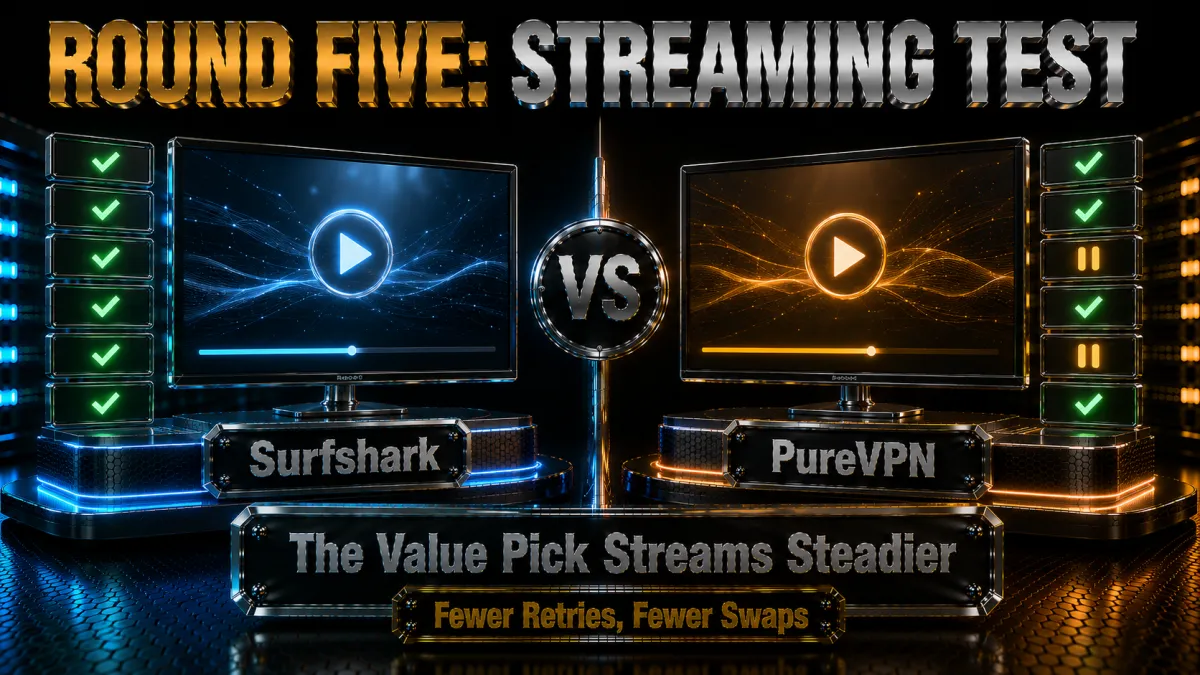
The quiet main use case, compared honestly.
- Both workable, one steadier. Major platforms have worked through both in our use, with PureVPN needing the hop-and-retry habit more often and its labelled streaming modes helping less consistently than the marketing suggests. Surfshark keeps closer pace with the access arms race, per every comparison it enters.
- Coverage compounds it. Unlimited devices put Surfshark natively on every TV, tablet, and console without slot arithmetic; PureVPN’s ten slots ration a large household. Both halves of the streaming experience point the same way.
- PureVPN’s honest position. Well-chosen servers stream capably, and the wide country map occasionally reaches a regional catalogue rivals miss, the one streaming card it genuinely holds. Patience is the price.
- The standing terms note. Platforms’ terms restrict cross-border catalogue access, and that use rides at your own account risk, the caveat this site attaches everywhere. Mechanics described, terms yours to weigh.
Round winner: Surfshark, on flagged-server frequency and every-screen coverage together.
Round 6: Server network breadth
The round PureVPN was built to win, scored honestly.
- PureVPN’s map. A large fleet spread across one of the widest country lists in the consumer market, including locations many rivals skip entirely. For the buyer whose need is a specific, less-common country, this breadth is the whole purchase reason, and it is real.
- Surfshark’s competent spread. A hundred-plus countries, sensibly balanced, entirely sufficient for mainstream use, per every matchup it enters. Breadth is not its brief; coverage-per-bill is.
- Depth versus breadth, honestly. Surfshark’s fleet behaves more consistently under evening load; PureVPN’s reaches further on the map. Different axes, and this round scores the one PureVPN chose.
- The practical test. Check both live server lists against your must-have locations before subscribing, per the standing advice; if your country is on one list only, this round just decided your page.
Round winner: PureVPN, on genuine map breadth, its strongest card.
Round 7: Extra features, included against add-ons
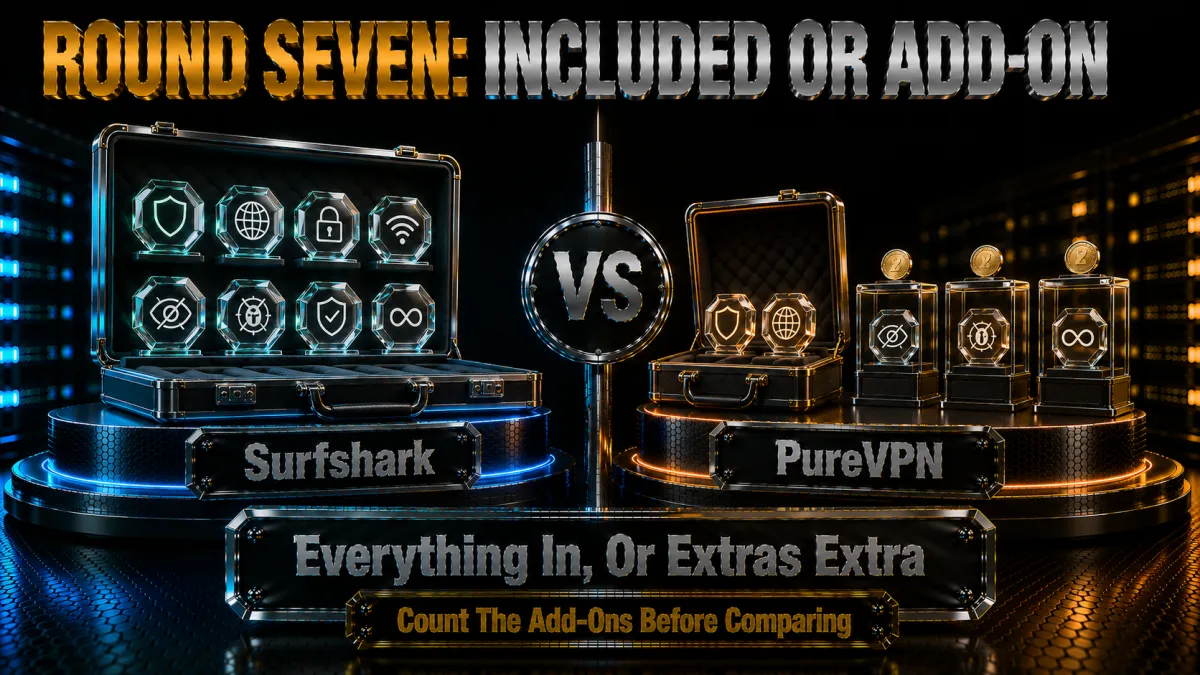
Two cupboards, two pricing philosophies.
- Surfshark’s included suite. Alternative ID, Alert breach monitoring, CleanWeb blocking, Dynamic MultiHop, rotating IP, and cookie tooling, all inside the base subscription. The bundling is the value case, per every comparison it enters.
- PureVPN’s add-on menu. Port forwarding, dedicated IP, and DDoS protection exist and work, and each sits behind an additional monthly fee; the base plan is the tunnel plus essentials. The model is legitimate and must be priced honestly: the advertised bill is not the configured bill.
- The overlap. Both block ads and malicious domains, both offer split tunnelling, both cover the fundamentals. The divergence is everything beyond them and who pays extra for it.
- The honest score. At near-identical headline prices, one service includes what the other sells. This round follows the arithmetic.
Round winner: Surfshark, decisively, on included value.
Round 8: Pricing and value

No invented price tables; the structures compared instead.
- The positions. Both live in the budget band on long plans, with PureVPN’s headline rates often nominally lower and its multi-year promotions aggressive. On sticker price alone the two trade places by season.
- Intro versus renewal, both sides. Headline rates belong to first terms on both, renewals run higher, and PureVPN’s renewal jump has been among the sharper ones users report; the checkout-page renewal figure is the commitment on both. Read it before paying, here as everywhere.
- The configured bill. Add PureVPN’s port forwarding or dedicated IP and the gap to Surfshark closes or inverts, while Surfshark’s unlimited devices stretch the same bill across every screen. Sticker parity, configured divergence.
- The honest score. Raw price ties; delivered value per rupee tilts Surfshark through the features and devices rounds where it is scored. This round, on money alone, is a genuine tie.
Round winner: Tie on sticker price, with the value verdict carried by rounds seven and eleven.
Round 9: Support and refunds
The safety nets, compared as users meet them.
- Both offer 24/7 live chat. Round-the-clock chat with workable response quality and full knowledge bases on both sides. The category standard, met by both.
- Refund practice. Surfshark’s 30-day and PureVPN’s 31-day guarantees are both honoured as routine practice in our experience and broad user reports. Calendar the deadline either way, per the standing habit.
- The sales pressure note. PureVPN’s support interactions lean toward retention offers and upsells more than most rivals when cancellation is mentioned; firm, polite repetition gets the refund processed. Stated so the expectation is set.
- Documentation. Both publish serviceable setup guides across platforms. Parity in substance.
Round winner: Tie, with the retention-pressure note attached for PureVPN.
Round 10: Hostile networks and obfuscation
Filtered-network behaviour, compared practically.
- Surfshark’s stack. Camouflage disguises OpenVPN traffic automatically and NoBorders engages on restrictive networks without hunting for toggles, the strongest ergonomics in the budget tier, per every matchup it enters. It simply works more often without thought.
- PureVPN’s answer. Obfuscation exists on OpenVPN configurations and helps on ordinary throttling networks; engagement is more manual and results more variable in our use. Capable, less effortless.
- The shared ceiling. Determined national filtering defeats consumer VPNs unpredictably, and honest comparisons say so on both sides. Neither promises what cannot be promised.
- The travel arithmetic. Unlimited devices also cover the whole travelling family’s gear on the Surfshark side, compounding the round the same way it does elsewhere on this site.
Round winner: Surfshark, on automatic engagement and consistency.
The full scorecard: twelve rounds tallied

Every round in one table, with devices and the audit model scored inline.
| Round | Surfshark | PureVPN | Winner |
|---|---|---|---|
| 1. Privacy & trust record | Clean audited record | 2017 incident in ledger | Surfshark |
| 2. Security architecture | MultiHop, Camouflage | Obfuscation, port forwarding | Tie |
| 3. Speed pattern | Consistent evenings | Capable, variable | Surfshark |
| 4. Apps | Calm, consistent | Improved, upsell-heavy | Surfshark |
| 5. Streaming | Steadier, every screen | Wide-map catalogues | Surfshark |
| 6. Server map breadth | 100+ countries | Among the widest lists | PureVPN |
| 7. Features: included vs add-ons | Suite bundled | Extras sold separately | Surfshark |
| 8. Pricing (sticker) | Budget band | Budget band, sharp renewals | Tie |
| 9. Support | 24/7, honoured | 24/7, retention pressure | Tie |
| 10. Hostile networks | Automatic Camouflage | Manual, variable | Surfshark |
| 11. Device allowance | Unlimited | 10 slots | Surfshark |
| 12. Audit model | Audited, snapshot norm | Always-on Big Four rolling audit | PureVPN |
- Final tally: Surfshark 7, PureVPN 2, Ties 3. The rankings call is confirmed in the open: at the same money, one service includes more, behaves more steadily, and carries the cleaner record. PureVPN’s two wins, map breadth and audit ambition, are real and specific rather than consolation.
- How to read a 7-2-3. This is what an honest gap looks like when scored fairly: not a shutout, not a smear, and not close. If your purchase reason lives inside PureVPN’s two winning rounds, it remains a legitimate, knowing choice.
Which should you pick? The decision, made explicit
The tally, translated honestly into buyers.
- Pick Surfshark, for almost everyone comparing these two. Same budget money, more included, steadier evenings, cleaner history, unlimited screens: seven rounds say the same sentence. This is why it holds the ranking place.
- Pick PureVPN if a specific location decides your purchase. Its map reaches countries most rivals skip, and if yours is one of them, round six just outvoted the other eleven for you specifically. Check both live lists before paying.
- Pick PureVPN if port forwarding is non-negotiable. Surfshark does not offer it; PureVPN sells it as an add-on that works. Price the configured bill honestly when you do.
- Read the trust round first either way. The 2017 incident is history, the rebuild and always-on audit are real, and where you land on that ledger is a personal call this page informs rather than makes. Eyes open beats slogans.
- Either window makes the proof cheap. 30 and 31 days respectively, honoured in practice: the parallel plan below turns this page into your own verdict.
Test both in parallel: the 30-day head-to-head plan
Two refund windows, one experiment, your connection as referee.
- Day 1: subscribe to both, calendar both deadlines. Same week, renewal rates screenshotted at both checkouts, add-ons declined on PureVPN for a fair base-to-base fight, decision date at day 25. The guarantees make the experiment nearly free.
- Day 1: install and verify both. Kill switches on, leak suite per device on each including the IPv6 check, per our leak-check guide. Same devices, same baseline.
- Week 1: alternate days through real life. Surfshark odd days, PureVPN even: commutes, evening streams, calls. Note friction and interruptions, not just numbers.
- Week 2: the ten-minute speed method on each. Baseline, three nearest servers per service, your real evening hour, recorded side by side, repeated once at the weekend for the consistency picture this matchup turns on. Your table outranks ours by definition.
- Week 3: stress each service’s own case. Every household screen on Surfshark simultaneously one evening; the specific far-map location you actually need on PureVPN, plus your real streaming platforms on both, counting the hops. Score the rounds your life contains.
- Day 25: keep one, refund the other. Polite, firm refund request for the loser inside its window, repeated once if a retention offer arrives; renewal for the winner. Your verdict binds.
Mistakes buyers make in this matchup
Collected so you can skip them.
- Comparing sticker prices instead of configured bills. PureVPN’s add-ons move the real total; Surfshark’s bundle holds it still. Price what you will actually run, both sides.
- Reading the 2017 incident as the whole story, or as no story. The rebuild, relocation, and always-on audit are real; so is the ledger entry. Both halves belong in the decision, weighted by your own threat model.
- Buying PureVPN’s map without needing it. Breadth you never use is a round you should not pay attention to; check whether your locations exist on both lists first. Most buyers’ countries do.
- Missing the renewal jump. Both intro rates expire, and PureVPN’s step-up runs sharper than most in user reports. The checkout-page renewal figure is the commitment.
- Skipping the parallel test. Two windows at the same budget price make this the cheapest head-to-head on the site to verify. Run the plan; the verdict becomes yours.
Related reading:
Frequently asked questions
Which is better, Surfshark or PureVPN?
Surfshark wins our twelve rounds seven to two with three ties, on trust record, speed consistency, apps, streaming, included features, hostile-network ergonomics, and unlimited devices, which is why it sits in our top five and PureVPN does not. PureVPN honestly wins server-map breadth and the audit-model round, and remains a knowing choice for buyers those two rounds serve.
Is PureVPN trustworthy?
Its ledger carries a documented 2017 case where connection data reached law enforcement despite no-logs marketing, and its present carries a rebuilt policy, a BVI relocation, and an unusual always-on audit arrangement with a Big Four firm. Both halves are stated in our trust round; where you land between them is a personal call this page informs rather than makes.
Is Surfshark faster than PureVPN?
In our use Surfshark’s WireGuard holds steadier evening and long-haul behaviour, while PureVPN is capable nearby with more variability at peak hours; the gap is consistency rather than raw pace. Run the ten-minute method on both, twice, inside the refund windows; your connection outranks every published table.
What is PureVPN’s always-on audit?
A rolling arrangement with a Big Four firm permitting surprise, unscheduled examinations of its no-logs claims rather than the industry’s scheduled-snapshot norm, and it is genuinely more ambitious than most rivals’ models. Our round twelve credits it to PureVPN outright, incident history notwithstanding.
Does PureVPN really have more server locations than Surfshark?
Its country list is among the widest in the consumer market and reaches locations many rivals skip, winning our round six outright; Surfshark’s hundred-plus countries cover mainstream needs comfortably. If a specific less-common location decides your purchase, check both live lists before paying.
Which is cheaper, Surfshark or PureVPN?
Sticker prices trade places by promotion season and our pricing round is an honest tie; the configured bills diverge, because PureVPN sells port forwarding, dedicated IP, and DDoS protection as add-ons while Surfshark bundles its extras. Read both renewal figures at checkout, and price what you will actually run.
Which is better for streaming?
Surfshark, on flagged-server frequency and unlimited-device coverage, while PureVPN’s wide map occasionally reaches a regional catalogue rivals miss, at the cost of more hop-and-retry patience. Platforms’ terms restrict cross-border catalogue access, at your own account risk, per the standing caveat.
Does Surfshark or PureVPN allow more devices?
Surfshark allows unlimited simultaneous connections against PureVPN’s ten, the same unlimited policy that anchors its value case across this site. For crowded households the round is decisive on its own.
Does PureVPN have port forwarding? Does Surfshark?
PureVPN offers it as a paid add-on that works, one of its genuine technical cards; Surfshark does not offer port forwarding at all. Buyers for whom it is non-negotiable have their answer, priced honestly into the configured bill.
Do Surfshark and PureVPN allow torrenting?
Yes, both support P2P with kill switches and private DNS covering the leak side, and PureVPN’s port-forwarding add-on serves the technical torrenting crowd specifically, per our torrenting-safety guidance. The standing legal note applies on both: the tunnel changes network visibility, not the legality of downloads.
Who owns Surfshark and PureVPN?
Surfshark operates under Nord Security alongside NordVPN; PureVPN operates under GZ Systems from the British Virgin Islands, relocated from Hong Kong. This site earns commission only on the Surfshark side, disclosed in full on this page, and both structures are stated wherever relevant.
Why is PureVPN not in your top five?
The trust round’s history, the consistency gap, and the add-on pricing model, all argued in the open above, kept it outside while Surfshark, NordVPN, ExpressVPN, CyberGhost, and IPVanish held their places. The 7-2-3 tally is the ranking call shown rather than asserted; if the reasoning fails anywhere, it fails where you can see it.
Can I test Surfshark and PureVPN before committing?
Yes: 30 and 31-day money-back guarantees respectively, both honoured in practice, make the parallel head-to-head nearly free. Subscribe to both base plans the same day, alternate for three weeks, and keep the winner by day 25; a firm, polite refund request handles any retention offer.
The Bottom Line
- Surfshark wins, seven rounds to two with three ties. Same budget money, more included, steadier behaviour, cleaner record, unlimited screens: the ranking call, confirmed in the open.
- PureVPN‘s two wins are real. The widest map in the matchup and a genuinely innovative always-on audit: specific strengths for specific buyers, credited without hedging.
- The trust round is the page’s spine. A documented incident against a clean record, with the rebuild honestly noted: read it first, whichever way you lean.
- Price the configured bill, not the sticker. Add-ons against a bundle at the same headline money: the arithmetic is most of the verdict.
- Full coverage carries the depth. Our standalone Surfshark review examines it on its own terms, twelve sections deep, and our rankings show where every service placed and why.
A ranked pick against an outside challenger ends the way honest scoring should: the placement survives inspection, and the challenger keeps the two rounds it truly owns. Buy Surfshark for the bundle, the steadiness, and the record; choose PureVPN knowingly when its map or its menu serves a need nothing ranked can; and let two refund windows prove the tally on your own connection.
Jyoti VPN Expert leads VPN testing at VPN Expert Guide, covering streaming and regional access, speed and latency testing, and leak checks on Windows, Android and router-level setups. Our guides are built from vendor documentation, provider terms and our own connection testing on a residential line in India, and we publish those measurements in full so readers can check them. Every guide is reviewed before publication and dated so you can see how current it is.
Meet our testing team →Last updated: August 25, 2026