
NordVPN vs Surfshark 2026: The Family Feud, Scored Honestly
NordVPN and Surfshark are corporate siblings under Nord Security, which is exactly why this comparison starts with that disclosure and earns commission on both sides, removing any incentive to tilt it. What follows is a genuine dead heat: twelve rounds, honest ties, and a 4-4-4 tally that ends with the only tiebreaker that matters, the shape of your household. Speed ceilings, streaming, extras, and price are all scored in the open below.
Why this matchup is different, and the short answer by use case

The family fact first, then the quick routing table.
- The shared parent, stated plainly. Nord Security has owned both brands since the 2022 merger, and the products remain separately built, separately audited, and separately priced. We treat them as genuine competitors because in every way a buyer touches, apps, fleets, features, money, they are; the ownership belongs in your awareness, not in a footnote.
- Why the matchup still matters. These are the two services most buyers actually shortlist after reading rankings, ours included, because they bracket the premium-versus-value decision cleanly. Same trust floor, different bets on what you will pay for.
- The one-line character split. Nord bets you will pay more for peak performance and a security suite; Surfshark bets you will trade a step of each for a lower bill and no device counting. Twelve rounds test both bets.
| If you want… | Pick | Because |
|---|---|---|
| Best overall performance | NordVPN | NordLynx pace and fleet depth |
| Unlimited devices | Surfshark | No slot counting, whole household |
| Lowest price of the two | Surfshark | Undercuts Nord at every term |
| Deepest security suite | NordVPN | Threat Protection, Meshnet, Dark Web Monitor |
| Identity extras | Surfshark | Alternative ID, Alert monitoring |
| Streaming reliability | Tie | Both dependable; both occasionally hop |
The two cards, side by side

The senior partner in every performance sense: NordLynx throughput that leads the market pattern, a fleet thousands of servers deep with speciality routes, a Panama base with the densest audit cadence in the industry, and a suite, Threat Protection, Meshnet, Dark Web Monitor, Double VPN, that reads like three products. Ten device slots and a premium-mid price frame the bet.
| Jurisdiction | Panama |
| Protocol | NordLynx (WireGuard-based) |
| Devices | 10 |
| Money-back | 30 days |
The insurgent with the two policies buyers feel daily: unlimited simultaneous connections and a price that undercuts Nord at every term. WireGuard speeds sit a solid step behind NordLynx rather than a tier, the Netherlands base carries an audited no-logs policy, Camouflage handles hostile networks, and the Alternative ID and Alert extras answer identity questions Nord routes elsewhere.
| Jurisdiction | Netherlands |
| Protocol | WireGuard |
| Devices | Unlimited |
| Money-back | 30 days |
Round 1: Privacy, jurisdiction, and audits
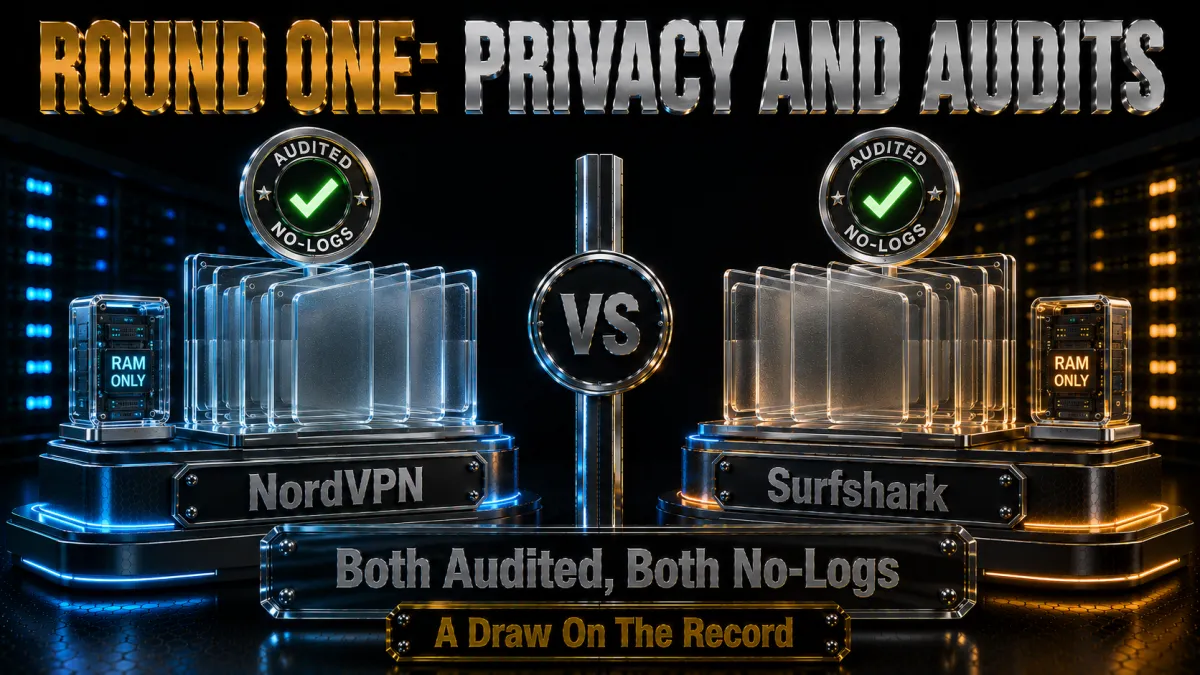
The trust foundations, compared inside one family.
- Jurisdictions: Nord’s edge on paper. Panama sits outside the intelligence-sharing alliances entirely; the Netherlands is EU-based with stronger legal process than the scare stories claim but a Nine Eyes membership on its record. For everyday privacy the difference is small; for flag-weighing purists it tilts Nord.
- Audit records: Nord by cadence, again. Both services hold independent no-logs examinations from reputable firms; Nord’s multi-year rhythm of repeated audits remains the densest in the industry, with Surfshark’s record solid and thinner. Cadence compounds in a trust market.
- Infrastructure: both modern. RAM-only across Nord’s fleet and Surfshark’s alike, diskless by design, so seizures yield nothing persistent. The architectural hygiene is shared family practice.
- The shared-parent question, answered. Does one owner weaken the comparison’s trust story? The audits are separate, the policies are separate, and the failure of one brand would not be survivable for the other’s reputation, which aligns incentives toward honesty on both. We disclose it and score the products.
Round winner: NordVPN, on jurisdiction and audit cadence together.
Round 2: Security architecture

The machinery, held to the same bar.
- Encryption: modern on both. Current-standard ciphers under NordLynx and Surfshark’s WireGuard, perfect forward secrecy throughout; the mathematics separates nothing. The family builds to the same floor.
- Kill switches: both dependable. Engaged on drops as designed in sustained use across desktop and mobile on both sides. Configure day one either way, per the standing guidance.
- Leak protection: clean records. Private DNS in-tunnel on both, clean leak-suite results in our sustained use. Verify per device regardless; one minute each.
- The differentiators. Nord fields Double VPN and Onion-over-VPN for layered routing; Surfshark answers with Dynamic MultiHop, pick-your-own two-hop pairs, and Camouflage plus NoBorders modes for hostile networks. Honest read: Surfshark’s obfuscation stack is the more flexible of the two.
Round winner: Tie. Nord’s layered routes against Surfshark’s obfuscation flexibility: both serious, differently aimed.
Round 3: Speed, patterns not fictions
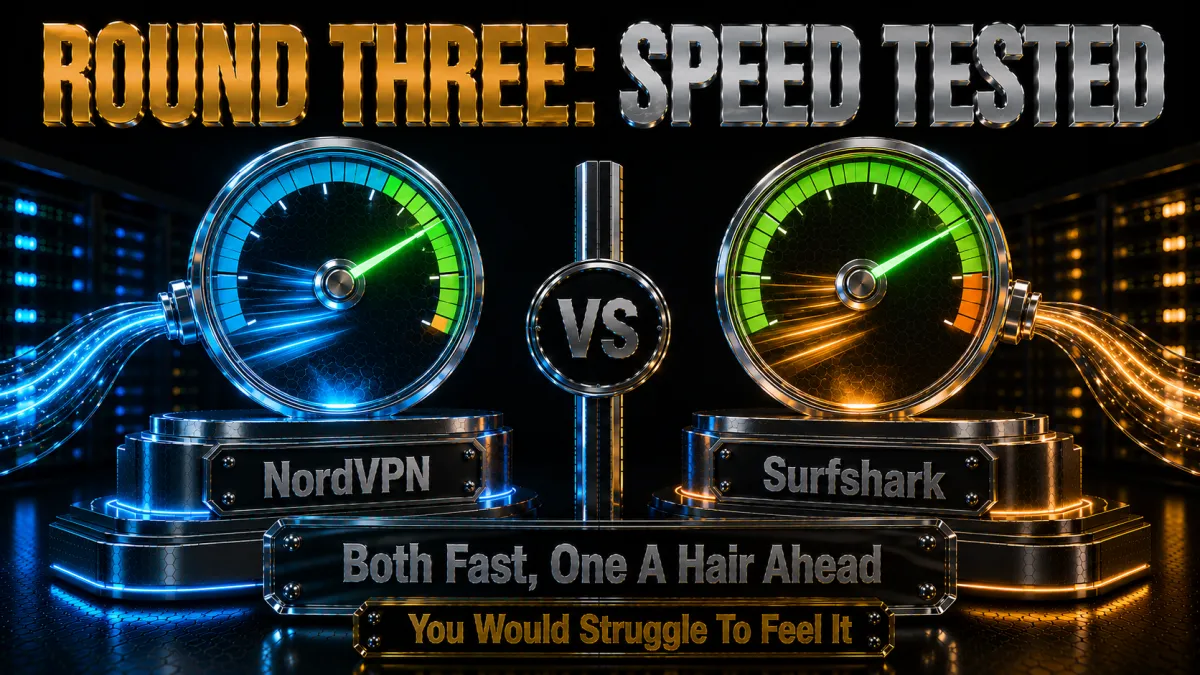
No fabricated Mbps tables, per the standing policy; the reproducible shape instead.
- The shared floor. Both cost a modest slice of baseline to a nearby server that browsing, streaming, and calls rarely notice. The matchup’s speed question is about peaks and consistency, not usability.
- Nord’s edge. NordLynx holds peak throughput and long-haul consistency better in matching conditions, the same pattern our reviews and the broad testing consensus describe, backed by a deeper fleet that keeps average server load lower on busy evenings. The step is real.
- Surfshark’s honest position. A solid step behind rather than a tier: WireGuard done well, entirely sufficient for 4K streaming and calls on ordinary connections. Most households would not identify the difference blind; power users on fast lines would.
- Your test outranks ours. Two refund windows, the ten-minute method on each, your real evening hour. The parallel plan below converts this round into your own numbers.
Round winner: NordVPN, on peak pattern and fleet depth behind it.
Round 4: Apps and everyday experience
Two capable interfaces, one small gap.
- Nord’s map-and-list. The explorable interface with speciality servers, per-app rules, and the suite within reach; dense without being difficult, and consistent across platforms with desktop leading slightly. A toolkit that rewards attention.
- Surfshark’s clean list. A simpler, friendlier layout with the essentials forward and the extras tucked sensibly behind; marginally quicker for a first-timer to feel at home in. The value brand’s interface carries no value-brand roughness.
- Feature parity. Both keep mobile close to desktop, with split tunnelling, auto-connect rules, and protocol choices present on the platforms that matter. Neither leaves phones as second-class citizens.
- The honest margin. This round is closer than Nord-versus-Express polish gaps; both are good, neither is the market’s calmest. Temperament decides at the margin.
Round winner: Tie, with Surfshark marginally friendlier and Nord marginally deeper.
Round 5: Streaming reliability
The quiet main use case, compared honestly.
- Both dependable. Major platforms have worked through both in sustained use, with flagged servers resolved by the hop-and-retry habit at similar, occasional rates. The family chases the access game with equal seriousness.
- Nord’s edge: alternates. The deeper fleet shortens the hop when an endpoint flags, streaming resilience as a side effect of scale. Felt at peak hours, invisible otherwise.
- Surfshark’s edge: every screen covered. Unlimited devices means the TVs, tablets, and consoles all run the app natively without slot arithmetic, which for a streaming household is the more practical advantage. Coverage beats marginal resilience for most families.
- The standing terms note. Platforms’ terms restrict cross-border catalogue access, and that use rides at your own account risk, the caveat this site attaches everywhere. Mechanics described, terms yours to weigh.
Round winner: Tie. Pick by household shape: depth of alternates against breadth of covered screens.
Round 6: Server networks
The maps, read practically.
- Nord’s scale. Thousands more servers across a hundred-plus countries with speciality categories layered on: P2P, obfuscated, Double VPN, dedicated IP. Scale translates to shorter hops and lower load at peak.
- Surfshark’s spread. A hundred-plus countries as well, competently load-balanced, with the smaller total fleet the price position implies. Coverage is not the gap; density is.
- Both RAM-only. Diskless fleets end to end, per the privacy round. Family hygiene, shared.
- Practical translation. Hop-happy users and peak-hour streamers feel Nord’s depth; connect-and-forget users feel no difference. Score by your habit, honestly.
Round winner: NordVPN, on fleet depth and speciality routes.
Round 7: Extra features
Two different bets on what extras mean.
- Nord’s security suite. Threat Protection working even off-tunnel, Dark Web Monitor, Meshnet private networking, Double VPN: security depth that reads like separate products bundled. The suite is the premium price’s best argument.
- Surfshark’s identity kit. Alternative ID generating masked personal details for sign-ups, Alert breach monitoring, CleanWeb blocking, and Dynamic MultiHop: extras aimed at identity exposure more than network threats. Genuinely differentiated, not imitation.
- The overlap. Both block ads and malicious domains, both monitor breaches at their respective tiers, both offer multi-hop. The cores rhyme; the accents differ.
- The honest score. Nord’s suite is deeper on security; Surfshark’s is cleverer on identity, and cheaper. Buyers who will use Meshnet or Onion routing tilt Nord; buyers who want sign-up masking tilt Surfshark.
Round winner: NordVPN, narrowly, on suite depth, with Surfshark’s Alternative ID the standout single feature on either side.
Round 8: Pricing, value, and the device policy
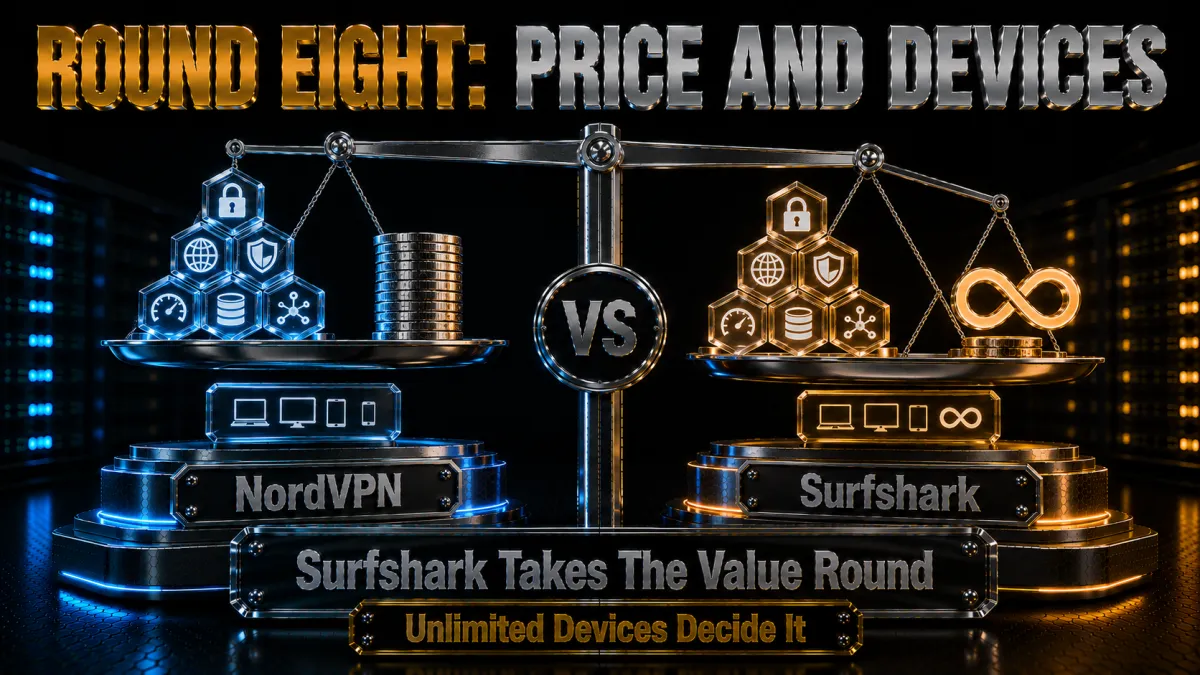
The rounds Surfshark was built to win, taken together.
- The price positions. Surfshark undercuts Nord at every term length, holding the budget-premium band while Nord sits premium-mid. The gap persists at renewal, which is where it actually matters.
- Intro versus renewal, both sides. Headline rates belong to first terms on both; the checkout-page renewal figure is the commitment. Read it before paying, here as everywhere on this site.
- Unlimited against ten. Surfshark’s unlimited simultaneous connections against Nord’s ten slots is the matchup’s most concrete difference: a crowded household covers every phone, TV, tablet, and console on one Surfshark plan without arithmetic. For many families this single policy decides the page.
- Value verdict. Per unit of money, Surfshark delivers more coverage and nearly comparable daily performance; Nord delivers more peak and more suite for more money. The value round is not close; the worth-it round depends on whether you use what Nord adds.
Round winner: Surfshark, decisively, on price and the unlimited policy together.
Round 9: Support and refunds
The safety nets, compared as users meet them.
- Both offer 24/7 live chat. Round-the-clock chat with competent responses and deep knowledge bases on both sides. The family standard holds across both brands.
- Refund practice. Both honour 30-day money-back guarantees as routine practice in our experience and broad user reports. Calendar the deadline either way.
- Documentation. Both publish clean setup guides across platforms, pairing well with our own fix ladders. No meaningful gap in self-serve quality.
- The bot layer. Both route chat through an assistant first; asking for an agent shortens the path on either. Shared, minor friction.
Round winner: Tie. Family-standard support on both sides.
Round 10: Hostile networks and obfuscation
The round where the value brand punches up.
- Surfshark’s stack. Camouflage mode disguising VPN traffic automatically on OpenVPN, plus NoBorders engaging on restrictive networks: a flexible, largely automatic answer to throttling hotels and filtered campuses. The obfuscation story is stronger than the price suggests.
- Nord’s answer. Obfuscated servers as a manual category, capable once selected, less effortless in the moment. The gap is ergonomic rather than capability.
- Neither promises miracles. Determined national filtering defeats consumer VPNs unpredictably, and honest comparisons say so; both services keep pace with the arms race without winning it outright.
- Travel arithmetic. Unlimited devices also means the whole travelling family’s gear is covered without slot juggling. Coverage compounds the round.
Round winner: Surfshark, on obfuscation ergonomics and flexibility.
What the shared family actually means for buyers
The merger, translated from press-release language into purchase consequences.
- Separate products, genuinely. Different apps, different protocols in practice (NordLynx against standard WireGuard), different fleets, different audit engagements, and different support teams: the merger consolidated ownership, not engineering. Nothing a buyer touches got blended, which is why this comparison exists at all.
- Positioning is deliberate, not accidental. One owner running a premium brand and a value brand is classic market segmentation: Nord holds the performance ceiling while Surfshark defends the price floor, and the family collects either way. Knowing this helps you read the pricing round correctly: the gap is strategy, and it is stable.
- The risk question, answered honestly. Could one owner quietly weaken both privacy policies at once? The audits are separate and repeated, the brands live on their trust reputations independently, and a scandal at either would burn both, which aligns the incentives toward caution. We watch the audit cadence on both and would say so plainly if it slipped.
- What it means for switching. Moving between them later is ordinary churn, separate accounts, separate refunds, no shared login, so a wrong first pick costs a cancellation, not a migration. The parallel test below makes even that unlikely.
The full scorecard: twelve rounds tallied

Every round in one table, with devices and identity extras scored inline.
| Round | NordVPN | Surfshark | Winner |
|---|---|---|---|
| 1. Privacy & audits | Panama, densest cadence | Audited, Netherlands | NordVPN |
| 2. Security architecture | Layered routes | Obfuscation flexibility | Tie |
| 3. Speed pattern | Peak and consistency | Solid step behind | NordVPN |
| 4. Apps | Deeper | Friendlier | Tie |
| 5. Streaming | More alternates | Every screen covered | Tie |
| 6. Server network | Thousands deeper | Broad, thinner | NordVPN |
| 7. Extra features | Suite depth | Alternative ID standout | NordVPN |
| 8. Pricing & value | Premium-mid | Undercuts throughout | Surfshark |
| 9. Support | 24/7, honoured | 24/7, honoured | Tie |
| 10. Hostile networks | Manual obfuscated | Camouflage + NoBorders | Surfshark |
| 11. Device allowance | 10 slots | Unlimited | Surfshark |
| 12. Identity extras | Dark Web Monitor | Alternative ID + Alert | Surfshark |
- Final tally: NordVPN 4, Surfshark 4, Ties 4. A dead heat on rounds, which is the honest arithmetic of a premium product against a value product executing different bets equally well. The tiebreaker is not on this table; it is in your household and budget, and the who-for section routes it.
- How to read a 4-4-4. Nord’s wins are performance and depth; Surfshark’s are money and coverage. Our overall ratings (4.8 vs 4.6) reflect absolute quality; this table reflects the head-to-head shape. Both readings are true at once.
Which should you pick? The decision, made explicit
The dead heat, broken by buyer.
- Pick NordVPN if performance leads. The fastest pattern, the deepest fleet, and the fullest security suite justify the premium for buyers who will feel peaks and use the tools. Our rankings’ top spot is earned on exactly this profile.
- Pick Surfshark if your device count laughs at ten. Unlimited connections at a lower price is the concrete, daily difference, and no Nord feature answers it for a crowded household. The value verdict is not charity; it is arithmetic.
- Pick NordVPN if you want the densest audit trail. The cadence round matters to trust-first buyers, and Nord owns it family-wide. Proton remains the open-source alternative outside this family, per that review.
- Pick Surfshark if hostile networks feature in your life. Camouflage and NoBorders handle throttling networks with less thought than Nord’s manual category. The travel-value combination is underrated.
- Either way, the family floor holds. Audited, RAM-only, kill-switch-equipped, refund-backed on both: you are choosing between the same company’s premium and value answers, both honest products.
Test both in parallel: the 30-day head-to-head plan
Two refund windows, one experiment, your connection as referee.
- Day 1: subscribe to both, calendar both deadlines. Same week, renewal rates screenshotted at both checkouts, decision date at day 25. The guarantees make the experiment nearly free.
- Day 1: install and verify both. Kill switches on, leak suite per device on each, per our leak-check guide. Same devices, same baseline.
- Week 1: alternate days through real life. Nord odd days, Surfshark even: commutes, evening streams, calls. Note friction, not just numbers.
- Week 2: the ten-minute speed method on each. Baseline, three nearest servers per service, your real evening hour, recorded side by side. Your own table beats ours by definition.
- Week 3: stress the difference-makers. Every household screen on Surfshark simultaneously one weekend evening; Nord’s suite exercised the next, Threat Protection, Meshnet if you have a use, a Double VPN session. Score the rounds your life actually contains.
- Day 25: keep one, refund the other. Polite refund request for the loser inside its window; renewal for the winner. Thirty days of parallel evidence settles a 4-4-4 better than any reviewer can.
Mistakes buyers make in this matchup
Collected so you can skip them.
- Treating the shared parent as a scandal or as irrelevant. It is neither: separate audited products under one owner, disclosed so you can weigh it. The mistake is learning it after purchase from a forum thread.
- Paying for Nord’s suite you will never open. Threat Protection and Meshnet justify the premium only if used; a connect-and-forget buyer is paying for shelf ornaments. Match the price to your actual usage.
- Choosing Surfshark for three devices. The unlimited policy is its trump card; a small household forfeits the advantage and should weigh the speed and fleet rounds more heavily. Buy the policy you will exercise.
- Deciding on intro price alone. Renewal figures on both checkout pages are the real commitment, and the gap between the services persists there. Read before paying, both sides.
- Skipping the parallel test. A 4-4-4 dead heat is precisely the matchup your own thirty days were made to break. Run the plan; the verdict becomes yours.
Frequently asked questions
Which is better, NordVPN or Surfshark?
Our twelve rounds end in an honest 4-4-4 dead heat: Nord wins performance, fleet depth, audits, and suite; Surfshark wins price, unlimited devices, hostile-network ergonomics, and identity extras. Performance-first buyers take Nord at 4.8; device-heavy and budget-led households take Surfshark at 4.6.
Are NordVPN and Surfshark owned by the same company?
Yes, both operate under the Nord Security umbrella following their 2022 merger, while remaining separately built, separately audited, separately priced products. We disclose it throughout this comparison rather than footnoting it; the head-to-head remains real because everything a buyer touches differs.
Is NordVPN faster than Surfshark?
In matching conditions NordLynx holds peak throughput and long-haul consistency a solid step ahead of Surfshark’s well-implemented WireGuard, with Nord’s deeper fleet lowering peak-hour load besides. Most households would not spot the gap blind; run the ten-minute test on both inside the refund windows.
Does Surfshark really allow unlimited devices?
Yes, unlimited simultaneous connections are honoured without practical asterisks, against NordVPN’s ten slots, and it is the most concrete difference in this matchup. For crowded households this single policy often decides the purchase.
Are both NordVPN and Surfshark safe?
Yes: audited no-logs policies, RAM-only fleets, modern encryption, and dependable kill switches on both, from Panama and the Netherlands respectively. The safety floor is family-standard; the differences live in performance, price, and extras.
Which is cheaper, NordVPN or Surfshark?
Surfshark, at every term length, with the gap persisting at renewal where it matters; Nord holds the premium-mid band its performance case supports. Read both renewal figures at checkout before paying, per the standing advice.
Which is better for streaming?
We score it a tie: Nord’s deeper fleet offers more alternates when servers flag, while Surfshark’s unlimited policy puts the app natively on every household screen. Platforms’ terms restrict cross-border catalogue access, at your own account risk, per the standing caveat.
What is Surfshark Alternative ID?
A generator for masked names, birthdates, and email identities to use on sign-up forms, reducing what data breaches can expose about the real you; it is the standout single feature on either side of this comparison. Nord’s answer, Dark Web Monitor, alerts after exposure rather than preventing it.
Which handles restrictive networks better?
Surfshark, on ergonomics: Camouflage disguises traffic automatically and NoBorders engages on filtered networks, against Nord’s capable but manual obfuscated-server category. Neither can promise certainty against determined national filtering, and honest comparisons say so.
Can I test NordVPN and Surfshark before committing?
Yes, both honour 30-day money-back guarantees, making the parallel head-to-head nearly free: subscribe to both, alternate days for three weeks, keep the winner, refund the loser by day 25. A 4-4-4 dead heat is exactly what your own evidence should break.
Which should a family with many devices choose?
Surfshark, almost automatically: unlimited connections cover every phone, TV, tablet, and console on one plan at the lower price. Nord’s ten slots suffice for smaller households that value its performance edge instead.
Do NordVPN and Surfshark both allow torrenting?
Yes: Nord routes P2P through dedicated servers automatically, Surfshark permits it broadly across its network, and both pair it with kill switches and private DNS per our torrenting-safety guidance. The standing legal note applies on both: the tunnel changes network visibility, not the legality of downloads.
Is Surfshark as trustworthy as NordVPN?
Both carry independent no-logs audits and RAM-only fleets; Nord’s audit cadence is denser, which our privacy round scores, while Surfshark’s record is solid rather than thin. Trust-first purists tilt Nord or read our ProtonVPN review for the open-source alternative outside this family.
Which is better for gaming, NordVPN or Surfshark?
Nord takes the round for latency-sensitive players: the sustained-throughput edge and deeper nearby fleet keep evening ping steadier, while Surfshark remains entirely playable for casual sessions at its lower price. Ping is the most connection-specific metric there is; test both through your real game inside the refund windows.
Should I just buy whichever is on sale?
Only if the tied rounds cover your whole use case: for connect-and-forget browsing on a handful of devices, honestly, either serves you well and the discount can decide. The moment device count, peak speed, or the security suite enters your requirements, the rounds above route you properly regardless of the banner price.
The Bottom Line
- The rounds end 4-4-4, and that is the honest score. Premium and value bets executed equally well by one corporate family, disclosed throughout.
- NordVPN is the pick for performance and depth. Fastest pattern, deepest fleet, densest audits, fullest suite, at 4.8 and a premium-mid price.
- Surfshark is the pick for coverage and money. Unlimited devices, lower bills, cleverer identity extras, at 4.6 and a price Nord does not answer.
- The tiebreaker is your household, not our table. Count your screens, weigh your budget, and the dead heat resolves itself.
- Two refund windows referee for free. The parallel plan above turns this page into your own verdict inside thirty days.
A comparison between corporate siblings could easily be theatre; this one is not, because the products embody genuinely different answers to what a VPN subscription should cost and cover. Buy Nord when the performance and the suite are your life; buy Surfshark when the device count and the bill are; and let the refund windows hold both brothers honest on your own connection.
Jyoti VPN Expert leads VPN testing at VPN Expert Guide, covering streaming and regional access, speed and latency testing, and leak checks on Windows, Android and router-level setups. Our guides are built from vendor documentation, provider terms and our own connection testing on a residential line in India, and we publish those measurements in full so readers can check them. Every guide is reviewed before publication and dated so you can see how current it is.
Meet our testing team →Last updated: September 2, 2026