
Best Free VPN for Daily Use in 2026: The Honest Guide Nobody Writes
Every list of free VPNs faces a choice: tell you what you want to hear, or tell you how this market actually works. This one does the second thing. Free VPNs range from honest, capped tasters run by audited companies to data-harvesting operations wearing a padlock icon. This guide explains how free services really sustain themselves, which kind of free is acceptable for daily use, and why a refund-window trial of a paid VPN is the best free VPN experience that exists.
How free VPNs actually make money
Start here, because everything else in this topic follows from one question: who pays for the servers?
- Infrastructure is never free. Servers, bandwidth, apps, and support cost real money every month. A service with no subscription revenue is paying those bills some other way, and you are the only asset on the premises.
- The historical answers are ugly. Investigations into free VPN apps over the years have repeatedly found traffic logging, data sales to brokers, injected ads, and worse. Not every free app sins, but the incentive structure points one direction.
- Freemium is the honest exception. Some audited providers run capped free tiers as marketing: the free users cost little, some convert to paid, and the paid business funds everything. The incentives are clean because the revenue is elsewhere.
- The one-sentence filter. If you can see how the company earns money without touching your data, the free tier can be trusted as far as its caps. If you cannot, assume your traffic is the product.
What the wrong free VPN costs you
The price of a bad free VPN is paid in exactly the currency you were trying to protect.
- Your browsing becomes inventory. A logging free VPN sees every destination your device visits and sells that stream onward. That is a strictly worse position than using no VPN at all.
- Your connection gets tampered with. Ad injection means the operator edits pages as they pass. A middleman willing to inject ads is a middleman capable of injecting anything.
- Your security features are missing. Kill switches, leak protection, and modern protocols are usually paywalled or absent, so the moments a VPN exists for, drops on public Wi-Fi, go unprotected.
- Your accounts ride on unknown infrastructure. Logging into email or banking through an unaccountable relay hands your most sensitive sessions to a stranger. This is the free-VPN habit that genuinely hurts people.
- Your time drains through caps and throttles. Even setting security aside, the daily experience of data limits, queue systems, and crowded servers makes free tiers miserable as primary tools.
The two kinds of free, and why the difference is everything
The phrase free VPN covers two products that share nothing but a price.
- Freemium tiers from audited providers. A real VPN company, with published audits and a paid business, offers a deliberately limited free plan: capped data or servers, clearly labelled, honestly restricted. It is a taster, and it says so.
- Permanently free unlimited services. Unknown operators promising unlimited everything forever, with no visible revenue. The promise itself is the red flag: unlimited bandwidth costs unlimited money, and someone is paying it for a reason.
- The tell is the business model, not the app store rating. Ratings measure whether the app connects, not where your data goes. Ownership transparency, audit history, and a visible paid product are the signals that matter.
- This guide’s rule. Freemium from audited firms: acceptable within limits. Anonymous unlimited free: avoid entirely, for anything. Every recommendation below follows from that single split.
What legitimate free actually looks like
So you can recognise the honest kind on sight, here is its anatomy.
- A parent company with a paid product. The free tier exists to market the paid one, which means the operator profits from upgrading you, not from selling you.
- Published independent audits. The no-logs policy has been examined by outsiders, and the reports are public. Proton VPN’s free tier is the best-known example of this shape: capped, audited, and honest about its limits.
- Clearly stated restrictions. Honest free tiers advertise their caps, limited servers, limited speed priority, no streaming support, because the limits are the point. Vagueness about limits usually means the limits are hidden elsewhere.
- No unlimited promises. The legitimate free tier never claims to be a full product. If it did everything, nobody would upgrade, and the operator knows that better than anyone.
- Still not a daily driver. Even the best freemium tier is built to be outgrown: fine for occasional low-stakes use, structurally unfit for a household’s daily traffic. Honest free has honest limits.
The limits you will live with on any free tier
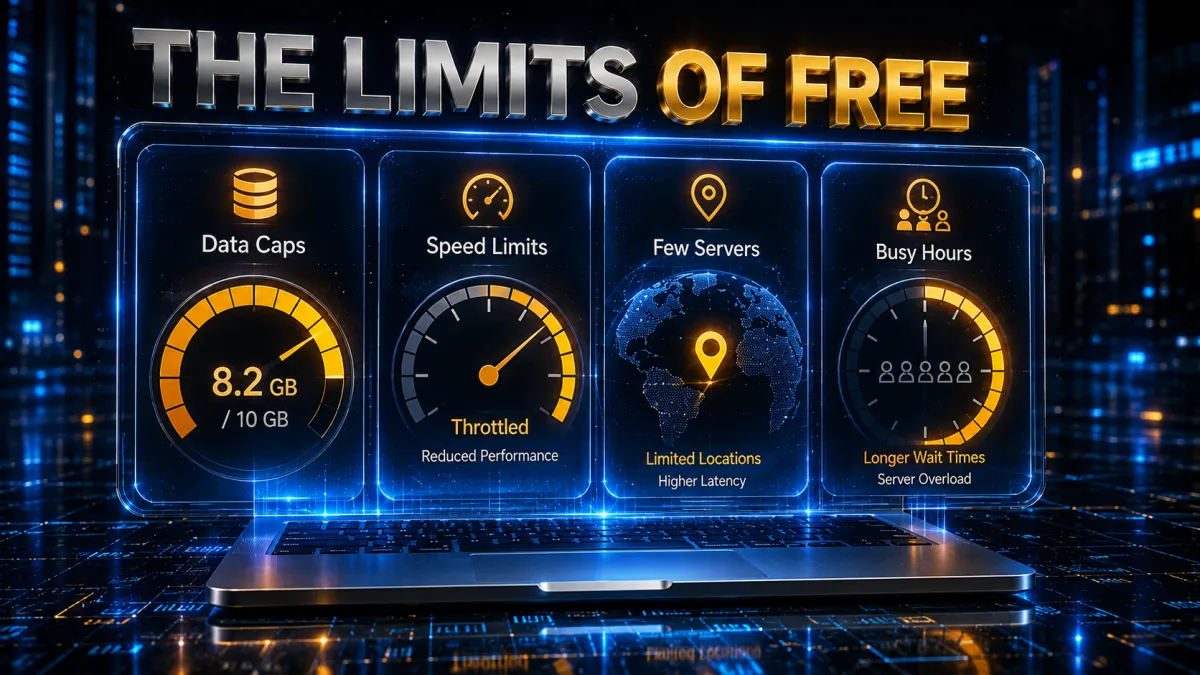
Assume the legitimate kind; here is the daily reality of it.
- Data caps end sessions early. Typical free allowances die inside a video call or a short streaming session. Browsing and messaging fit; anything heavier does not.
- Server choice shrinks to a handful. Free tiers offer few locations, often busy ones, which rules out most location-specific uses and slows everything at peak hours.
- Speed rides in the back. Paid users get priority; free traffic gets what remains. On crowded evenings, that remainder is thin.
- Streaming and heavy features are excluded. Free tiers rarely unblock streaming platforms and usually withhold extras like multi-hop or domain blocking. Those are upgrade bait by design.
- The caps are the honesty. Worth repeating: on a legitimate freemium tier, the restrictions are what make the free price sustainable without touching your data. Resent them less; they are the receipt.
The refund-window method: the best free VPN that exists
Here is the route this site genuinely recommends, spelled out honestly.
- Every top provider refunds within 30 to 45 days. Subscribe, use the full product, every server, full speed, all features, and request a refund inside the window if it did not earn its keep. That is a month-plus of premium protection at zero net cost.
- It is a sanctioned trial, not a trick. Money-back guarantees exist precisely so you can evaluate risk-free, and reputable providers honour them without drama. Use the method in good faith: actually evaluate, actually decide.
- CyberGhost stretches it longest. Its 45-day window is six real weeks, the longest evaluation period in the industry, which is why it appears in the picks below despite this being a free-focused page.
- Chain evaluations if you are genuinely comparing. Trying two providers across two refund windows is a legitimate way to spend a season deciding. By the end you will know exactly what your connection needs.
- The honest endpoint. If a VPN proves worthless to you, refund and keep the freemium taster for rare moments. If it proves useful daily, a few dollars monthly is the fair price of not being the product.
How to choose your free path in one minute
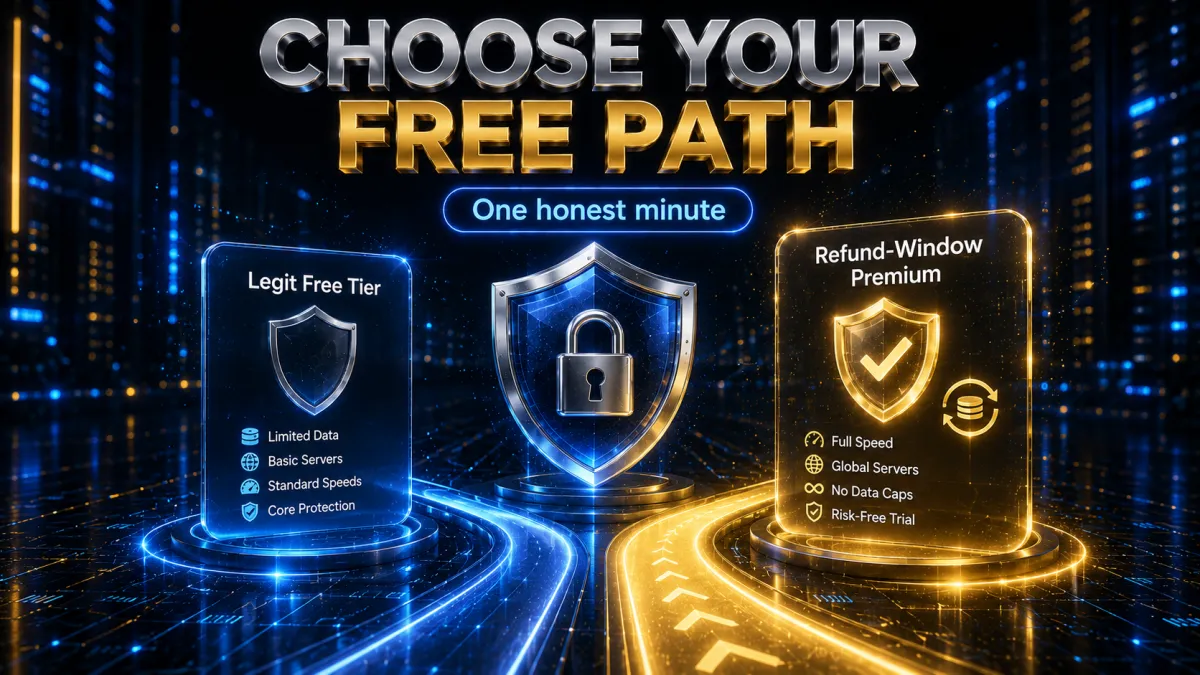
Three questions sort every reader of this page.
- Is your use occasional and low-stakes? A freemium tier from an audited provider covers it within its caps. Install, accept the limits, done.
- Is your use daily, or does it touch accounts and money? Run the refund-window method on a full product. Daily traffic deserves real protection, and the trial costs nothing.
- Is the free app you found anonymous and unlimited? Close the page. That combination has no honest explanation, and the risks section above is what it costs.
- Budget answer for afterwards. If the trial convinces you, Surfshark is the cheapest audited full product per device of the five below, which makes the upgrade the smallest possible step.
The 5 VPNs worth upgrading to in 2026
When the free experiment ends, these are the five worth paying for, ranked with upgrade economics in mind: trust first, then what your money buys per device, with the refund windows that make every choice reversible.
1. NordVPN – Best overall upgrade
NordVPN is everything the free tier taught you to want, delivered without the caps: a no-logs policy through multiple independent audits, RAM-only servers, NordLynx speeds that make the tunnel invisible, and no data limits, queues, or server lotteries anywhere in sight.
The extras justify the jump on their own: Threat Protection blocks malicious domains device-wide, on-demand and auto-connect rules make protection automatic, and Double VPN covers the cautious days. The 30-day window means the whole judgement stays reversible.
✔ Pros
- Multiple independent no-logs audits
- No caps, queues, or throttling anywhere
- NordLynx keeps the tunnel invisible
- Threat Protection blocks hostile domains
- Automatic protection rules
✘ Cons
- Best price needs a longer plan
- Denser settings than minimalist rivals
| Free tier | No, refund window instead |
| Audited no-logs | Yes, multiple audits |
| Data caps | None |
| Jurisdiction | Panama |
| Devices | 10 |
| Money-back | 30 days |
2. ExpressVPN – Premium simplicity
ExpressVPN is the opposite pole from the free-VPN world: the entire fleet runs in RAM and wipes on reboot, the no-logs policy is audited, the company sits in the British Virgin Islands, and the one-button apps never ask you to think. If a bad free app burned you, this is the purest trust-first antidote.
Lightway connects near-instantly and holds through hostile networks gracefully. It is the priciest of the five with an eight-device cap, which is precisely why it ranks on trust and polish rather than economics.
✔ Pros
- RAM-only fleet, audited no-logs
- Simplest apps of the five
- Excellent reliability everywhere
- BVI jurisdiction
- Automatic obfuscation on hostile networks
✘ Cons
- Most expensive of the five
- 8-device cap is the tightest here
| Free tier | No, refund window instead |
| Audited no-logs | Yes, audited |
| Data caps | None |
| Jurisdiction | British Virgin Islands |
| Devices | 8 |
| Money-back | 30 days |
3. Surfshark – Cheapest honest upgrade
Surfshark is the answer to the objection that kept you on free tiers: on long-term plans it costs less monthly than a snack, covers unlimited devices simultaneously, and still brings the audited no-logs policy, WireGuard speed, and CleanWeb domain blocking of a serious product.
For a household that was juggling capped free apps across several phones, one Surfshark subscription replaces the whole circus. Peak speeds trail the top two slightly and the Netherlands base is inside the EU; at this price per protected device, the trade is easy.
✔ Pros
- Lowest long-term price of the five
- Unlimited simultaneous devices
- Audited no-logs policy
- CleanWeb blocks hostile domains
- Replaces every capped free app at once
✘ Cons
- Peak speeds behind the top two
- Netherlands base, inside the EU
| Free tier | No, refund window instead |
| Audited no-logs | Yes, audited |
| Data caps | None |
| Jurisdiction | Netherlands |
| Devices | Unlimited |
| Money-back | 30 days |
4. CyberGhost – Longest risk-free evaluation
CyberGhost holds special relevance on this page: its 45-day money-back guarantee is the longest evaluation window in the industry, six full weeks of the complete product before any money is truly spent. For a free-tier user testing whether paid VPNs are worth it at all, this is the biggest sample you can take.
The app is the plainest-language of the five, the no-logs policy is audited with regular transparency reports, and the huge server network keeps nearby options quiet. Advanced controls run lighter than NordVPN’s, by design and for this audience, rightly so.
✔ Pros
- 45-day refund, longest evaluation anywhere
- Plainest-language apps of the five
- Audited no-logs with transparency reports
- Huge server network
- Purpose-labelled servers
✘ Cons
- Lighter advanced feature set
- Speeds good rather than leading
| Free tier | No, 45-day window instead |
| Audited no-logs | Yes, audited |
| Data caps | None |
| Jurisdiction | Romania |
| Devices | 7 |
| Money-back | 45 days |
5. IPVanish – Fast, unlimited, fairly priced
IPVanish offers brisk sustained speeds, unlimited simultaneous connections, and fair pricing: a straightforward workhorse that, next to any free tier, feels like removing a handbrake. Kill switch and split tunnelling come standard.
Fifth place is the usual honest note: US jurisdiction inside the major intelligence alliance and a lighter independent audit history than the four above. Against the free-VPN world it is still a categorical upgrade; against the four above, the evidence file is thinner.
✔ Pros
- Consistently brisk speeds
- Unlimited simultaneous connections
- Fair pricing
- Kill switch and split tunnelling standard
- Simple apps everywhere
✘ Cons
- US jurisdiction
- Lighter audit history than the leaders
| Free tier | No, refund window instead |
| Audited no-logs | Policy in place, lighter audit history |
| Data caps | None |
| Jurisdiction | United States |
| Devices | Unlimited |
| Money-back | 30 days |
| Feature | NordVPN | ExpressVPN | Surfshark | CyberGhost | IPVanish |
|---|---|---|---|---|---|
| Audited no-logs | Multiple audits | Audited | Audited | Audited | Lighter history |
| Long-term price | Mid | Highest | Lowest | Low | Fair |
| Refund window | 30 days | 30 days | 30 days | 45 days | 30 days |
| Speed | Excellent | Excellent | Strong | Good | Excellent |
| Devices | 10 | 8 | Unlimited | 7 | Unlimited |
| Domain blocking | Threat Protection | Limited | CleanWeb | Basic | No |
Matching a free VPN to your main daily activity
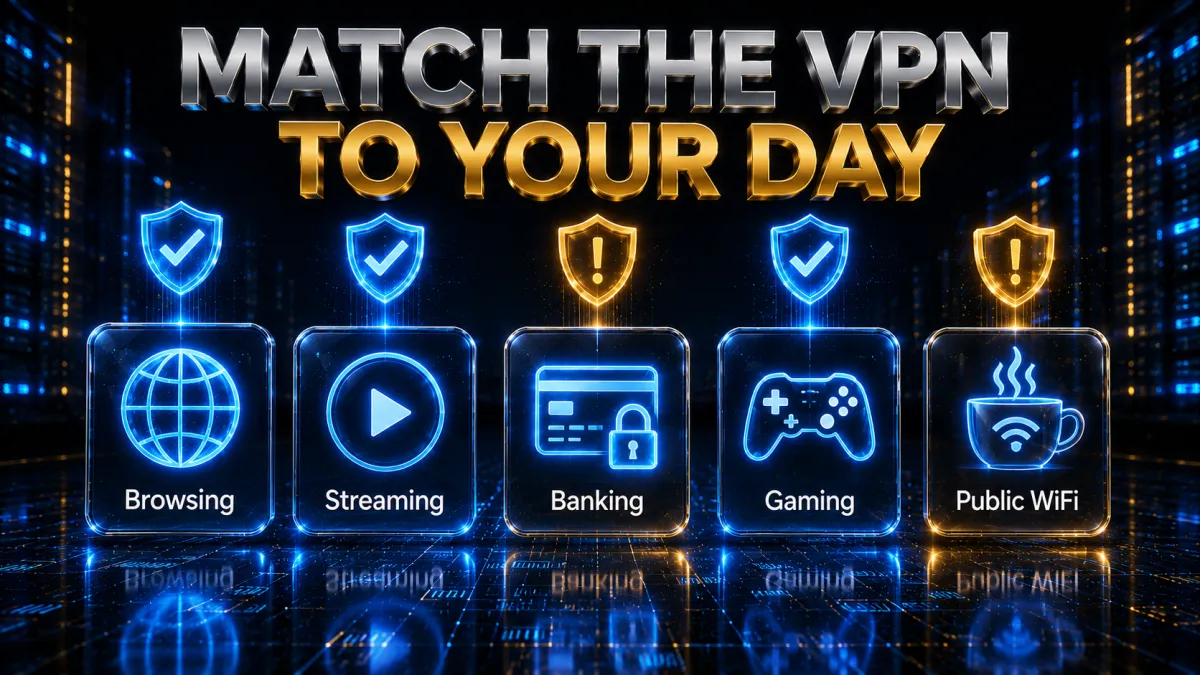
Daily use means different things; here is where free tiers honestly fit, activity by activity.
- Light browsing and messaging: the free sweet spot. Low data, low stakes, tolerant of speed dips. A capped freemium tier handles this comfortably, and it is the one daily pattern where free genuinely suffices.
- Public Wi-Fi protection: freemium works, barely. Occasional cafe sessions fit within caps, but note that free tiers often lack auto-connect rules, so protection depends on your memory, which is the weak link the paid tiers fix.
- Streaming: free fails, by design. Data caps die mid-episode and free servers rarely clear platform blocks anyway. Providers reserve streaming for paid tiers deliberately. No free tier honestly serves this.
- Banking and work accounts: skip free entirely. Not because freemium logs you, the audited ones do not, but because missing kill switches and leak protections matter most exactly here. Sensitive sessions deserve the full toolkit.
- Torrenting and heavy downloads: caps make it pointless. A data allowance measured in gigabytes meets a use case measured in tens of them. Paid or nothing, honestly.
Free vs paid, laid side by side
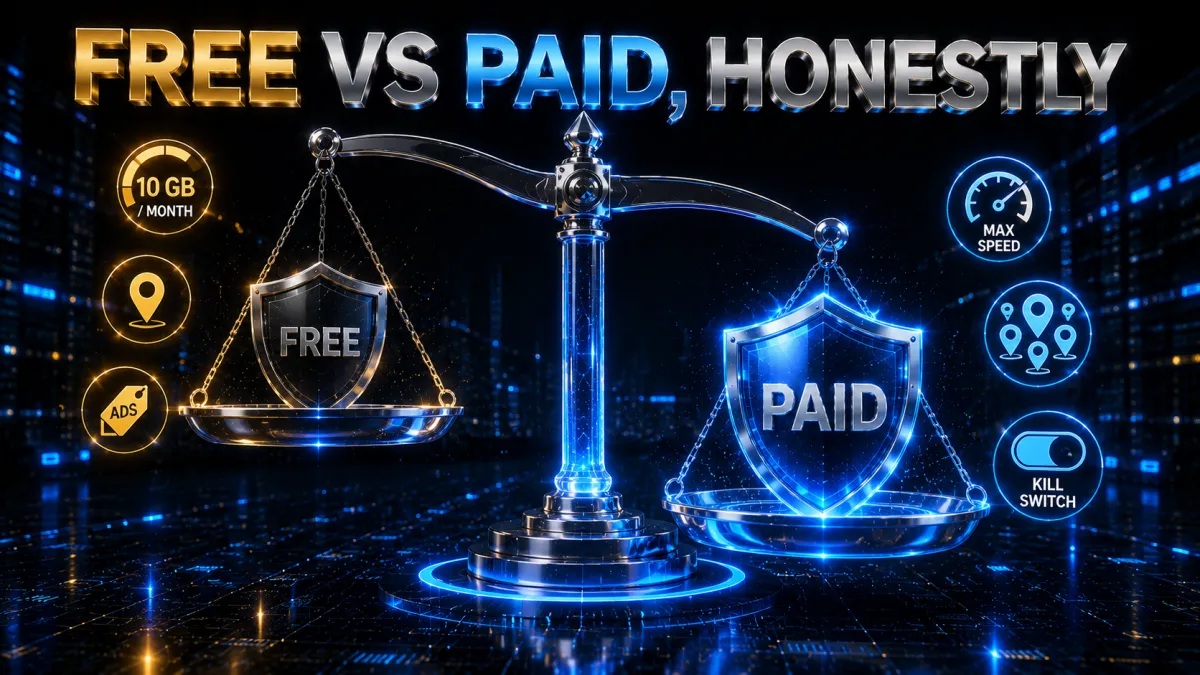
The whole trade-off in five lines, no drama.
- Protection quality. Free tiers carry basic encryption; kill switches, leak protection, and modern protocol priority usually sit behind the paywall. The safety net has holes precisely where falls happen.
- Daily experience. Caps, queues, and throttles versus none of those. The paid product disappears into the background; the free one reminds you of itself hourly.
- Coverage. One device on limited servers versus every device on thousands. A household cannot live on a free tier; one paid plan with unlimited devices covers it entirely.
- Privacy economics. Audited freemium is honest but limited; anonymous free is monetised against you; paid means you are the customer, full stop. You always pay somebody, in money or in data.
- Real cost gap. The cheapest audited full product runs to snack money monthly on long plans. The gap between honest-free and paid is smaller than one coffee; the gap between honest-free and shady-free is your browsing history.
What 2026 research says about free VPN risk
Free VPN safety is not just a theory. In 2026, researchers from the University of Michigan, the University of New Mexico and IIT Delhi reported that many Android VPN apps still fail at the basic job users expect from a VPN: keeping traffic private. Their MVPNalyzer work found examples of VPN traffic leaks, plain-text data transmission and user tracking risks in popular mobile VPN apps.
Separate free VPN investigations have also found recurring red flags such as risky Android permissions, advertising identifiers, installed-app scanning and third-party tracking libraries. These findings do not mean every free VPN is unsafe, but they do mean users should judge a free VPN by its privacy model, audit record and permissions — not only by downloads, ratings or speed.
- For daily browsing: prefer a reputable free tier from a known paid VPN over a random unlimited free VPN.
- For banking or work: avoid unknown free VPNs completely.
- For Android: check permissions before installing; a simple VPN should not need camera, contacts or unnecessary location access.
- For privacy claims: look for clear ownership, a readable privacy policy and independent audit history.
Sources: University of Michigan MVPNalyzer summary and Top10VPN free Android VPN investigation.
Red flags: how to spot a free VPN to avoid
Five signs, any one of which should end the download.
- Unlimited everything, forever, free. The economics have no honest explanation. This single flag filters most of the danger out of the category.
- No named company behind the app. Anonymous developers running relay infrastructure for strangers is exactly as reassuring as it sounds. Look for ownership you can name and locate.
- No audit, no transparency report, no policy worth reading. A privacy product that offers no evidence about privacy is telling you the evidence would not help it.
- Permission greed. A VPN needs the VPN permission. Contacts, location history, and browsing accessories signal a data business wearing a security costume.
- Ad-stuffed apps and miracle claims. Aggressive in-app advertising reveals the revenue model, and promises of total anonymity or unbreakable security reveal the marketing honesty. Both leak the same conclusion.
Common mistakes people make with free VPNs
The recurring errors, so you can skip the whole set.
- Judging by app store rank. Download counts measure marketing, not trustworthiness; some of the most-installed free VPNs have the worst records. Rank tells you nothing this page cares about.
- Logging into sensitive accounts through unknown free apps. The single most damaging habit in this topic: routing banking and email through an unaccountable middleman voluntarily.
- Treating a capped taster as a household solution. Freemium tiers are built to be outgrown; stretching one across a family’s daily traffic guarantees frustration and gaps.
- Ignoring the refund route out of subscription fear. The windows are real and honoured by reputable firms. Fearing a reversible charge while accepting irreversible data exposure is exactly backwards.
- Keeping three free apps instead of choosing once. Rotating between capped services multiplies the trust question by three and still delivers a worse week than one honest choice, free or paid.
If you do use a free VPN: the safe-habits checklist
Realistically, some readers will run a free tier anyway. Do it on these terms.
- Pick audited freemium only. The provider must have a named owner, published audits, and a visible paid business. That one filter removes most of the risk.
- Keep sensitive sessions off it. Banking, work systems, and anything involving money ride on trusted networks or a full product, not a capped free tunnel missing its kill switch.
- Check for leaks occasionally. Run the provider’s leak test now and then; free tiers get less engineering attention, and thirty seconds of verification is cheap.
- Watch the caps consciously. Know your allowance and what happens when it ends, protection that silently stops at a data limit is worse than protection you know has stopped.
- Schedule the graduation decision. Set a date to decide properly: upgrade through a refund-window trial, or accept the taster’s limits knowingly. Drifting indefinitely on a capped tier is how people end up on shady apps the next time a cap bites mid-task.
Related reading:
Frequently Asked Questions
What is the best free VPN for daily use in 2026?
Honestly: a capped freemium tier from an audited provider for light daily use, or a paid VPN run through its 30 to 45 day refund window for anything serious, which delivers a month-plus of full protection at zero net cost. Permanently free unlimited services from anonymous operators are the category to avoid outright, because their business model is your data.
Are free VPNs safe?
The audited freemium kind is safe within its limits: real companies, published audits, honest caps. The anonymous unlimited kind is the opposite: investigations have repeatedly found logging, data sales, and ad injection in that corner. The safety question is really an ownership question, and the split runs exactly along it.
How do free VPNs make money?
Legitimate ones use the free tier as marketing for a paid product, which keeps the incentives clean. Illegitimate ones monetise the users directly: logging and selling browsing data, injecting ads, and bundling trackers. If you cannot see how a service earns money without touching your data, assume your data is the revenue.
Can I use a free VPN for streaming?
Realistically no: data caps die inside an episode, free servers rarely clear platform blocks, and providers reserve streaming support for paid tiers deliberately. If streaming is the goal, the refund-window route on a full product is the only honest free-ish answer, and platform terms of service apply either way.
Is a free VPN better than no VPN at all?
An audited freemium tier: yes, within its caps, it adds real protection on public Wi-Fi. A shady free app: no, it is actively worse than nothing, because you add a logging middleman to your connection while believing yourself protected. The answer depends entirely on which kind of free is in your hand.
What are the limitations of free VPNs?
Data caps that end sessions early, a handful of crowded server locations, deprioritised speeds behind paying users, no streaming support, and usually missing safety features like kill switches and auto-connect rules. On honest freemium tiers these limits are stated openly, which is precisely what makes those tiers honest.
What is the refund-window method and is it allowed?
Subscribe to a full VPN, evaluate it genuinely for 30 to 45 days, and request a refund inside the window if it did not earn its keep. It is entirely allowed: money-back guarantees exist for exactly this, and reputable providers honour them without drama. Used in good faith, it is the best free VPN experience available.
Which paid VPN is cheapest to upgrade to from a free tier?
Surfshark, on long-term plans: the lowest monthly price of our five with unlimited simultaneous devices, so one subscription replaces every capped free app in the household. CyberGhost runs close behind and stretches the evaluation longest with its 45-day refund window.
Do free VPNs sell your data?
Some have, demonstrably: investigations into the anonymous-free corner of the market have documented traffic logging and sales to data brokers repeatedly. Audited freemium tiers from named companies are the exception, because their revenue comes from paid subscribers, not from you. Choose accordingly.
Can I use a free VPN for online banking?
Avoid it: not because audited freemium tiers log you, but because free tiers typically lack the kill switch and leak protections that matter most during sensitive sessions, and banks challenge shared free-server addresses aggressively anyway. Bank on trusted networks or through a full product.
Why do free VPNs have data caps?
Because bandwidth costs the provider real money, and the cap is what lets an honest company give service away without monetising your traffic. The cap is effectively the receipt for a clean business model, which reframes the annoyance: an uncapped free service should worry you far more than a capped one.
Are free VPN browser extensions safe?
Treat them with double suspicion: many are proxies rather than VPNs, encrypting nothing and covering only the browser, and the extension format has a long record of tracking abuse. An audited provider’s extension paired with its real app is fine; a standalone free unlock-everything extension is the classic red-flag package.
How do I close my account with a shady free VPN I already used?
Delete the app, then use the service’s account deletion route if one exists, and revoke any VPN configuration profiles it installed in your device settings. Change passwords for sensitive accounts you used through it, and treat the episode as motivation for the audited-only rule going forward.
The Bottom Line
The free VPN question has a cleaner answer than the market wants you to believe: free is fine when you can see who pays for it, and dangerous when you cannot. Audited freemium tiers are honest tasters, capped, limited, and safe within those limits, while anonymous unlimited free services monetise the very thing you installed them to protect. And quietly sitting above both is the option this page keeps returning to, because it wins on every axis: a full-featured paid VPN evaluated through its money-back window, which is a genuine month-plus of complete protection for exactly nothing.
The five picks in one line each:
- NordVPN is the best overall upgrade: multiply audited, fast, cap-free everything.
- ExpressVPN is the trust-first premium pick with the simplest apps.
- Surfshark makes upgrading cheapest, one plan for every device in the house.
- CyberGhost offers the longest risk-free evaluation anywhere at 45 days.
- IPVanish is the fast unlimited workhorse, audit caveat noted honestly.
Whichever route you take, take it deliberately: pick the honest kind of free, or trial the real thing at zero cost, and stop paying for a free VPN with the one currency it was supposed to guard.
Jyoti VPN Expert leads VPN testing at VPN Expert Guide, covering streaming and regional access, speed and latency testing, and leak checks on Windows, Android and router-level setups. Our guides are built from vendor documentation, provider terms and our own connection testing on a residential line in India, and we publish those measurements in full so readers can check them. Every guide is reviewed before publication and dated so you can see how current it is.
Meet our testing team →Last updated: September 15, 2026