
ProtonVPN vs CyberGhost 2026: Which VPN Wins?
ProtonVPN is the privacy purist’s favourite; CyberGhost is the streaming and value champion. We put them head to head on privacy, speed, streaming, servers, price and support so you can pick the right one with confidence.
ProtonVPN vs CyberGhost: Quick Comparison
Before the detail, here is the head-to-head at a glance. Each has clear strengths, and the right choice depends on what you value most. Use this table for a quick decision, then read the sections that matter to you for the full reasoning behind each result.
| Category | ProtonVPN | CyberGhost |
|---|---|---|
| Jurisdiction | Switzerland | Romania (EU) |
| Privacy & audits | Open-source, audited | Audited (Deloitte) |
| Streaming | Good | Excellent (dedicated servers) |
| Servers | 100+ countries | Thousands of servers |
| Free tier | Yes (unlimited data) | No |
| Money-back | 30 days | 45 days |
| Best for | Privacy & P2P | Streaming & value |
In one line: choose ProtonVPN if privacy is your priority, and CyberGhost if streaming and price matter most. The sections below explain exactly why, category by category.
Keep in mind that these are two of the better-known names in the VPN world, so this is not a case of a good VPN against a bad one. Both encrypt your traffic properly, both have audited no-logs policies, and both will keep you private on public Wi-Fi. The real question is which one’s strengths line up with how you personally plan to use it, and that is what the head-to-head below is designed to settle.
Privacy & Security: ProtonVPN vs CyberGhost
This is ProtonVPN’s home turf, and it is the most important category for anyone using a VPN to actually stay private. Privacy is, after all, the whole reason a VPN exists, so even if you mainly want one for streaming, it is worth knowing how each service treats your data behind the scenes.
ProtonVPN’s privacy strengths:
- Swiss jurisdiction. Switzerland has strong privacy laws and sits outside the 5, 9 and 14 Eyes alliances, which reduces the pressure to log or share data. It is widely regarded as one of the best possible homes for a privacy service.
- Open-source and audited. Its apps are open-source and independently audited, so anyone can inspect the code and its no-logs claims have been verified by security firms. That transparency is rare and hard to fake.
- Secure Core. A multi-hop feature routes your traffic through privacy-friendly countries first, adding protection against network-based attacks. It is especially valuable for activists, journalists and anyone at higher risk.
- Built by a privacy company. ProtonVPN comes from the team behind Proton Mail, with a long track record focused on privacy rather than advertising. Privacy is the core business, not an add-on.
CyberGhost’s privacy position:
- Romania jurisdiction. Romania is in the EU but has no mandatory data-retention law, which is a genuinely good base for privacy. It has previously pushed back against EU-wide data-retention rules, too.
- Independently audited. CyberGhost’s no-logs policy has been examined by Deloitte, and it publishes regular transparency reports showing the requests it receives. That openness is a positive sign.
- NoSpy servers. Optional servers housed and managed by CyberGhost itself in Romania, for users who want extra control. Because CyberGhost runs them directly, there is no third-party data centre in the chain.
It is also worth noting how each proves its claims. ProtonVPN publishes its apps as open-source and invites independent auditors to verify both the code and its no-logs policy, which is about as transparent as a VPN gets. CyberGhost relies on third-party audits and transparency reports too, so it is far from untrustworthy; the gap is one of pedigree and structure rather than any current red flag.
Winner: ProtonVPN. Both are privacy-friendly, but Proton’s Swiss base, open-source code and audit record make it the stronger choice for anyone who puts privacy first.
Speed: ProtonVPN vs CyberGhost
Speed matters for streaming, gaming and large downloads, and here the two are closely matched, with both using the fast WireGuard protocol. It is one of the areas where budget and premium VPNs have converged in recent years, so you should not expect a night-and-day difference between these two.
- Both run WireGuard. ProtonVPN’s WireGuard and CyberGhost’s WireGuard both deliver quick, responsive connections suitable for HD streaming and video calls. This modern protocol is far more efficient than the older OpenVPN, and it is the default on both.
- Nearby servers win. As always, a server close to you is fastest, and long-distance connections slow down on either service. If speed feels low, switching to a closer location usually fixes it instantly.
- CyberGhost’s huge network helps. With so many servers, it is easy to find an uncongested one, which keeps real-world speeds high even at busy times. Overloaded servers are one of the most common causes of a slow VPN, and sheer numbers help avoid that.
- ProtonVPN’s VPN Accelerator. Proton includes speed-boosting technology that helps on long-distance connections in particular. It is designed to claw back some of the speed usually lost when connecting to a faraway server.
Winner: a tie. For everyday use both feel fast, and the difference for most people is small. Your own broadband and server choice matter far more than the gap between these two, so neither will hold you back for browsing, streaming or calls.
Streaming: ProtonVPN vs CyberGhost
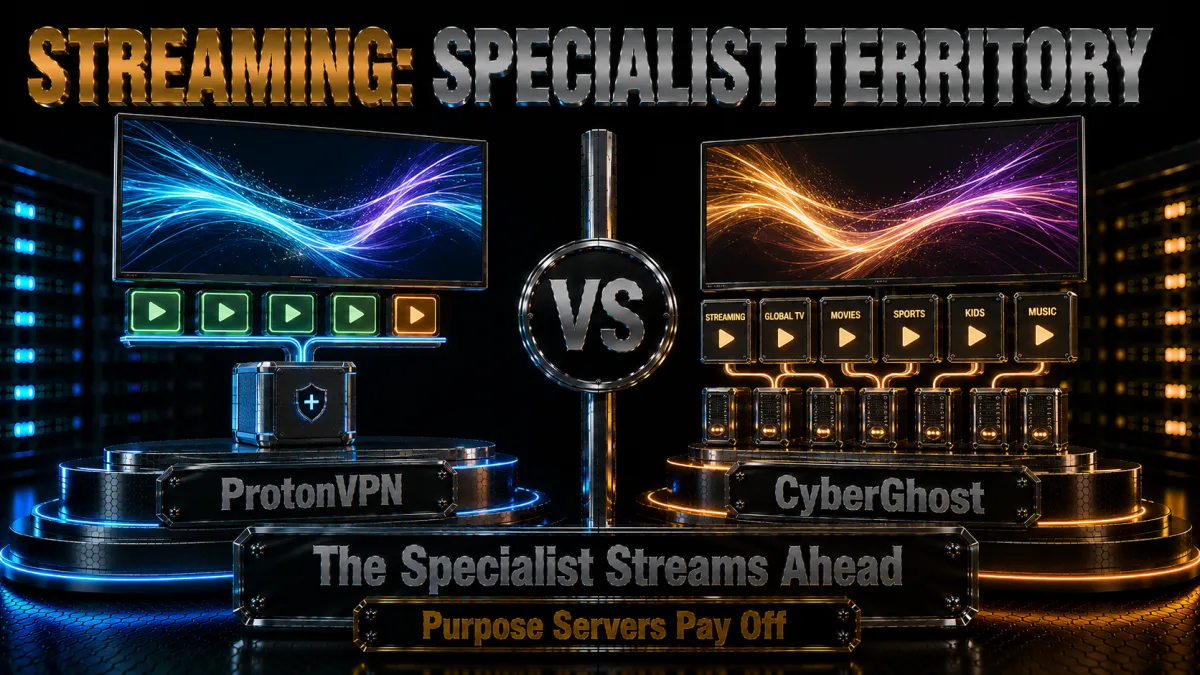
If your main reason for a VPN is unblocking Netflix, iPlayer, Disney+ and other libraries, this category may decide it for you. Streaming is one of the single most popular uses for a VPN, and it is an area where the two services take noticeably different approaches, so it is worth weighing carefully.
- CyberGhost’s dedicated streaming servers. CyberGhost labels servers for specific platforms and regions, so you can pick one made for, say, US Netflix or BBC iPlayer and connect with confidence. This takes the guesswork out of finding a server that actually works.
- Broad platform coverage. CyberGhost reliably unblocks a wide range of streaming services, which is a major reason it is so popular with streamers. From Netflix regions to iPlayer, ITVX and Disney+, it handles the big names smoothly.
- ProtonVPN also streams well. Proton unblocks the major services on its paid plans, though it does not have the same purpose-built, clearly labelled streaming servers. You may need to try a couple of standard servers to find one that works for a given platform.
- Free tier caveat. ProtonVPN’s free plan is not aimed at streaming, so you need a paid plan for reliable unblocking. The free tier is best thought of as a privacy and browsing tool rather than a streaming one.
Winner: CyberGhost. Its dedicated, clearly labelled streaming servers make unblocking simpler and more reliable, which is exactly what most streamers want. If watching region-locked content is your main reason for a VPN, this category alone may decide it.
Servers & Locations
A bigger, better-spread network means less congestion, more choice and easier access to regional content. It is one of the more measurable differences between the two, though as with speed, the headline number matters less than whether the specific locations you need are well covered.
- CyberGhost has the sheer numbers. It runs thousands of servers, one of the largest networks of any VPN, so finding a fast, uncongested option is easy. A large fleet also means popular locations are less likely to be overloaded at peak times.
- ProtonVPN has wide country coverage. Proton offers servers across a large number of countries, which is great for reaching many different regions. For travellers and expats, that breadth of locations is genuinely useful.
- Specialised servers on both. CyberGhost has streaming and gaming-optimised servers, while ProtonVPN has Secure Core and P2P-optimised servers. Each network is tuned around its strengths, streaming for one and privacy for the other.
- Location matters more than raw count. For most people, having a nearby server in the country they need beats a huge global total. Both services comfortably cover the locations the majority of users actually want.
Winner: CyberGhost on raw numbers and specialised servers, though ProtonVPN’s country coverage is more than enough for typical use and its specialised servers serve privacy better.
Features Compared
Beyond the basics, each VPN has standout features that suit different users. Both cover the essentials: a kill switch, DNS-leak protection and strong encryption. Where they differ is in the extras built on top, and those extras reveal what each company thinks its users care about most.
- ProtonVPN extras. Secure Core multi-hop, Tor over VPN, a genuinely usable free tier, open-source apps, and a strong focus on P2P and privacy tools. These are aimed squarely at users who take privacy seriously.
- CyberGhost extras. Dedicated streaming and gaming servers, NoSpy servers, an optional dedicated IP, automation rules, and a very beginner-friendly app. The theme here is convenience and entertainment rather than hardcore privacy.
- Both support many devices. Apps for Windows, macOS, iOS, Android, browsers and routers, with generous simultaneous connections. Whichever you choose, every device in your home can be covered.
- Both allow P2P. Torrenting is supported on each, though ProtonVPN’s privacy focus gives it a slight edge for cautious downloaders. CyberGhost makes it easy with clearly labelled P2P servers.
The pattern is consistent across the feature set: ProtonVPN’s extras are built around privacy and control, while CyberGhost’s are built around entertainment and ease. Neither is missing anything essential, so it comes down to which set of extras you will actually use.
ProtonVPN’s Free Tier: A Real Advantage
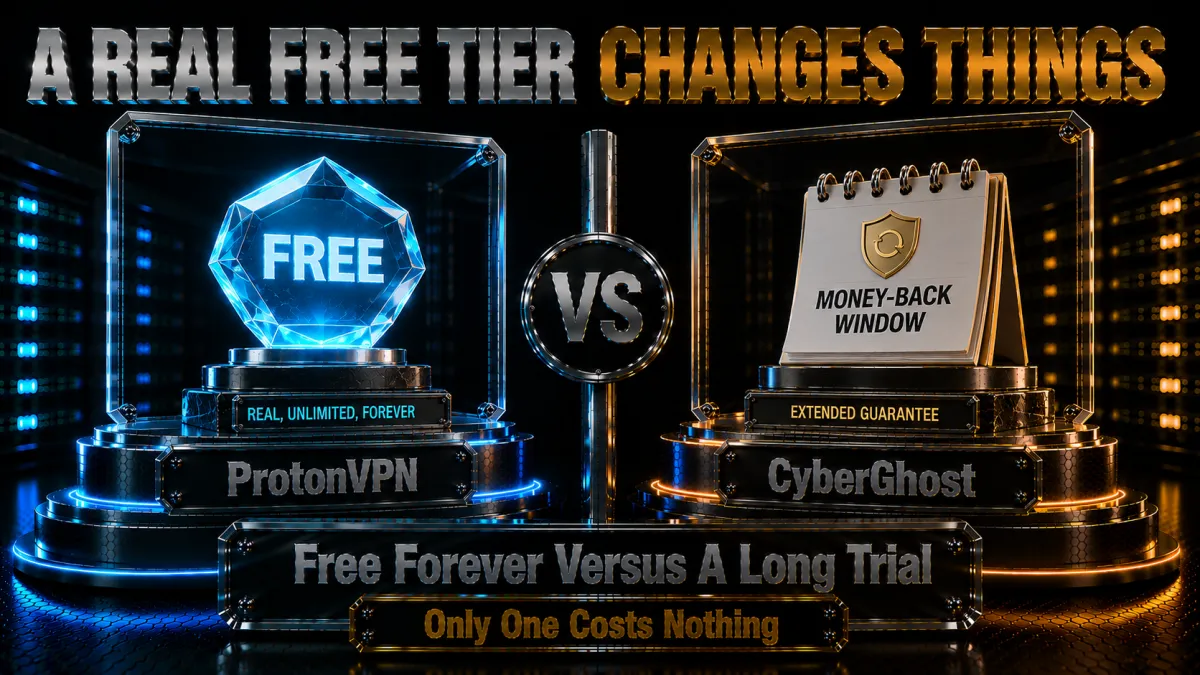
One of the biggest differences between these two is that ProtonVPN has a free plan and CyberGhost does not. It is worth understanding because Proton’s free tier is unusually good, and free VPNs in general have such a poor reputation that a trustworthy one genuinely stands out.
- Unlimited data. Unlike most free VPNs that cap your usage, ProtonVPN’s free plan does not limit how much data you use, which is genuinely rare. You can browse and use it every day without watching a data meter.
- No ads, no logs. The free tier keeps the same no-logs commitment and does not bombard you with adverts, so it is safe to rely on for basic privacy. Many free VPNs make money from your data, but Proton’s model does not.
- Fewer locations and features. The trade-off is a smaller choice of countries, lower priority speeds and no streaming focus, so heavy users will still want a paid plan. It is designed as a genuine free option, not a crippled trial.
- A safe way to test. Because it is from a trusted privacy company, the free tier is a low-risk way to try Proton before paying. If you like it, upgrading unlocks the full server list and streaming support.
CyberGhost counters with its 45-day money-back guarantee, which effectively works like an extended free trial, but if you want a genuinely free long-term option, only ProtonVPN offers it. For students, light users, or anyone who just wants basic privacy without a subscription, that free tier can be reason enough to choose Proton, even before considering its other strengths.
ProtonVPN vs CyberGhost for Gaming
Gamers care about low latency and stable connections more than raw download speed, and both VPNs can help, with some differences. A VPN will not lower your ping to a nearby server, but it can help you avoid ISP throttling, reach game servers in other regions, and protect against attacks in competitive play.
- CyberGhost has gaming servers. It offers servers labelled for gaming, which can make choosing a low-latency option simpler and takes the guesswork out of finding a responsive route.
- Both add some latency. Any VPN adds a little delay, so connect to a nearby server and use WireGuard to keep the impact small. For competitive play, the closest server is always the best choice.
- ProtonVPN is stable and fast. While it has no dedicated gaming servers, Proton’s fast protocol and VPN Accelerator keep gameplay smooth on nearby servers. Its stability means fewer mid-match disconnects.
- Use it to avoid throttling. Both can help if your provider throttles gaming traffic, and both let you play on regional servers when needed, which is useful for accessing games or lobbies in other regions.
For casual gaming either works well; CyberGhost’s labelled gaming servers give it a slight convenience edge, while ProtonVPN remains a solid, stable choice. Remember that no VPN will make a distant server feel local, so for the lowest possible ping you should always pick a nearby location, whichever service you use.
ProtonVPN vs CyberGhost for Torrenting
For private, safe torrenting, the priorities are P2P support, a reliable kill switch and a trustworthy no-logs policy. Both deliver, with Proton slightly ahead on peace of mind. Torrenting is one of the situations where a VPN’s privacy credentials matter most, so it is worth paying attention to more than just whether P2P is technically allowed.
- Both support P2P. Torrenting is allowed on each service, with CyberGhost offering P2P-optimised servers and ProtonVPN allowing it across its network. Neither forces you into workarounds to share files.
- Kill switch on both. Each includes a kill switch to stop your real IP leaking if the connection drops mid-download, which is essential during long torrent sessions when brief drops are most likely.
- ProtonVPN’s privacy edge. Its Swiss base, open-source apps and audits make it the more reassuring pick for cautious downloaders who want the strongest possible privacy guarantees.
- CyberGhost is convenient. Clearly labelled P2P servers make it easy to pick the right one and get downloading quickly, which suits users who value simplicity over maximum privacy.
Both are good torrenting VPNs. Choose ProtonVPN if maximum privacy is your priority, or CyberGhost if you value labelled, easy-to-pick servers. As always, torrent only legal content, and double-check the kill switch is enabled before you start a large download so a brief connection drop can never expose your real IP address.
Pricing: Which Costs Less?

Price is often the tie-breaker, and here the two take different approaches. One competes on the lowest possible paid price, while the other competes by offering a free option alongside its paid plans, so the better value genuinely depends on what you are looking for.
- CyberGhost is cheaper long-term. On its longest plan CyberGhost is one of the most affordable VPNs, which suits budget-focused users. The savings over a multi-year term are significant compared with most rivals.
- CyberGhost’s 45-day guarantee. Its money-back window is one of the longest in the industry, well beyond the usual 30 days, so you get more time to test it. That extra fortnight is handy for properly trying it across streaming and daily use.
- ProtonVPN costs more, but has a free tier. Proton’s paid plans are pricier, yet it is the only one of the two with a free plan that offers unlimited data, which is rare and genuinely useful. You can stay on free indefinitely or upgrade when you need more.
- Short plans cost more on both. As with every VPN, the big savings come from committing to a longer subscription. If you only need short-term cover, the monthly price is far less competitive on either.
Winner: CyberGhost for lowest long-term price and the longest refund window, though ProtonVPN’s free tier is a unique advantage if you want to pay nothing at all. Which counts as cheaper really depends on whether you value a free option or the lowest paid price.
Ease of Use & Support
How easy a VPN is to live with matters, especially if you are not technical.
- CyberGhost is beginner-friendly. Its app is clean and guided, with servers clearly labelled by purpose, which makes it very easy to just connect and go. New users rarely need to touch a setting beyond the connect button.
- ProtonVPN is powerful but clear. Proton’s apps expose more advanced privacy features while staying approachable, which power users appreciate. The extra options are there if you want them and easy to ignore if you do not.
- Both offer 24/7 support. Live chat and detailed help centres are available on each, so help is on hand whenever you need it. That round-the-clock cover is reassuring when you are setting things up.
- Both cover every platform. Setup is quick on phones, laptops and TVs, and both provide router guides for whole-home coverage. You will not be short of installation help on either service.
It is worth saying that neither app is hard to use. ProtonVPN has become far more polished over the years and is perfectly approachable for newcomers, while CyberGhost never feels dumbed down for those who want to dig deeper. The difference is one of emphasis rather than a gulf in quality.
Winner: CyberGhost by a nose for outright beginner-friendliness, though ProtonVPN is the better fit for users who want more control over their privacy settings.
ProtonVPN Scorecard
Our at-a-glance rating of ProtonVPN, the privacy-first pick, scored across the areas that matter most to a typical user.
ProtonVPN is the choice for privacy-focused users. Its Swiss base, open-source audited apps and Secure Core routing make it one of the most trustworthy VPNs available, and its free tier with unlimited data is genuinely useful. It streams well and runs fast, just without CyberGhost’s purpose-built streaming servers. If your top priority is knowing your VPN is as private and transparent as possible, ProtonVPN is very hard to beat, and the free tier means you can verify that for yourself before spending anything.
✔ Pros
- Swiss jurisdiction, open-source, audited
- Secure Core multi-hop routing
- Genuinely usable free tier
- Strong for P2P and privacy work
✘ Cons
- Pricier paid plans
- No dedicated streaming servers
| Jurisdiction | Switzerland |
| No-logs | Open-source, audited |
| Best feature | Secure Core + free tier |
| Money-back | 30 days |
CyberGhost Scorecard
Our at-a-glance rating of CyberGhost, the streaming-and-value pick.
CyberGhost is the choice for streamers and budget-focused users. Its thousands of servers include dedicated, clearly labelled streaming and gaming locations, it is very easy to use, and its 45-day money-back guarantee is the longest around. Privacy is solid too, though its Kape ownership means Proton edges it on pure pedigree. If your main goal is effortless streaming at a low price, CyberGhost delivers that better than almost anyone, and the long refund window makes it easy to try without risk.
✔ Pros
- Dedicated streaming and gaming servers
- Thousands of servers, easy to use
- 45-day money-back guarantee
- Audited no-logs, Romania jurisdiction
✘ Cons
- Owned by Kape Technologies
- No free tier
| Jurisdiction | Romania (EU) |
| No-logs | Audited (Deloitte) |
| Best feature | Streaming servers + 45-day refund |
| Money-back | 45 days |
Which Should You Choose?
Both are good VPNs, so the decision comes down to what you will actually use it for. There is no wrong answer here, only a better fit, and the two lists below make that fit obvious at a glance. Read the one that sounds most like you, and you have your answer.
Choose ProtonVPN if you:
- Prioritise privacy. You want the strongest jurisdiction, open-source audited apps and features like Secure Core, and you judge a VPN mainly on how well it protects you.
- Torrent or do sensitive work. Proton’s privacy focus makes it the safer choice for P2P, research and anything where anonymity really matters.
- Want a free option. You would like a genuinely usable free tier with unlimited data before paying, or you want to keep a free privacy tool on hand permanently.
Choose CyberGhost if you:
- Mainly stream. You want dedicated, labelled servers that make unblocking Netflix, iPlayer and others effortless, without hunting for one that works.
- Want the lowest price. CyberGhost is cheaper long-term and gives you 45 days to get a refund, which is the most generous window around.
- Prefer simplicity. You want a clean, guided app that just works without fiddling with settings, which is ideal if you are new to VPNs.
Head-to-Head Summary: Who Wins Each Round?
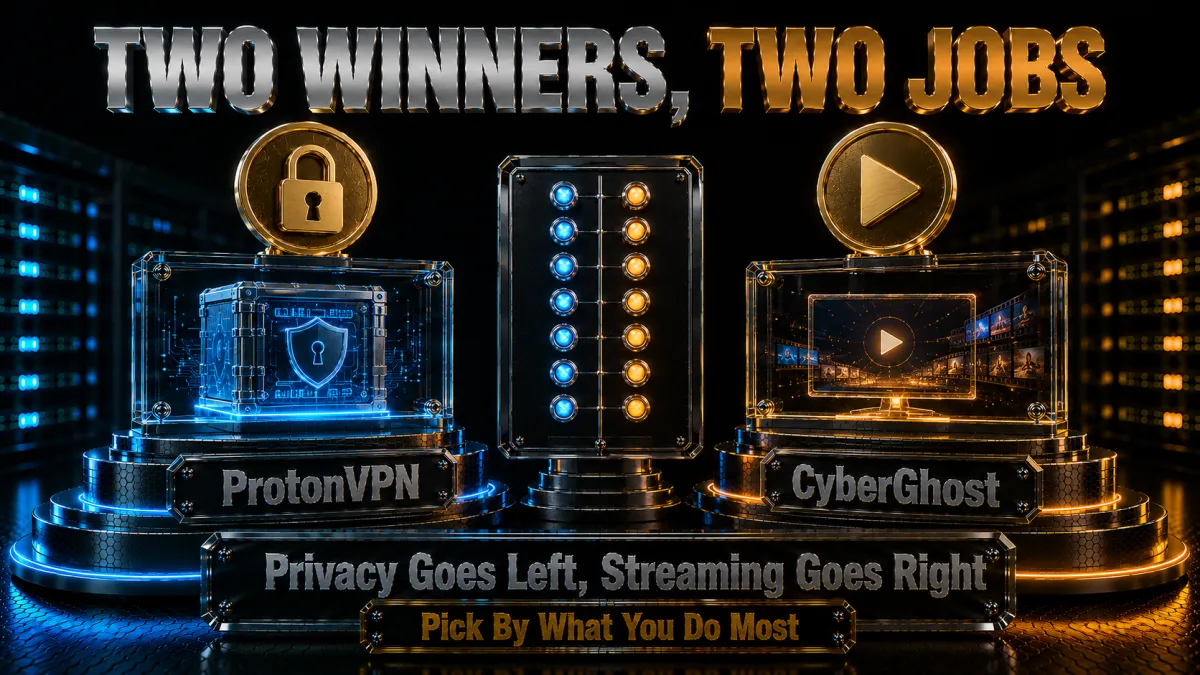
Pulling the categories together makes the picture clear. Neither VPN sweeps every round, which is exactly why the right choice depends on you. Rather than declaring a single overall winner, it is far more useful to see who wins each individual category, so you can weight the ones that matter to you.
- Privacy and security: ProtonVPN, thanks to Switzerland, open-source apps and its audit record.
- Speed: a tie, with both fast on WireGuard for everyday use.
- Streaming: CyberGhost, for its dedicated, labelled streaming servers.
- Servers: CyberGhost on raw numbers and specialised locations.
- Free tier: ProtonVPN, the only one that offers one.
- Price and refund: CyberGhost, cheaper long-term with a 45-day guarantee.
- Ease of use: CyberGhost, slightly, for beginners.
So CyberGhost takes more individual rounds on streaming, price and convenience, while ProtonVPN wins the rounds that matter most for privacy. If you tally them by importance rather than count, a privacy-focused user will still lean Proton, and an entertainment-focused user will still lean CyberGhost. That is the honest bottom line: there is no single winner, only the right winner for your priorities. The good news is that because both are genuinely capable, you are not choosing between a good option and a bad one, so whichever way you lean you will end up with a solid, well-audited VPN that does its core job properly. If you truly cannot decide, default to your most frequent use: if you stream more than anything else, take CyberGhost, and if privacy is the reason you are here at all, take ProtonVPN.
Our Top Overall VPN Picks
ProtonVPN and CyberGhost are both strong, but if you want the very best all-round performance without having to choose between privacy and streaming, these three lead our rankings. Each one blends the strengths that Proton and CyberGhost split between them, which is why they consistently top our lists. All have audited no-logs policies and a 30-day money-back guarantee.
1. NordVPN, Best Overall
NordVPN is the strongest all-round choice, blending the fast NordLynx protocol, an independently audited no-logs policy, excellent streaming and a clean record. It matches CyberGhost on streaming and rivals ProtonVPN on privacy, which is why it tops our list. For anyone who does not want to compromise on either privacy or streaming, it is the safest single pick.
✔ Pros
- Independently audited no-logs
- Fast NordLynx (WireGuard) protocol
- Excellent streaming and reliability
- Threat Protection blocks trackers
✘ Cons
- Price rises at renewal
- No free tier
| Price from | ~$3.39/mo (long plan) |
| No-logs | Independently audited |
| Best feature | Speed + streaming |
| Money-back | 30 days |
2. ExpressVPN, Most Proven
ExpressVPN is the pick for users who value a long, proven track record. Its Network Lock kill switch is among the best, its Lightway protocol is fast and stable, and RAM-only TrustedServer technology means nothing is written to disk. Pricier, but rock-solid. If dependability and a spotless history are what you care about most, ExpressVPN rarely puts a foot wrong.
✔ Pros
- Rock-solid Network Lock kill switch
- RAM-only TrustedServer infrastructure
- Consistent, reliable streaming
- Very easy apps on all platforms
✘ Cons
- Most expensive of the three
- Fewer simultaneous connections
| Price from | ~$4.99/mo (long plan) |
| No-logs | Audited + RAM-only |
| Best feature | Reliability + kill switch |
| Money-back | 30 days |
3. Surfshark, Best Value
Surfshark combines the value of CyberGhost with a cleaner record and strong all-round polish. It allows unlimited simultaneous devices, runs fast WireGuard speeds, keeps an audited no-logs policy on RAM-only servers, and costs very little on longer plans. If you like CyberGhost’s low price but want a provider without the Kape connection, Surfshark is the natural alternative.
✔ Pros
- Unlimited simultaneous connections
- Audited no-logs, RAM-only servers
- Reliable streaming and WireGuard speeds
- Excellent price on longer plans
✘ Cons
- Speeds slightly behind the top two
- Short plan is comparatively pricey
| Price from | ~$2.19/mo (long plan) |
| No-logs | Audited + RAM-only |
| Best feature | Unlimited devices + value |
| Money-back | 30 days |
Related reading:
Frequently Asked Questions
Is ProtonVPN or CyberGhost better?
It depends on your priority. ProtonVPN is better for privacy, security and P2P thanks to its Swiss base and open-source audited apps. CyberGhost is better for streaming and value, with dedicated streaming servers and a 45-day money-back guarantee. Both are good; choose based on what you will use it for.
Which is more private, ProtonVPN or CyberGhost?
ProtonVPN. Its Switzerland jurisdiction, open-source apps and independent audits give it the stronger privacy profile. CyberGhost is also audited and based in privacy-friendly Romania, but its ownership by Kape Technologies means Proton edges it on pedigree.
Which is better for streaming, ProtonVPN or CyberGhost?
CyberGhost. It offers dedicated, clearly labelled streaming servers for specific platforms and regions, which makes unblocking Netflix, iPlayer, Disney+ and others simple and reliable. ProtonVPN streams well on paid plans but lacks the same purpose-built servers.
Does ProtonVPN or CyberGhost have a free version?
ProtonVPN has a genuinely usable free tier with unlimited data, which is rare among reputable VPNs. CyberGhost does not offer a free plan, but it does have a long 45-day money-back guarantee so you can try it risk-free.
Which is cheaper, ProtonVPN or CyberGhost?
CyberGhost is cheaper on its longest plan and offers a longer 45-day refund window. ProtonVPN’s paid plans cost more, but it is the only one of the two with a free tier if you want to pay nothing at all.
Are ProtonVPN and CyberGhost safe to use?
Yes, both are safe, reputable VPNs with audited no-logs policies, strong encryption and kill switches. ProtonVPN has the stronger privacy pedigree, while CyberGhost is a well-established, independently audited service based in the EU.
Can I use ProtonVPN or CyberGhost for torrenting?
Both support P2P traffic and include a kill switch to protect your IP. ProtonVPN’s privacy-first design gives it a slight edge for cautious downloaders, but CyberGhost also offers P2P-optimised servers. Use either only for legal file sharing.
Is there a better VPN than both ProtonVPN and CyberGhost?
For all-round performance, NordVPN, ExpressVPN and Surfshark lead our rankings, combining strong privacy, fast speeds and reliable streaming. They cost a little more than CyberGhost but offer the most complete overall experience.
How many devices can each VPN cover?
Both ProtonVPN and CyberGhost allow generous simultaneous connections, enough for a typical household. If you need to cover unlimited devices on one plan, Surfshark is the standout option among our top picks.
Where is ProtonVPN based, and why does it matter?
ProtonVPN is based in Switzerland, a country with some of the strongest privacy laws in the world and no membership of the major intelligence-sharing alliances. This matters because it reduces the legal pressure a provider can face to collect or hand over user data, which is a big part of why Proton is trusted for privacy.
Who owns CyberGhost?
CyberGhost is owned by Kape Technologies, which also owns several other VPNs. Under a former name, Kape once distributed adware, though CyberGhost today is a separate, independently audited product based in Romania. If corporate history is important to you, ProtonVPN’s privacy-first pedigree has the edge.
Does ProtonVPN or CyberGhost have more servers?
CyberGhost has the larger raw network, with thousands of servers including many optimised for streaming and gaming. ProtonVPN covers a wide range of countries with specialised Secure Core and P2P servers. For most people, having a fast nearby server matters more than the total count.
Which VPN is easier to use for beginners?
CyberGhost is slightly easier for beginners, thanks to a clean, guided app and servers clearly labelled by purpose. ProtonVPN is also approachable but exposes more advanced privacy settings, which power users will appreciate and beginners can simply ignore.
Do ProtonVPN and CyberGhost work on smart TVs and routers?
Yes. Both offer apps for the main platforms and support router setup, so you can protect a smart TV, console or your whole home network. CyberGhost’s labelled servers make choosing a streaming location on a TV especially simple.
Can I try both VPNs risk-free?
Yes. ProtonVPN offers a free tier plus a 30-day money-back guarantee on paid plans, while CyberGhost offers a 45-day money-back guarantee. Between them you have plenty of ways to test each service with your own needs before committing.
The Bottom Line
ProtonVPN and CyberGhost are both excellent, but they are built for different people. The right pick comes down to a single question: is privacy or streaming your main goal? Answer that honestly and the decision almost makes itself, because each VPN is clearly stronger in one of those two areas.
In short:
- Choose ProtonVPN for the strongest privacy, open-source audited apps, Secure Core and a genuinely usable free tier.
- Choose CyberGhost for the best streaming experience, thousands of servers, the lowest long-term price and a 45-day refund.
- Choose NordVPN, ExpressVPN or Surfshark if you want the best all-round VPN overall.
Whichever you lean towards, use the money-back guarantee to test it with your own needs first. Both ProtonVPN and CyberGhost will serve you well; the winner is simply the one that matches how you actually use a VPN. And if you would rather not compromise on any single area, one of our top three overall picks will give you privacy, speed and streaming in a single package, which is why we recommend starting there if you are unsure.
Jyoti VPN Expert leads VPN testing at VPN Expert Guide, covering streaming and regional access, speed and latency testing, and leak checks on Windows, Android and router-level setups. Our guides are built from vendor documentation, provider terms and our own connection testing on a residential line in India, and we publish those measurements in full so readers can check them. Every guide is reviewed before publication and dated so you can see how current it is.
Meet our testing team →Last updated: August 24, 2026