
What Is the IKEv2 Protocol? The Mobile VPN Veteran, Explained Honestly
Before WireGuard took the headlines, IKEv2 was the protocol your phone wanted: quick to connect, graceful when networks changed, and natively supported on Apple devices like nothing else. It still carries millions of VPN connections daily, which makes the it-is-obsolete takes as wrong as marketing that hides its trade-offs. This guide explains what IKEv2 actually is, why it earned the mobile crown, how it honestly compares against WireGuard and OpenVPN, and which providers give the best protocol lineup.
What IKEv2 actually is
The definition, and the division of labour that confuses everyone at first.
- It is the negotiator, not the whole tunnel. IKEv2 is a key-exchange protocol: it authenticates the two ends, agrees the cryptographic parameters, and establishes the security associations, the shared secrets and rules, that the connection will use. The heavy lifting of encrypting your actual traffic then belongs to IPsec, running in the operating system’s network stack. That pairing is why the honest full name is IKEv2/IPsec, and why calling IKEv2 a VPN protocol is shorthand rather than error.
- A standards-body veteran. IKEv2 was standardised in 2005 by the IETF as a ground-up redesign of the tangled IKEv1, cutting the negotiation from many round trips to a handful and removing whole categories of configuration ambiguity. Two decades of deployment across corporate networks, operating systems, and consumer VPNs have given it a maturity record few protocols can match.
- Built into the platforms you already own. Apple’s systems and Windows ship native IKEv2 support, no third-party tunnel driver required, which historically made it the smoothest protocol to deploy on iPhones, iPads, Macs, and corporate Windows fleets. Native support still matters today for managed devices and app-less configurations.
- Configurable cryptography, competently modern. Unlike WireGuard‘s fixed suite, IKEv2/IPsec negotiates its algorithms, and modern deployments settle on strong contemporary choices like AES-GCM with robust key exchange groups. The flexibility is a feature for enterprises and a responsibility for implementers, a theme the comparison sections return to.
How IKEv2 works, in plain language

Four moving parts explain the experience it delivers.
- A two-phase handshake that hurries. The initial exchange establishes a secure channel and authenticates both ends, then a second, quicker exchange creates the child associations that carry traffic. The design compresses what IKEv1 spread across slow negotiation modes into a handful of messages, which is why IKEv2 connections establish noticeably fast, a property users feel every time the VPN toggles on.
- MOBIKE is the mobility trick that made its name. The Mobility and Multihoming extension lets an established session change its underlying IP address without renegotiating from scratch. In practice: your phone walks out of Wi-Fi range, jumps to cellular, and the VPN session simply continues rather than dying and rebuilding. For the smartphone era that arrived right after IKEv2 did, this was the killer feature.
- Certificates and EAP handle identity. IKEv2 authenticates with certificates or EAP methods, the same machinery enterprises use for managed identity, which is part of why corporate VPNs adopted it deeply. Consumer VPN apps hide all of this behind a login screen, but the enterprise-grade skeleton is what their connection stands on.
- Dead peer detection keeps sessions honest. The protocol periodically verifies the other end is still alive and tears down dead sessions cleanly, avoiding the zombie-tunnel states that plagued older setups. Combined with fast re-establishment, the practical result is a connection that recovers from trouble quickly and quietly.
IKEv1 vs IKEv2: why the redesign mattered
The version number carries real history worth two minutes.
- IKEv1 worked, and sprawled. The 1998 original established the IPsec key-exchange idea but accumulated modes, options, and ambiguities that made implementations complex and interoperability painful. Security reviews repeatedly flagged the complexity itself as the risk: not broken cryptography, but a design with too many corners for bugs to hide in.
- Version 2 was a genuine rewrite. IKEv2 collapsed the negotiation into fewer messages, defined behaviour precisely where v1 left room for interpretation, added built-in NAT traversal for the home-router world, and folded in liveness checks and mobility. It is the rare version-two that is simpler than version one, and the industry migrated accordingly.
- IKEv1 today is a legacy flag. Two decades on, v1 survives mainly in old corporate hardware, and its presence in any modern product is a sign of neglect rather than choice. Consumer VPNs among our picks run v2 exclusively for IPsec-family connections, and this page uses IKEv2 to mean exactly that.
- The lesson echoes into the WireGuard era. The v1-to-v2 story, complexity is itself a vulnerability, is the same argument WireGuard later made against the entire stack. Understanding that lineage makes the modern protocol landscape feel less like fashion and more like one long editing process.
The mobile story: where IKEv2 earned its crown

Its defining strength deserves its own honest section.
- Network hopping without tears. MOBIKE’s seamless address changes meant IKEv2 sessions survived the Wi-Fi-to-cellular dance that kills naive tunnels, which for commuting, travelling phone users was the difference between a VPN they kept on and one they turned off. This single property drove a decade of it-is-best-for-mobile advice, and the advice was correct.
- Fast reconnects fit phone rhythms. Phones sleep, wake, and switch constantly, and IKEv2’s quick handshake made each recovery near-instant. Battery costs stayed reasonable because the protocol is not chatty at idle, another fit for pocket hardware.
- Native Apple support removed friction. iOS and macOS speak IKEv2 without extra tunnel drivers, so VPN profiles and apps could use the platform’s own machinery, historically smoother and more stable than third-party network extensions. Managed corporate iPhones still lean on this today.
- WireGuard then matched the act. Seamless roaming is native to WireGuard’s design rather than an extension, its reconnects are as fast or faster, and its efficiency suits batteries at least as well. The mobile crown is now shared at minimum, which is the honest 2026 framing: IKEv2 remains excellent on phones; it is simply no longer alone.
IKEv2 vs WireGuard: the 2026 comparison
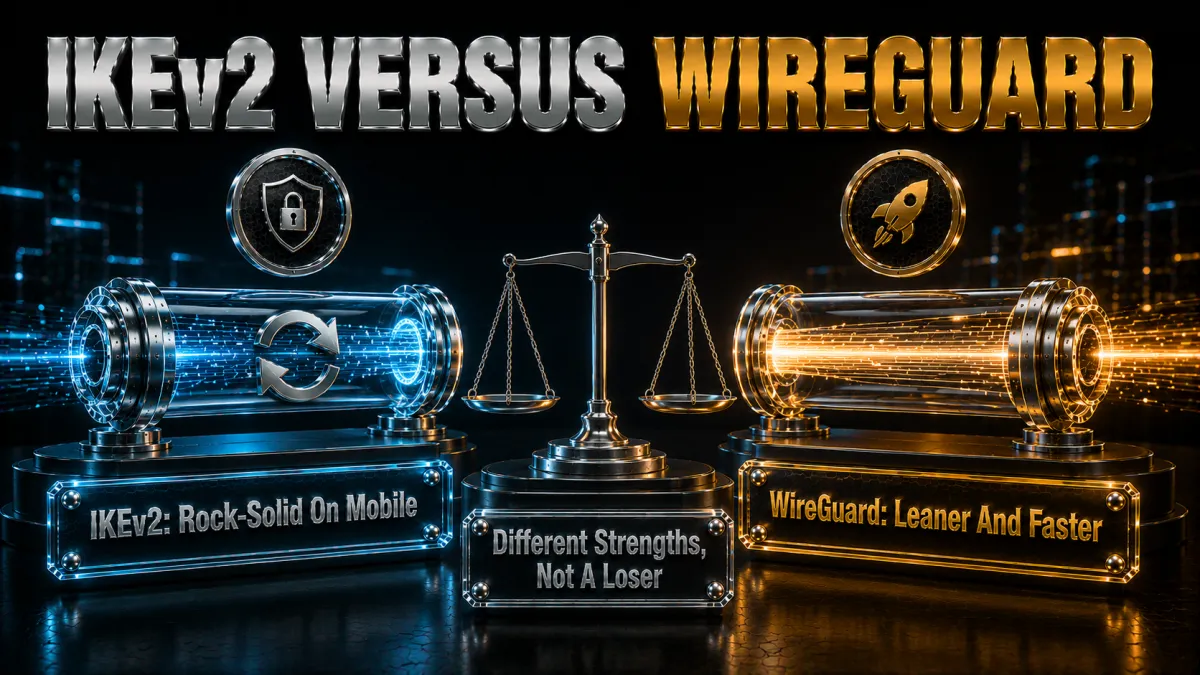
The question most readers arrived with, answered without loyalty.
- Complexity is the deepest difference. IKEv2/IPsec is a capable system with many parts: negotiation phases, cipher menus, the IPsec stack beneath. WireGuard is a few thousand lines with one fixed suite. Both can be deployed securely; one is far easier to audit fully and far harder to misconfigure, and that asymmetry is the core of the modern preference.
- Speed favours WireGuard, modestly to clearly. On phones the real-world gap is often modest, since both connect fast and roam well; on routers, older hardware, and fast lines the lean packet path pulls ahead visibly. IKEv2 with hardware-accelerated AES remains quick, and nothing about it is slow in absolute terms.
- Roaming is a draw in practice. MOBIKE versus WireGuard’s built-in roaming both deliver the seamless-switch experience; neither side wins anything a user would notice. This category, once IKEv2’s exclusive, is the clearest measure of how the newer design absorbed the older one’s lessons.
- Blocking resistance: neither, honestly. Both are recognisable to inspecting networks, IKEv2 on its well-known ports and WireGuard by its UDP signature, and both fall to firewalls that whitelist only web traffic. The escape hatch remains OpenVPN TCP or provider obfuscation in either case, so this is a shared limitation rather than a differentiator.
- The practical verdict. Where an app offers both, WireGuard is the better default for simplicity and ceiling; where a platform, workplace, or app speaks IKEv2 natively, using it is entirely sound. This is choosing between two good answers, and our WireGuard guide covers the other side of the coin in equal depth.
IKEv2 vs OpenVPN: the older rivalry
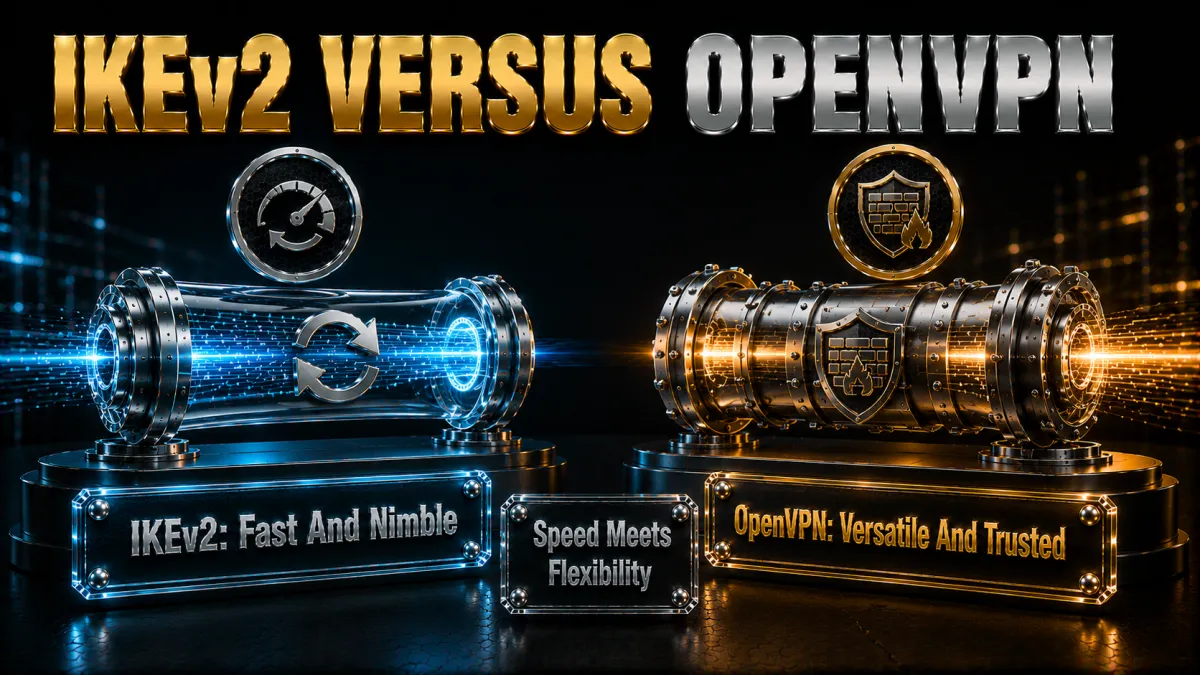
The comparison that dominated VPN menus for a decade, updated.
- Speed and connection feel favour IKEv2. OpenVPN’s user-space design and heavier handshake make it slower to connect and slower in throughput than IKEv2 on the same hardware, a gap users notice most at connection time. For daily driving on friendly networks, IKEv2 was and remains the quicker experience of the two.
- Firewall traversal favours OpenVPN decisively. OpenVPN over TCP port 443 wears the costume of ordinary HTTPS and passes restrictive networks that block IKEv2’s well-known UDP ports outright. Hotels, campuses, and stricter environments are exactly where IKEv2 connections mysteriously fail and the OpenVPN fallback quietly succeeds.
- Both carry mature security records. Decades of audits, enterprise deployment, and academic attention back each; competent modern configurations of either are sound. The risks live in sloppy deployments, ancient cipher choices, or unpatched implementations, not in the protocols’ designs.
- Their 2026 roles have settled. IKEv2 serves as the fast native option, particularly on Apple platforms; OpenVPN serves as the get-through-anything gear. Modern apps carrying WireGuard, IKEv2, and OpenVPN are offering exactly that division of labour, with automatic modes choosing sensibly.
How to choose a VPN with the right protocol lineup
The IKEv2 question folds into a broader, more useful one.
- Lineup over loyalty. The best provider is not the one shouting a protocol name but the one carrying a modern default, WireGuard-class, plus IKEv2 where platforms favour it, plus an OpenVPN or obfuscated fallback for hostile networks, with automatic selection that spares you the menu. All five picks below meet that bar in their own configurations.
- Implementation quality still decides. A protocol menu means little without the surrounding engineering: kill switch, DNS handling, leak sealing, and audited no-logs policies apply identically whichever protocol carries packets. Our leak-testing guide’s one-minute suite validates any choice you make here.
- Platform fit matters at the margins. Apple-centric households benefit from strong IKEv2 support; router-heavy homes want WireGuard’s efficiency; travellers need the obfuscated gear. Map your actual devices and networks before weighting any single protocol heavily.
- Refund windows make protocol shopping free. Thirty to forty-five days is ample time to test each protocol on your real networks, timing connections and running speed tests as our slow-VPN guide walks. Buy the lineup, keep what your own hardware proves.
The 5 best VPNs by protocol lineup in 2026

Ranked for complete, well-implemented protocol lineups: modern default, IKEv2 availability, hostile-network fallback, audits, and value.
1. NordVPN – Best overall lineup
NordVPN’s lineup covers the whole division of labour this page described: NordLynx as the fast daily default, OpenVPN in UDP and TCP for networks that fight back, and IPsec-family support where Apple platforms favour it, all behind an automatic mode that picks sensibly. Connection quality and reconnect speed sit at the top of the market.
Multiple independent no-logs audits on RAM-only servers make it the most verified home for whichever protocol carries your packets, and the leak protection seals every one of them identically.
✔ Pros
- Complete modern lineup with smart auto-select
- NordLynx leads on speed
- OpenVPN TCP fallback for hostile networks
- Multiple independent no-logs audits
- Identical leak sealing across protocols
✘ Cons
- Denser settings than minimalist apps
- Best price needs a longer plan
| Modern default | NordLynx (WireGuard-class) |
| OpenVPN fallback | Yes, UDP and TCP |
| Audited no-logs | Yes, multiple audits |
| Jurisdiction | Panama |
| Devices | 10 |
| Money-back | 30 days |
2. ExpressVPN – Lightway-first, fallback-smart
ExpressVPN simplified its lineup around Lightway, its own open-sourced WireGuard-class protocol, with OpenVPN retained as the fallback and automatic obfuscation handling the networks that block VPNs outright. The result trades menu length for a curated set that covers the same roles with fewer decisions.
Mobile roaming and reconnects, IKEv2’s historical strengths, are handled natively by Lightway’s design, and the RAM-only, audited infrastructure carries the trust side at the familiar premium price.
✔ Pros
- Lightway covers the modern-default role excellently
- Best hostile-network behaviour of the five
- Automatic obfuscation built in
- RAM-only fleet, audited no-logs
- Seamless mobile roaming
✘ Cons
- Shortest protocol menu here
- Most expensive of the five
| Modern default | Lightway |
| OpenVPN fallback | Yes, plus obfuscation |
| Audited no-logs | Yes, audited |
| Jurisdiction | British Virgin Islands |
| Devices | 8 |
| Money-back | 30 days |
3. Surfshark – The full menu for less
Surfshark carries the classic three-protocol menu, WireGuard default, IKEv2, and OpenVPN, across unlimited devices at the lowest long-term price of the five. Apple users who prefer the native IKEv2 path get it here without climbing the price ladder, and the audited no-logs policy holds the floor.
Honest placement: peak speeds and app polish sit a step behind the top two, and the Netherlands base is inside the EU. As protocol flexibility per rupee, nothing here competes.
✔ Pros
- WireGuard, IKEv2, and OpenVPN all offered
- Unlimited simultaneous devices
- Lowest long-term price of the five
- Audited no-logs policy
- IKEv2 available for Apple-native preference
✘ Cons
- Peak speeds behind the top two
- Netherlands base, inside the EU
| Modern default | WireGuard |
| OpenVPN fallback | Yes, plus IKEv2 |
| Audited no-logs | Yes, audited |
| Jurisdiction | Netherlands |
| Devices | Unlimited |
| Money-back | 30 days |
4. CyberGhost – Protocols chosen for you, gently
CyberGhost offers WireGuard, IKEv2, and OpenVPN with an automatic mode that makes the choice invisible, wrapped in the plainest-language apps of the five and one of the market’s largest server networks. The protocols work; the user never meets their names unless curious.
The 45-day money-back guarantee remains the longest protocol-testing window anywhere: six weeks to try each option on your real networks. Speeds rank good rather than leading, and power users will find fewer dials than NordVPN offers.
✔ Pros
- Full menu behind automatic selection
- 45-day refund, longest here
- Plainest-language apps of the five
- Audited no-logs with transparency reports
- Huge server network
✘ Cons
- Lighter advanced protocol controls
- Speeds good rather than leading
| Modern default | WireGuard |
| OpenVPN fallback | Yes, plus IKEv2 |
| Audited no-logs | Yes, audited |
| Jurisdiction | Romania |
| Devices | 7 |
| Money-back | 45 days |
5. IPVanish – Three protocols, unlimited screens
IPVanish rounds out the list with WireGuard, IKEv2, and OpenVPN across unlimited simultaneous connections at a fair price, delivering the brisk sustained speeds its badge promises whichever protocol you pick. The IKEv2 option serves Apple-native preferences on the budget tier.
Fifth for the standing reasons: US jurisdiction and a lighter independent audit history than the four above. The protocol menu is complete; the verification behind the no-logs promise is where the leaders pull ahead.
✔ Pros
- WireGuard, IKEv2, and OpenVPN offered
- Brisk speeds on all of them
- Unlimited simultaneous connections
- Fair pricing
- Kill switch and leak protection included
✘ Cons
- US jurisdiction
- Lighter audit history than the leaders
| Modern default | WireGuard |
| OpenVPN fallback | Yes, plus IKEv2 |
| Audited no-logs | Policy in place, lighter audit history |
| Jurisdiction | United States |
| Devices | Unlimited |
| Money-back | 30 days |
| Feature | NordVPN | ExpressVPN | Surfshark | CyberGhost | IPVanish |
|---|---|---|---|---|---|
| Modern default | NordLynx | Lightway | WireGuard | WireGuard | WireGuard |
| IKEv2 offered | Apple platforms | No | Yes | Yes | Yes |
| Hostile-network gear | OpenVPN TCP | Auto obfuscation | OpenVPN | OpenVPN | OpenVPN |
| Audited no-logs | Multiple audits | Audited | Audited | Audited | Lighter history |
| Devices | 10 | 8 | Unlimited | 7 | Unlimited |
| Money-back | 30 days | 30 days | 30 days | 45 days | 30 days |
How to use IKEv2 in practice
The concrete steps, app-based and native.
- In a VPN app, open protocol settings. Providers offering IKEv2, Surfshark, CyberGhost, and IPVanish among our picks, list it under Protocol alongside WireGuard and OpenVPN. Selecting it and reconnecting is the entire operation; nothing else changes.
- Compare it against the modern default. Time the connection, run a speed test against your baseline, and hop between Wi-Fi and mobile data to feel the roaming. On many phones IKEv2 and WireGuard feel nearly identical, which is itself useful knowledge: it means either choice is safe.
- Know the native-profile route exists. Apple and Windows can run IKEv2 connections without any app, via configuration profiles pointing at a server, which is how managed corporate devices often work. Consumer providers mostly steer users to apps because apps add the kill switch and leak protections the bare profile lacks.
- Keep the fallback in mind. If an IKEv2 connection fails on hotel or campus Wi-Fi, the network is likely blocking its ports; switch to OpenVPN TCP or the provider’s obfuscated mode rather than fighting. This is the division of labour working, not the protocol failing.
- Seal and verify like always. Kill switch on, then the one-minute leak suite from our leak guide: IP, DNS, WebRTC, IPv6. Protocol choice changes none of these obligations, and a sealed IKEv2 tunnel beats a leaky anything.
Is IKEv2 secure? The honest assessment
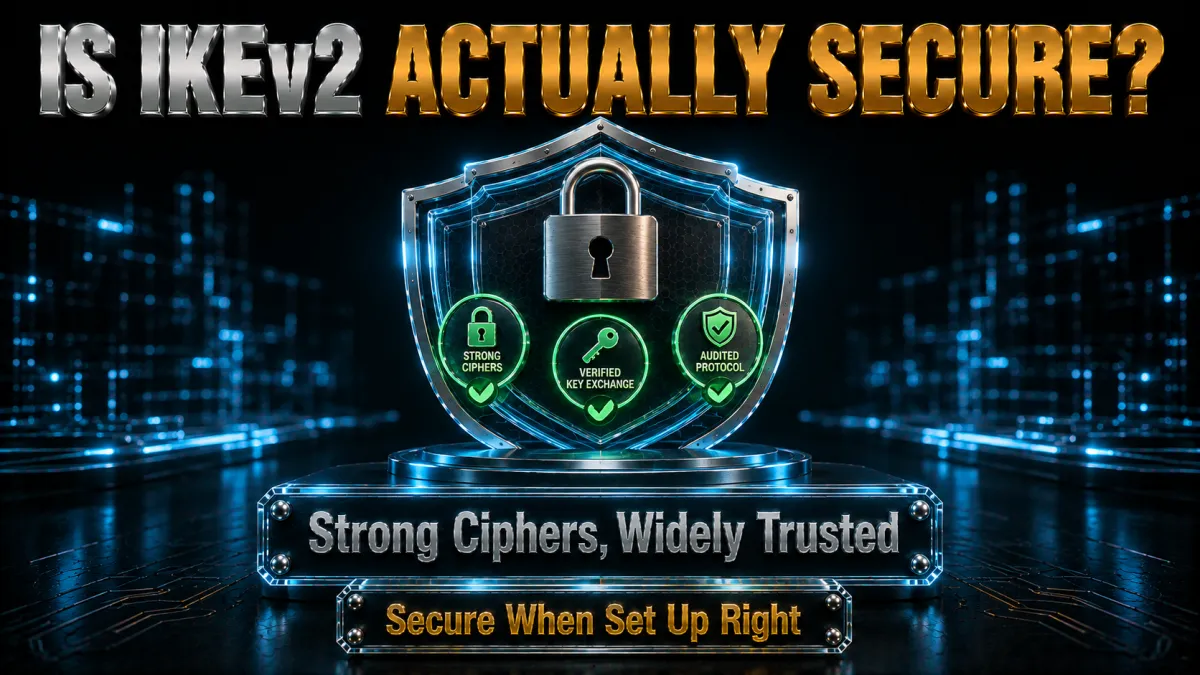
The record, the caveats, and the sentence that summarises both.
- The design is sound and battle-tested. Two decades of enterprise deployment, IETF standardisation, and academic scrutiny have validated IKEv2’s architecture; competently configured with modern ciphers, it protects traffic to contemporary standards. No practical break of a well-configured IKEv2/IPsec deployment is publicly known.
- Configuration is where risk lives. The cipher-menu flexibility that suits enterprises means bad deployments can negotiate weak options, and the IPsec stack’s complexity has historically hidden implementation bugs across vendors. Consumer users inherit whatever their provider configured, which is why provider quality and audits matter more than the protocol name.
- Historical disclosures deserve honest framing. Leaked intelligence documents from the mid-2010s prompted questions about IPsec-family deployments, with follow-up research pointing at weak pre-shared keys and legacy IKEv1 modes rather than breaks of well-configured IKEv2. The episode’s real lesson is the one this page keeps repeating: configuration and implementation quality decide.
- The summary sentence. IKEv2 through a reputable, audited provider with modern settings is a secure choice in 2026; IKEv2 as a checkbox on a careless service is as risky as everything else about that service. Judge the deployment, not the acronym.
IKEv2’s honest limitations

The fair account of where it gives ground.
- Recognisable and blockable. IKEv2 runs on well-known UDP ports that restrictive firewalls block trivially, and it carries no disguise mode. Networks permitting only web traffic defeat it completely, the shared weakness with WireGuard that keeps OpenVPN TCP employed.
- Complexity beneath the surface. The IPsec machinery under IKEv2 is far larger than WireGuard’s few thousand lines, making full audits harder and implementation bugs statistically likelier across the ecosystem. This is the structural argument for the newer design, and it applies regardless of how good any single deployment is.
- Cipher agility cuts both ways. Negotiable cryptography lets deployments modernise without protocol changes, and lets careless ones run weak options invisibly. Fixed-suite designs traded that flexibility away specifically to remove the failure mode.
- Momentum has moved. Development energy, new features, and default slots across the industry now flow to WireGuard-class protocols, leaving IKEv2 in maintained-veteran status. Nothing breaks tomorrow, but the direction of travel is worth knowing when making long-term choices.
- None of this dents the daily case. Through a good provider on friendly networks, IKEv2 remains fast, stable, and secure, and Apple-native scenarios still favour it. The limitations define its edges, not its centre.
Common misunderstandings about IKEv2
Five corrections worth carrying out of this page.
- IKEv2 is obsolete. It is a maintained, widely deployed, secure veteran that lost the default slot, not its soundness. Obsolete describes IKEv1; IKEv2 describes millions of healthy daily connections.
- IKEv2 encrypts my traffic. Strictly, IKEv2 negotiates and IPsec encrypts; the pair does the job together. The distinction matters when reading security discussions, where the two components are analysed separately.
- It is only for iPhones. The Apple association reflects native support, but IKEv2 runs on Windows, Android, and routers throughout the enterprise world. The mobile crown story explains the reputation; the deployment reality is far broader.
- Newer always beats it. On phones especially, well-implemented IKEv2 and WireGuard feel nearly identical, and platform-native scenarios can favour the veteran. The preference for modern defaults is about simplicity and ceiling, not about IKEv2 failing.
- Protocol choice is the security decision. Provider quality, audits, kill switches, and leak sealing decide far more than the acronym in the settings menu. Choose the deployment first; the protocol menu is the last mile.
Where IKEv2 goes from here
The trajectory, read without drama.
- Long maintained life ahead. Enterprise IPsec infrastructure, platform-native support, and managed-device ecosystems guarantee IKEv2 relevance for years; standards this deeply embedded retire slowly and gracefully. Expect maintenance and modernised cipher defaults rather than new frontiers.
- Consumer menus will keep shortening. As WireGuard-class defaults satisfy more users, some consumer apps will trim IKEv2 from their menus as ExpressVPN already did. Its consumer presence will increasingly be the Apple-native and compatibility option rather than a headline.
- The corporate world moves slower, deliberately. Managed fleets, compliance requirements, and existing IPsec investments keep IKEv2 central in enterprise VPNs, where its identity machinery fits established infrastructure. That world’s timescales are measured in refresh cycles, not release notes.
- For buyers today, the advice is stable. Choose providers with complete lineups and audited implementations, use the modern default, and treat IKEv2 as the respectable alternative it is. That posture survives every version of the protocol future.
Frequently Asked Questions
What is IKEv2 in simple terms?
IKEv2 is the negotiation half of a VPN connection: it authenticates your device and the server, agrees the encryption rules, and sets up the secure session, which the IPsec machinery then uses to encrypt your actual traffic. The pair, written IKEv2/IPsec, delivers fast connections and famously smooth survival of network switches on phones.
Is IKEv2 still good in 2026?
Yes: it connects fast, roams seamlessly via MOBIKE, and remains secure with modern configurations through reputable providers. WireGuard-class protocols now match those strengths with less underlying complexity, so IKEv2 has moved from default to respectable alternative, strongest on Apple platforms where native support runs deep.
Which is better: IKEv2 or WireGuard?
WireGuard where both are offered, for its tiny auditable codebase, fixed modern cryptography, and usually higher speed ceiling; the real-world gap on phones is modest since both connect fast and roam well. IKEv2 remains entirely sound, and platform-native or managed-device scenarios can legitimately favour it. This is a choice between good options.
Which is better: IKEv2 or OpenVPN?
Different jobs: IKEv2 connects faster and moves data quicker on friendly networks, while OpenVPN’s TCP mode on port 443 passes restrictive firewalls that block IKEv2’s well-known ports outright. Modern apps carry both for exactly that reason, IKEv2 or WireGuard for daily speed, OpenVPN as the get-through-anything fallback.
Is IKEv2 secure?
Well-configured IKEv2/IPsec through a reputable provider meets contemporary security standards, backed by two decades of deployment and scrutiny; no practical break of such deployments is publicly known. The risks live in careless configurations, weak legacy options, and unaudited implementations, which is why provider quality matters more than the protocol name.
Why is IKEv2 recommended for mobile?
Its MOBIKE extension lets sessions change IP addresses without renegotiating, so the VPN survives the constant Wi-Fi-to-cellular hops phones make, and its quick handshake makes wake-from-sleep reconnects near-instant. WireGuard now delivers the same experience natively, which is why the mobile recommendation lists two names instead of one.
What does MOBIKE mean?
Mobility and Multihoming for IKEv2: the extension that lets an established VPN session move to a new network address seamlessly. It is the specific piece of engineering behind the your-VPN-survives-network-switches experience that made IKEv2 the phone protocol of choice for a decade.
Is IKEv2 the same as IPsec?
They are partners, not synonyms: IKEv2 negotiates identities and keys, IPsec encrypts the packets using what was negotiated. Security discussions analyse them separately, marketing collapses them together, and the honest compound name IKEv2/IPsec keeps the relationship visible.
Can IKEv2 be blocked by firewalls?
Easily: it uses well-known UDP ports that restrictive networks block as a category, and it carries no stealth mode. Hotels, campuses, and workplaces that whitelist only web traffic defeat it, which is when OpenVPN over TCP port 443 or a provider’s obfuscated mode becomes the working answer.
Which VPN providers offer IKEv2?
Among our picks, Surfshark, CyberGhost, and IPVanish list IKEv2 alongside WireGuard and OpenVPN, NordVPN carries IPsec-family support on Apple platforms alongside NordLynx, and ExpressVPN has consolidated on Lightway plus OpenVPN instead. The better question is whether a provider’s whole lineup covers daily speed plus a hostile-network fallback.
Should I use IKEv2 on my iPhone?
It is a fine choice: Apple’s native support runs deep, battery behaviour is good, and roaming is seamless. Where your app offers WireGuard or an equivalent, that default serves equally well or better, so treat this as picking between two good answers rather than hunting for a wrong one.
Does IKEv2 slow down internet speed?
Modestly, like any encryption: with hardware-accelerated AES on modern devices, overhead on nearby servers stays small, and connection establishment is among the fastest of any protocol. If an IKEv2 connection crawls, the usual suspects from our slow-VPN guide, crowded servers and distance, are almost always the cause rather than the protocol.
What replaced IKEv2?
Nothing replaced it; WireGuard-class protocols took the default slot in consumer apps while IKEv2 continues serving enterprise deployments, Apple-native setups, and users who select it deliberately. Protocol history is accumulation rather than substitution: OpenVPN, IKEv2, and WireGuard now each hold the role they fit best.
The Bottom Line
IKEv2 is what a successful protocol looks like after the spotlight moves on: standardised, hardened by two decades of deployment, natively supported by the platforms in your pocket, and still delivering the fast-connect, seamless-roaming experience that made it the mobile default, just no longer alone in delivering it. The 2026 posture writes itself: use WireGuard-class defaults where your app offers them, respect IKEv2 as the fully sound alternative it is, keep OpenVPN TCP for the networks that fight, and spend your real scrutiny on the provider’s audits and leak sealing, because the deployment always mattered more than the acronym.
The five picks in one line each:
- NordVPN fills every protocol role well under the market’s strongest audit record.
- ExpressVPN covers the same roles with Lightway and the best hostile-network gear, no menu required.
- Surfshark puts the full WireGuard-IKEv2-OpenVPN menu on unlimited devices for the least money.
- CyberGhost chooses protocols for you in plain language, with 45 days to verify.
- IPVanish offers the complete menu fast and unlimited, audit caveat noted honestly.
Pick the lineup, test it on your own networks inside the refund window, and let the protocols do what they were each built for.
Jyoti VPN Expert leads VPN testing at VPN Expert Guide, covering streaming and regional access, speed and latency testing, and leak checks on Windows, Android and router-level setups. Our guides are built from vendor documentation, provider terms and our own connection testing on a residential line in India, and we publish those measurements in full so readers can check them. Every guide is reviewed before publication and dated so you can see how current it is.
Meet our testing team →Last updated: August 24, 2026