
Surfshark vs ProtonVPN 2026: Two 4.6s, Two Different Buyers
This is the only matchup on this site where both services carry the same 4.6 rating and earn it for completely different reasons. Surfshark is the value all-rounder: unlimited devices, stacked extras, budget price. ProtonVPN is the verifiability specialist: open-source audited apps, a Swiss legal home, and the only free tier we have ever recommended. Twelve rounds settle which 4.6 fits which buyer, with our one-sided commission disclosed in full below and honest ties throughout.
Why this matchup is unusual, and the short answer by use case
A tie on paper, a fork in practice.
- Why buyers shortlist these two. Both sit just below the Nord-and-Express tier in most rankings while beating it on specific axes, price and devices for Surfshark, verifiability and the free tier for Proton, so value-minded and privacy-minded shoppers keep arriving at this exact fork. This page maps it round by round.
- The one-line character split. Surfshark asks “how much coverage can one low bill buy?”; Proton asks “how much of this can you verify without trusting us?”. Both questions are legitimate, and your answer to which matters more is most of the verdict.
- Ownership and incentives, disclosed. Surfshark operates under Nord Security alongside NordVPN; Proton operates under the foundation-influenced Proton AG structure built to resist acquisition. Our commission exists on the Surfshark side only, the full note below spells it out, and the rounds are written to survive that scrutiny.
| If you want… | Pick | Because |
|---|---|---|
| Unlimited devices, low bill | Surfshark | Coverage arithmetic Proton does not match |
| Most verifiable privacy stack | ProtonVPN | Open-source audited apps, Swiss base |
| Easiest streaming evenings | Surfshark | Less server-hopping patience needed |
| A genuinely free VPN | ProtonVPN | The only honest free tier we recommend |
| Identity extras | Surfshark | Alternative ID, Alert monitoring |
| Linux or the Proton ecosystem | ProtonVPN | Best-in-market Linux client, Unlimited bundle |
The two cards, side by side
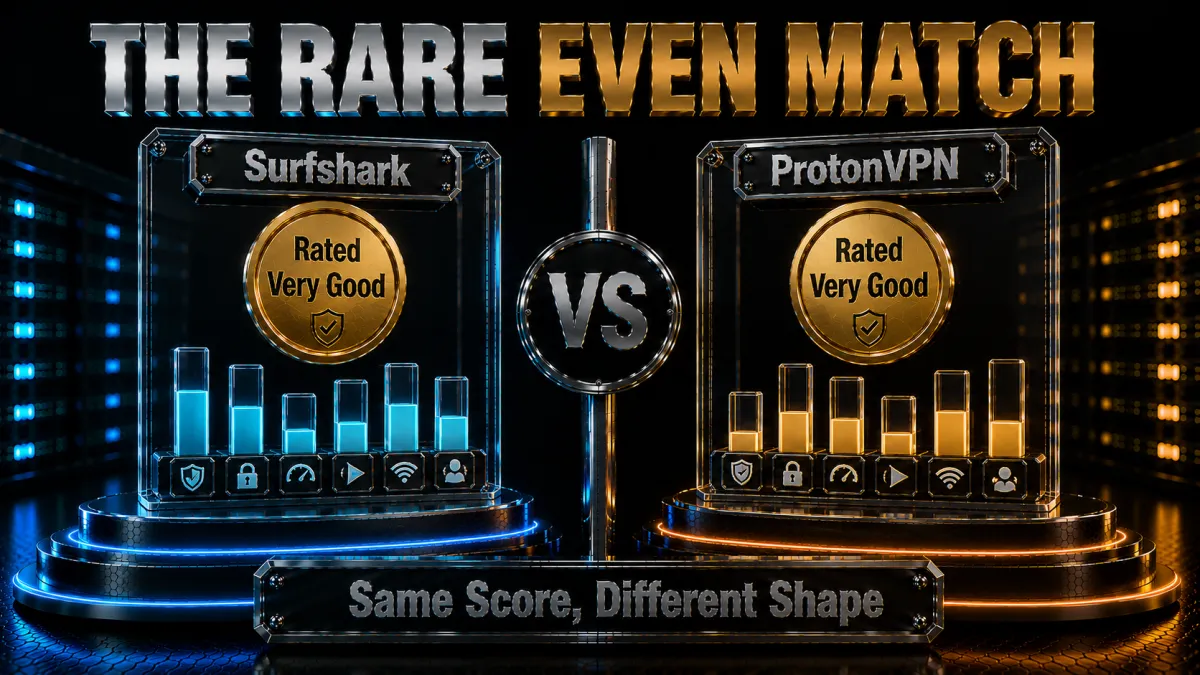
The value all-rounder: unlimited simultaneous connections honoured without asterisks, well-implemented WireGuard, Camouflage and NoBorders for filtered networks, Dynamic MultiHop, and the market’s cleverest single extra in Alternative ID, all at a budget-premium price. The Netherlands base carries an audited no-logs policy on a cadence lighter than the leaders’, scored honestly in round one.
| Jurisdiction | Netherlands |
| Protocol | WireGuard |
| Devices | Unlimited |
| Money-back | 30 days |
The verifiability specialist: every app open-source and independently audited, a Swiss legal home outside the intelligence alliances, Secure Core multi-hop through hardened facilities it controls, Stealth obfuscation, transparency reports with a warrant canary, and the one free tier this site recommends without wincing. Paid pricing runs above Surfshark’s, funding the proof and the free tier alike; this review carries no affiliate push for it.
| Jurisdiction | Switzerland |
| Protocol | WireGuard, Stealth |
| Devices | 10 (paid) |
| Money-back | 30 days + free tier |
Round 1: Privacy, jurisdiction, and audits
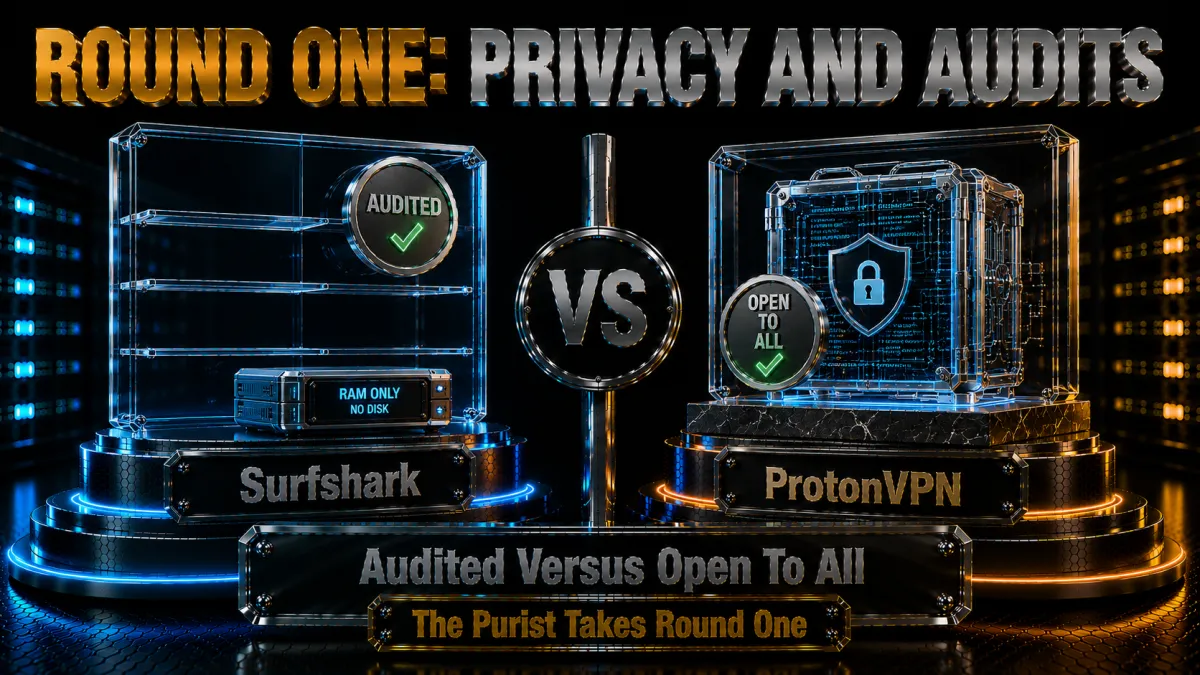
The round where Proton’s whole reason for existing shows.
- Verifiability: Proton’s home ground. Every client published open-source and independently audited, a combination Surfshark does not offer, converts trust claims into checkable statements. This is the deepest verification stack in the consumer market, and no service we rank matches it end to end.
- Jurisdictions. Switzerland sits outside the major intelligence alliances with strict privacy statute and judicial-process requirements; the Netherlands is a Nine Eyes member with sound legal process. Both are workable homes; the Swiss flag carries genuinely more weight, backed by Proton’s structure and habits.
- Audit records. Surfshark holds a solid independent no-logs examination on a cadence lighter than the leaders’; Proton pairs audits with open code, transparency reports, a warrant canary, and no-logs claims tested in real legal proceedings. Depth and repetition both tilt one way here.
- The honest note for Surfshark buyers. None of this makes Surfshark untrustworthy: its policy is audited, its fleet is RAM-only, and everyday-privacy buyers clear the bar comfortably. This round measures the distance between good and the market’s best, and the distance is real.
Round winner: ProtonVPN, by the clearest margin of any round on this page.
Round 2: Security architecture
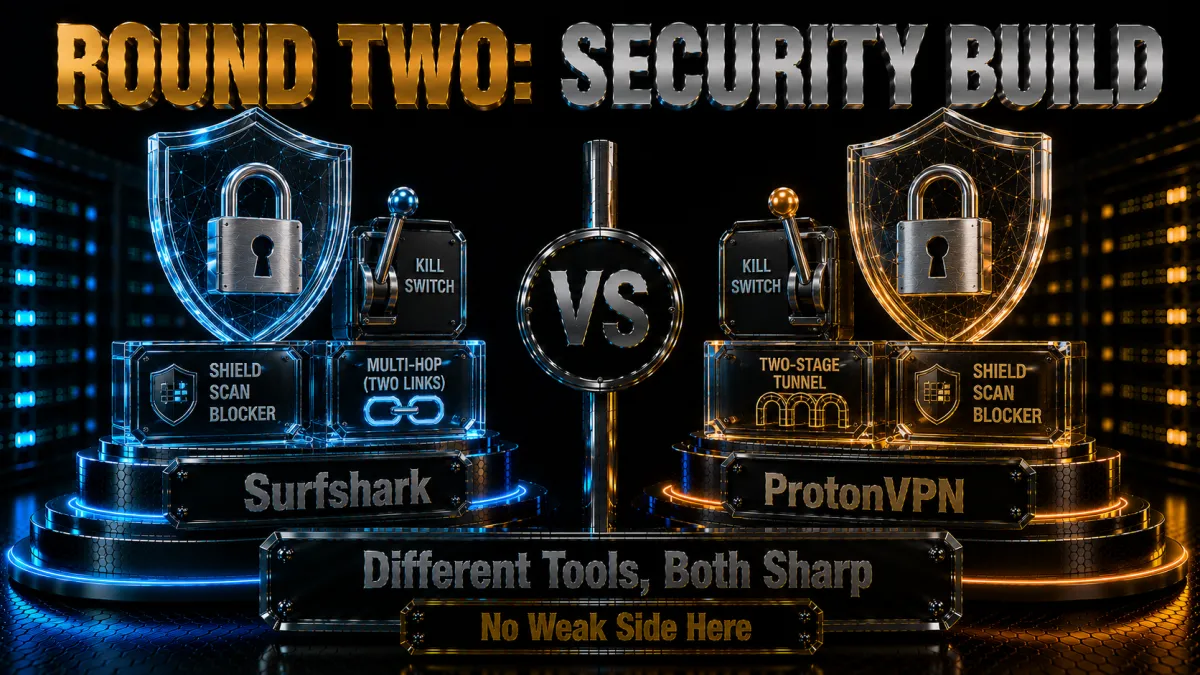
The machinery, held to the same bar.
- Encryption: modern on both. Current-standard ciphers under both WireGuard implementations, perfect forward secrecy throughout. The mathematics separates nothing.
- Kill switches: both dependable. Engaged on drops as designed across desktop and mobile in sustained use, with Proton adding a permanent always-on variant. Configure and verify day one either way, per the standing guidance.
- Leak protection: clean records. Private DNS in-tunnel on both, clean leak-suite results in our sustained use. Verify per device regardless; one minute each.
- The differentiators. Proton fields Secure Core’s hardened two-hop routing and Stealth; Surfshark answers with Dynamic MultiHop’s pick-your-own pairs, Camouflage, NoBorders, and rotating IP. Hardened depth against flexible breadth: both serious, differently aimed, and close enough that a forced winner would be dishonest.
Round winner: Tie. Secure Core’s seriousness against MultiHop’s flexibility, at parity on the fundamentals.
Round 3: Speed, patterns not fictions
No fabricated Mbps tables, per the standing policy; the reproducible shape instead.
- The shared floor. Both cost a modest slice of baseline to a nearby paid server that daily use rarely notices; 4K evenings and calls sit comfortably inside either overhead. Usability separates nothing.
- The shared ceiling. Both sit a step behind the NordLynx-and-Lightway tier on peak throughput in matching conditions, in the market’s capable middle band, per our full reviews of each. Neither buyer is purchasing the market’s fastest tunnel, and both know it.
- The tier-specific notes. Proton’s VPN Accelerator helps its longer routes, while its free-tier servers are deliberately modest and busy, not a paid-speed preview; Surfshark’s evening consistency benefits from its load spread. Fine-grained differences that trade places by route and hour.
- Your test outranks ours. Proton’s free tier plus two 30-day windows leave more testing runway than any matchup we score. The plan below converts this round into your own numbers.
Round winner: Tie. Same band, different fine print, and your connection is the real referee.
Round 4: Apps and everyday experience
Friendliness against a small learning curve.
- Surfshark’s clean list. A friendly, list-first interface with the essentials forward and extras tucked sensibly behind, quick for a first-timer to feel at home in, consistent across platforms. The value brand carries no value-brand roughness.
- Proton’s handsome density. The map-based apps are polished and capable but assume you know why you want Secure Core, which protocol to prefer, and what a profile is; the curve is shallow and real, per our full review. A week of use flattens it.
- Mobile parity. Both keep phones close to desktops with auto-connect rules and split tunnelling on Android; Proton adds its open-source build channels for the cautious. Small differences, honestly small.
- The honest margin. For the connect-and-forget buyer both pages serve, Surfshark’s fewer-decisions design wins the day-to-day. Proton’s density is the price of its configurability, fairly charged.
Round winner: Surfshark, on lower friction for the everyday user.
Round 5: Streaming reliability
The quiet main use case, compared honestly.
- Surfshark’s steadier evenings. Major platforms have worked through both in sustained use, with Proton needing the hop-and-retry habit somewhat more often, the patience gap our full Proton review names as its honest weakness. Surfshark keeps closer pace with the access arms race.
- Coverage compounds it. Unlimited devices put Surfshark’s app natively on every TV, tablet, and console without slot arithmetic, while Proton’s ten paid slots ration generously but ration. The streaming household feels both halves of this round in the same direction.
- Proton’s honest position. Plus servers stream capably with patience, and the free tier does not stream at all, by design and stated openly. The mission costs polish exactly here, per that review.
- The standing terms note. Platforms’ terms restrict cross-border catalogue access, and that use rides at your own account risk, the caveat this site attaches everywhere. Mechanics described, terms yours to weigh.
Round winner: Surfshark, on flagged-server frequency and every-screen coverage together.
Round 6: Server networks
The maps, read practically.
- Both span a hundred-plus countries. Wide, competently balanced coverage on either side, with per-server load visible in both apps. Mainstream users want for nothing on either map.
- Proton’s distinctive geography. Secure Core entry nodes in Switzerland, Iceland, and Sweden sit in facilities chosen for physical and legal resilience, infrastructure with an argument behind it. The free tier’s small country set is clearly labelled rather than teased.
- Surfshark’s practical spread. A competent fleet tuned for the streaming-and-daily-use profile of its audience, with rotating-IP and MultiHop options layered on. Less distinctive, entirely serviceable.
- The honest score. Neither network out-scales the other meaningfully, and their special features serve different briefs. Parity, called honestly.
Round winner: Tie. Two good maps with different signatures.
Round 7: Extra features
Two inventive cupboards, aimed at different fears.
- Surfshark’s identity kit. Alternative ID generating masked personal details for sign-ups, Alert breach monitoring, CleanWeb blocking, cookie-popup tooling, and rotating IP: extras aimed at identity exposure, with Alternative ID the standout single feature on either side. Genuinely inventive, per every comparison it appears in.
- Proton’s privacy machinery. Secure Core, Stealth, NetShield filtering, port forwarding, and the wider Proton ecosystem of encrypted mail, calendar, storage, and passwords for those who want one privacy roof. Extras aimed at surveillance rather than breaches.
- The overlap. Both block ads and malicious domains, both offer multi-hop, both monitor the essentials at their tiers. The cores rhyme; the accents point at different threats.
- The honest score. Which cupboard is fuller depends entirely on which fear is yours: sign-up exposure and breaches, or network surveillance and trust. We decline to pretend one fear is objectively correct.
Round winner: Tie. Identity tooling against privacy machinery, at parity on invention.
Round 8: Pricing and value
No invented price tables; the structures compared instead.
- The paid positions. Surfshark holds the budget-premium band; Proton Plus prices meaningfully above it, funding the audited open-source engineering and the free tier itself. The gap persists at renewal, where it matters.
- Intro versus renewal, both sides. Headline rates belong to first terms on both; the checkout-page renewal figure is the commitment. Read it before paying, here as everywhere on this site.
- Coverage arithmetic. Unlimited devices at the lower bill against ten slots at the higher one: for paid-tier value per household, the equation is not close. Proton’s answer, that you are paying for proof, is honest and belongs in the next round’s ledger, not this one’s.
- The free-tier asterisk. Proton’s free tier is a pricing fact too, and for the zero-budget buyer it wins this whole page single-handedly; it gets its own round below because it deserves one. This round scores the paid tiers, and the paid verdict is clear.
Round winner: Surfshark, on paid-tier price and coverage together.
Round 9: Support and refunds
The safety nets, compared as users meet them.
- Hours and channels. Surfshark runs 24/7 live chat; Proton’s live chat covers generous hours for paid users with email for all, and replies queue longer at peaks, per our full review. Round-the-clock beats generous-hours for the 3 a.m. problem.
- Quality. Both deliver competent, technically literate responses and strong documentation, with Proton’s Linux and router guides a notch above the market. No gap in substance, only in availability.
- Refund practice. Both honour 30-day money-back guarantees as routine practice, and Proton adds the downgrade-to-free exit no rival offers, softening the cancellation cliff entirely. A genuine structural credit.
- The honest score. Availability tilts Surfshark; the free-tier landing pad tilts Proton; documentation ties. The 24/7 line wins the round narrowly for the buyer who needs help when help is needed.
Round winner: Surfshark, narrowly, on round-the-clock availability.
Round 10: The free tier
The round only one side can enter, scored anyway because buyers live here.
- Proton’s free tier, restated plainly. No ads, no data cap, no logging trade, no card required: the same encryption and audited policy as Plus on a small, busy server set. It is the only free VPN this site recommends, full stop, per our free-VPN guide’s documentation of what the rest of that market does.
- Why this round exists. A large share of the people comparing these two services have a budget of zero, and for them the comparison is over before it starts. Pretending otherwise would misdescribe the actual decision most readers face.
- Surfshark’s honest position. No free tier, a 30-day guarantee as the trial path, and a low paid price as the answer. Legitimate, and simply not an entry in this round.
- The proving-path bonus. Even for buyers headed to a paid plan, the free tier lets you live with Proton’s character for weeks before money moves, a testing luxury no ranked rival offers. The test plan below is built around it.
Round winner: ProtonVPN, unopposed, and decisive for the zero-budget reader.
The full scorecard: twelve rounds tallied
Every round in one table, with devices and platform depth scored inline.
| Round | Surfshark | ProtonVPN | Winner |
|---|---|---|---|
| 1. Privacy & audits | Audited, lighter cadence | Open-source, Swiss, tested | ProtonVPN |
| 2. Security architecture | MultiHop, Camouflage | Secure Core, Stealth | Tie |
| 3. Speed pattern | Capable middle band | Capable middle band | Tie |
| 4. Apps | Lower friction | Handsome, denser | Surfshark |
| 5. Streaming | Steadier, every screen | Patience needed | Surfshark |
| 6. Server network | Practical spread | Secure Core geography | Tie |
| 7. Extra features | Identity kit | Privacy machinery | Tie |
| 8. Pricing (paid tiers) | Lower bill, unlimited slots | Priced for proof | Surfshark |
| 9. Support | 24/7 chat | Generous hours + free exit | Surfshark |
| 10. Free tier | None | The market’s one honest free VPN | ProtonVPN |
| 11. Device allowance | Unlimited | 10 paid slots | Surfshark |
| 12. Platform depth | Broad coverage | Best-in-market Linux client | ProtonVPN |
- Final tally: Surfshark 5, ProtonVPN 3, Ties 4. The daily-life rounds went one way and the trust-and-access rounds went the other, which is precisely how two services earn the same 4.6 differently. The count favours Surfshark; the margins within Proton’s wins run deeper for the buyers they serve.
- How to read a 5-3-4. This is the rare tally where the loser of the count is the outright winner for two entire audiences, verification-first buyers and anyone with a budget of zero. Buy the column that describes your question, not the row count.
Which should you pick? The decision, made explicit
Two 4.6s, routed honestly.
- Pick Surfshark if a VPN is a utility. Unlimited screens, easy streaming, 24/7 help, and a low bill: the daily-life cluster, won cleanly. Most households comparing these two on convenience land here and stay happy.
- Pick ProtonVPN if a VPN is a trust decision. Open code, Swiss law, Secure Core, and habits that invite verification rather than belief: the proof cluster, unmatched by anything we rank. The buyer whose first question is “show me” has their answer.
- Pick ProtonVPN if the budget is zero. The free tier is real protection with no hidden trade, and this page’s most important sentence for a large share of its readers. Start there today; upgrade only if your needs grow.
- Pick Surfshark if identity extras are the draw. Alternative ID and Alert answer the breach-and-exposure fear more directly than anything in Proton’s cupboard. Match the extras to your actual fear.
- Pick ProtonVPN if you live on Linux or in Proton’s ecosystem. The Linux client and the Unlimited bundle serve audiences the mainstream neglects, per our full review. Depth where rivals offer apologies.
Test both: the free-first parallel plan
Proton’s free tier plus two refund windows: the most testing runway on this site.
- Week 0: live on Proton free. Install the free tier on your main phone and laptop, kill switch on, leak suite run per our leak-check guide, and carry it through real cafe and commute days. No money has moved and you already have evidence.
- Day 1: open both paid windows. Subscribe to Surfshark and upgrade Proton to Plus the same day, renewal rates screenshotted at both checkouts, decision date calendared for day 25. The guarantees make the experiment nearly free.
- Week 1: alternate days through real life. Surfshark odd days, Proton Plus even: commutes, evening streams, calls. Note friction, not just numbers.
- Week 2: the ten-minute speed method on each. Baseline, three nearest servers per service, your real evening hour, plus Proton free servers for the third column. Your table outranks ours by definition.
- Week 3: stress each service’s own case. Every household screen on Surfshark simultaneously one weekend evening, Alternative ID exercised on a real sign-up; a Secure Core session and a Stealth connection on Proton, and your actual streaming platforms on both, counting the hops. Score the rounds your life contains.
- Day 25: decide, with Proton’s soft landing. Keep the winner; refund the loser inside its window; and remember that walking away from Proton Plus lands on the free tier rather than nothing, a fallback that changes the risk arithmetic entirely. Your verdict binds.
Mistakes buyers make in this matchup
Collected so you can skip them.
- Reading the same rating as the same product. Two 4.6s earned on different axes serve different buyers; the tally table maps which axes are which. The mistake is flipping a coin between them.
- Judging Proton’s paid speed by its free servers. Free is deliberately modest and busy; Plus is a different experience, per our full review. Benchmark both separately or the comparison misleads you.
- Buying Surfshark for verification-first needs. Its audited policy is solid and its cadence is lighter, and round one was not close; the buyer whose threat model runs on proof belongs on Proton. Match the purchase to the actual question.
- Buying Proton for a streaming-first household. The patience gap is real and stated, and unlimited screens live on the other side of this page. Convenience buyers should read the tally honestly.
- Deciding on intro price alone. Both renewal figures are the real commitment, and Proton’s free tier is the third option the checkout pages will not mention. Read everything before paying.
Related reading:
Frequently asked questions
Which is better, Surfshark or ProtonVPN?
Surfshark takes our twelve rounds five to three with four ties, winning apps, streaming, paid pricing, support hours, and unlimited devices, while Proton wins privacy verifiability, the free tier, and platform depth by margins that matter more to its audience. Both carry 4.6 ratings earned differently: utility buyers take Surfshark, verification-first and zero-budget buyers take Proton.
Is ProtonVPN more private than Surfshark?
Its privacy stack is more verifiable: open-source audited apps, a Swiss base, transparency reports, and legally tested no-logs claims against Surfshark’s solid but lighter-cadence audit record from the Netherlands. Surfshark remains trustworthy for everyday privacy; Proton is the market’s most provable service, and round one was not close.
Is Surfshark faster than ProtonVPN?
Both sit in the market’s capable middle band, a step behind the NordLynx-and-Lightway tier, with fine-grained differences that trade places by route and hour; our speed round is an honest tie. Proton’s free servers are deliberately slower than its paid ones; run the ten-minute test on all three inside the windows.
Is the ProtonVPN free tier really safe?
Yes: same encryption and audited no-logs policy as the paid tier, no ads, no data cap, no hidden monetisation, funded openly by paid subscribers as a mission decision. It is the only free VPN this site recommends, with the honest limits that servers are fewer, busier, and not built for streaming.
Which is better for streaming, Surfshark or ProtonVPN?
Surfshark, on flagged-server frequency and unlimited-device coverage together; Proton’s Plus servers stream capably with more hop-and-retry patience, and its free tier does not stream by design. Platforms’ terms restrict cross-border catalogue access, at your own account risk, per the standing caveat.
Does Surfshark have a free version like ProtonVPN?
No, its trial path is the 30-day money-back guarantee at a low paid price; Proton’s free tier is unique among the services we cover and wins that round unopposed. Zero-budget readers have their answer before any other round is read.
What is the difference between Secure Core and Surfshark’s MultiHop?
Secure Core routes traffic through hardened servers Proton controls in Switzerland, Iceland, or Sweden before the exit country, defending against compromised exit infrastructure; Dynamic MultiHop lets you pick any two-hop pair for flexible routing. Hardened depth against flexible breadth, tied in our security round.
Which has better extra features?
They aim at different fears: Surfshark’s Alternative ID and Alert answer identity exposure and breaches, while Proton’s Secure Core, Stealth, and ecosystem answer surveillance and trust. Our features round is an honest tie; match the cupboard to your actual concern.
Do Surfshark and ProtonVPN allow torrenting?
Yes: Surfshark supports P2P broadly across its network, and Proton supports it on designated paid servers with port forwarding for the technical crowd, both paired with kill switches and private DNS per our torrenting-safety guidance. The standing legal note applies on both: the tunnel changes network visibility, not the legality of downloads.
Who owns Surfshark and ProtonVPN?
Surfshark operates under Nord Security alongside NordVPN following their 2022 merger; Proton AG runs under a foundation-influenced Swiss structure built to resist acquisition, and this site earns commission only on the Surfshark side, disclosed in full on this page. Both structures are stated wherever relevant across our reviews.
Which should Linux users choose?
ProtonVPN, comfortably: its graphical Linux client is arguably the best in the consumer market, a rarity worth naming, with router and TV setups documented alongside. Surfshark covers Linux serviceably without matching that depth.
Can I test both before committing?
Yes, with the most runway on this site: live on Proton’s free tier for a week first, then open both 30-day windows the same day, alternate for three weeks, and decide by day 25 knowing Proton’s cancellation lands on free rather than nothing. Your parallel evidence outranks every review, this one included.
Why do both services have the same 4.6 rating?
Because they execute different briefs equally well: Surfshark maximises coverage and convenience per unit of money, Proton maximises verifiability and access, and our rating scale rewards excellence at a chosen brief rather than sameness. The twelve rounds show which brief is which; your priorities pick between them.
The Bottom Line
- Surfshark takes the count, five rounds to three with four ties. Apps, streaming, paid pricing, support hours, and unlimited devices: the daily-life cluster, won cleanly.
- Proton wins the rounds that define it. The market’s most verifiable privacy stack, the one honest free VPN, and best-in-class Linux depth: fewer wins, deeper margins.
- The commission runs one way, and the page says so. We earn on Surfshark and nothing on Proton; every round is argued in the open so you can check the referee.
- The free tier changes the whole test. Start on Proton free today, open both windows when ready, and let the most generous testing runway on this site referee.
- Full reviews carry the depth. Our standalone Surfshark and ProtonVPN reviews examine each service on its own terms, twelve sections each.
Two services, one rating, and no coin flip needed: ask whether your VPN is a utility or a trust decision, and this page has already routed you. Buy Surfshark when coverage per rupee is the assignment; choose Proton when proof is the product; and let the free tier and two refund windows confirm, on your own connection, that the 4.6 you picked is the one you meant.
Jyoti VPN Expert leads VPN testing at VPN Expert Guide, covering streaming and regional access, speed and latency testing, and leak checks on Windows, Android and router-level setups. Our guides are built from vendor documentation, provider terms and our own connection testing on a residential line in India, and we publish those measurements in full so readers can check them. Every guide is reviewed before publication and dated so you can see how current it is.
Meet our testing team →Last updated: August 25, 2026