
ProtonVPN Review 2026: The Privacy Purist’s Pick, Reviewed Honestly
ProtonVPN is the service this site recommends without earning a rupee from the recommendation: we have no affiliate relationship with Proton, which makes this the easiest review here to trust. It is the privacy purist’s pick, with open-source audited apps, a Swiss legal home, Secure Core routing, and the only free tier we have ever recommended. This review scores all of it honestly at 4.6, including the gaps that keep faster, cheaper rivals in our top five.
What is ProtonVPN, and who is behind it
The company and the positioning, before any judgement.
- The product. ProtonVPN is a consumer VPN from Proton AG, the Swiss company behind Proton Mail, built by scientists who met at CERN and funded by users rather than advertisers. The VPN is one organ of a privacy ecosystem spanning mail, calendar, storage, and passwords.
- The company. Proton operates from Switzerland under some of the world’s stricter privacy law, publishes transparency reports, and structures itself around a foundation model designed to resist acquisition pressure. In a market where ownership changes hands quietly, that structure is a real differentiator.
- The positioning. Where our ranked five compete on speed, price, and streaming, Proton competes on verifiability: open-source everything, published audits, and a free tier that exists as a mission statement rather than a funnel trick. This review judges it on that ground and says plainly where the mission costs performance.
- What it is not. Not an anonymity system, not a substitute for passwords and 2FA, and not a legal loophole, per the standing honesty across this site. The tunnel changes network visibility, never your identity with services you log into.
ProtonVPN scorecard: our rating at a glance

The rating rests on verifiability no rival matches end-to-end: every app open-source and audited, a Swiss legal home, transparency reporting, Secure Core routing through hardened data centres, and a free tier with no ads, no data cap, and no logging trade hiding underneath. For the buyer whose first question is “prove it,” Proton has the most complete answer in the market.
The deductions are practical: paid-tier speeds trail NordVPN’s pace, streaming needs more server-hopping patience than the leaders demand, prices run above the value picks, and the interface assumes slightly more comfort than CyberGhost’s hand-holding. The mission costs a little polish, and this review prices that honestly.
✔ Pros
- Open-source, independently audited apps
- Swiss jurisdiction, transparency reports
- Only free tier we recommend, no catches
- Secure Core multi-hop routing
- Foundation-backed ownership stability
✘ Cons
- Speeds trail the leaders we rank
- Streaming less dependable than rivals
- Pricier than the value picks
| Jurisdiction | Switzerland |
| Audited no-logs | Yes, apps open-source + audited |
| Protocols | WireGuard, OpenVPN, Stealth |
| Devices | 10 simultaneous (paid) |
| Support | Live chat (paid), email |
| Money-back | 30 days |
Privacy and logging: the trust examination

The section where Proton plays its strongest hand.
- Open-source, audited apps. Every client is published for public inspection and has passed independent security audits, a combination none of our ranked five offers across the board. Verifiability of this depth converts trust claims into checkable statements, which is the entire point of the exercise.
- No-logs policy, examined. The no-logs claim has been independently assessed and has faced real-world legal tests, with the Swiss legal framework limiting what can be compelled in the first place. Policy, jurisdiction, and architecture point the same direction here.
- Swiss jurisdiction. Switzerland sits outside the major intelligence-sharing alliances with strong domestic privacy statute and a legal tradition of requiring judicial process. No flag is magic, and this one carries more genuine weight than most.
- Secure Core. Traffic can enter through hardened servers in privacy-friendly countries, in facilities Proton controls, before exiting elsewhere, blunting attacks on exit infrastructure. It is the most serious multi-hop implementation in the consumer market, with the speed cost multi-hop always carries.
- Transparency in practice. Regular transparency reports, a warrant canary, published legal-request statistics, and a foundation structure resistant to quiet acquisition: the surrounding habits match the headline claims. The residual is the same as everywhere, you shift trust from ISP to provider, and Proton shrinks that leap further than any service we have examined.
Security features: the machinery examined
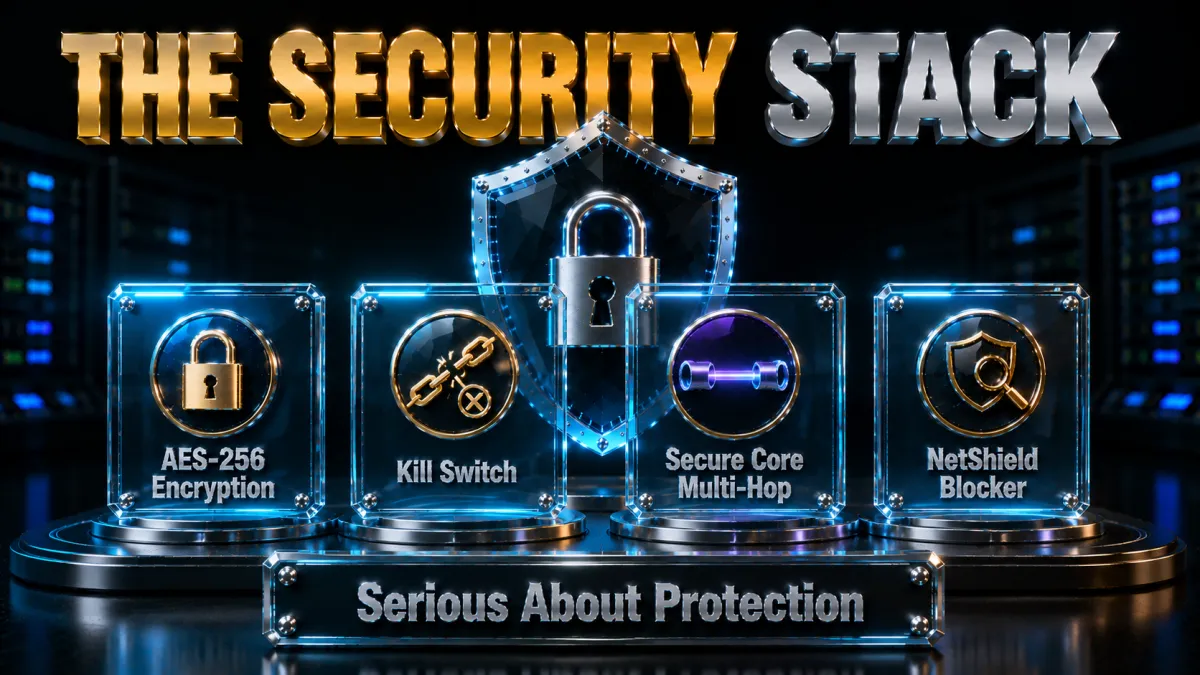
Each piece, and whether it actually works.
- Modern encryption throughout. WireGuard and OpenVPN seal traffic with current-standard ciphers, with perfect forward secrecy across the board; the mathematics is not the weak point. Defaults are sensible out of the box.
- A kill switch that behaves. The switch, including a permanent always-on variant, engages on tunnel drops as designed in our sustained use. Turning on the permanent version is the right day-one move for most users.
- Private DNS and leak protection. Queries resolve inside the tunnel on Proton’s own DNS, and our leak-suite checks have come back clean in sustained use. Verify on your own devices day one, per the standing guidance.
- Stealth protocol. Proton’s obfuscation protocol disguises VPN traffic on hostile networks, closing a gap that budget rivals leave open. It is a genuine answer to VPN-throttling hotels and campuses, if a manually selected one.
- NetShield. DNS-level blocking of ads, trackers, and malware domains on paid plans, in the same family as rivals’ filters. Useful, and honestly comparable rather than superior to NordVPN’s Threat Protection.
Speed: the honest pattern, and your own test

No fabricated Mbps tables, per the standing policy; the reproducible shape instead.
- The paid-tier pattern. WireGuard to a nearby paid server costs a modest slice of baseline that ordinary use rarely notices, aided by Proton’s VPN Accelerator engineering on longer routes. In matching conditions the pace sits behind NordVPN and ExpressVPN, roughly alongside the mid-tier of our ranked five, and stated so.
- The free-tier pattern, honestly. Free servers are fewer, busier, and deliberately modest: fine for browsing, mail, and public-WiFi protection, not built for 4K evenings. That is the honest price of a free tier with no data cap and no ad model, and it is a fair one.
- Secure Core costs speed by design. Routing through two hops in hardened facilities adds latency arithmetic no engineering removes. Use it when your threat model calls for it, not as a daily default.
- Your ten-minute test. Baseline without the VPN, three nearest servers, WireGuard on, your real evening hour, free tier and paid trial both if you are weighing them. Run it inside the 30 days; your connection outranks every published table.
Apps and ease of use
Clean, capable, and a notch more demanding than the friendliest rivals.
- Desktop. Windows, macOS, and a genuinely first-class Linux app, a rarity in this market, share a clean map-based interface with profiles for repeat configurations. The design is handsome and slightly denser than CyberGhost’s big-button minimalism.
- Mobile. iOS and Android carry the essentials plus auto-connect rules for untrusted WiFi, where mobile protection actually lives. Android additionally offers split tunnelling and the open-source build channels the privacy-minded prefer.
- TV and router. Android TV and Fire TV apps cover the living room, and router setup is documented for common firmware. Ten simultaneous connections on paid plans ration generously without reaching Surfshark’s unlimited.
- The honest friction. Proton assumes you know why you want Secure Core, which protocol to prefer, and what a profile is; the learning curve is shallow but real. Beginners who want zero decisions should read our CyberGhost review first, and everyone else adapts within a week.
Streaming performance

The honest picture, and the honest gap.
- Paid-tier streaming works with patience. Major platforms have worked through Plus servers in our sustained use, with flagged servers needing the hop-and-retry habit somewhat more often than NordVPN or ExpressVPN require. Proton keeps pace in the access game without leading it, and pretending otherwise would misplace the service.
- Free tier is not for streaming. Free servers exist for privacy, not catalogues, and expecting otherwise misreads the mission. The honest free VPN is honest about this too.
- Speed headroom on paid. The overhead pattern leaves margin for HD and 4K on ordinary connections through well-chosen servers. Buffering usually indicts a crowded endpoint rather than the service; hop first, judge second.
- The standing terms note. Platforms’ terms restrict cross-border catalogue access, and that use rides at your own account risk, the caveat this site attaches everywhere. Mechanics described, terms yours to weigh.
Server network and coverage

The map, read practically.
- Broad and growing. The paid network spans a hundred-plus countries with strong European density and widening coverage elsewhere, load-balanced visibly in the apps. Check the live map against your must-have locations before subscribing, per the standing advice.
- Secure Core geography. The hardened entry nodes sit in Switzerland, Iceland, and Sweden, in facilities chosen for physical and legal resilience. The geography is the feature; the latency is the fee.
- Free-tier honesty. Free users get a small set of countries chosen for capacity rather than variety, clearly labelled rather than teased. The limitation is stated where funnel products would hide it.
- Load visibility. Per-server load percentages make the hop habit easy to practise well, on free and paid alike. A small feature that pays daily.
Extra features: which ones earn their place
The additions beyond the tunnel, filtered for genuine value.
- Secure Core. The hardened multi-hop routing covered in the privacy section, unique in seriousness at consumer prices. Use it for sensitive sessions rather than daily browsing, and accept the latency knowingly.
- Stealth protocol. Obfuscation for VPN-hostile networks, per the security section, closing the hostile-hotel gap without an extra fee. A card CyberGhost cannot play.
- NetShield. DNS-level ad, tracker, and malware blocking on paid plans. Comparable to rivals’ filters, honestly labelled as such.
- Port forwarding and P2P support. Features the technical crowd asks for by name, present and documented, including on the excellent Linux client. Depth the friendliest rivals skip.
- The ecosystem question. Proton Unlimited bundles the VPN with encrypted mail, calendar, storage, and passwords, and the bundle only makes sense if you will live in the ecosystem. Buy components you will actually use, per the standing advice; the VPN alone is judged here on its own feet.
Pricing and value: the honest read

No invented price tables; the structure and caveats instead.
- The free tier, stated first. No ads, no data cap, no logging trade, no card required: it is the only free VPN this site recommends, full stop, and our free-VPN guide explains why the rest of that market earns suspicion. As a permanent public-WiFi and browsing shield, it is genuinely enough for many people.
- Paid pricing runs above the value picks. Plus plans price nearer the premium end than Surfshark or IPVanish territory, funding the audited open-source engineering and the free tier itself. You are paying for verifiability, and the price says so plainly.
- Intro versus renewal. The industry pattern applies here too, if less aggressively than most: read the renewal figure on the checkout page before committing. One glance prevents the category’s most common complaint.
- Value verdict. Against NordVPN you pay similar money for less speed and streaming but more verifiability; against the budget picks you pay more for the same daily job done with published proof. The mission is the product; price it against how much the proof matters to you.
Customer support and refunds in practice
The safety net, judged as users meet it.
- Live chat on paid, email for all. Paid subscribers reach live chat during generous hours with competent, technically literate responses; free users rely on email and an unusually good knowledge base. Support depth tracks the tier honestly.
- Self-serve help. Documentation is thorough and plainly written, including for Linux and router setups the market usually neglects. It pairs well with the fix ladders in our own guides.
- The 30-day guarantee honoured. Refunds are processed on request within the window as routine practice; note the deadline at purchase. The free tier also means you can test the service’s character indefinitely before paying at all, a proving path no ranked rival offers.
- The queue reality. Chat hours are generous rather than round-the-clock, and email replies take longer at peaks. Stated so the expectation is set correctly.
ProtonVPN vs the services we rank
Where it stands against four of our ranked five.
| Feature | ProtonVPN | NordVPN | ExpressVPN | Surfshark | CyberGhost |
|---|---|---|---|---|---|
| Open-source apps | All, audited | No | No | No | No |
| Honest free tier | Yes, no catches | None | None | None | None |
| Speed | Solid | Leading | Very strong | Solid | Good |
| Streaming | Patience needed | Dependable | Dependable | Good | Good |
| Multi-hop | Secure Core | Double VPN | None | Dynamic MultiHop | None |
| Price position | Higher | Mid | Premium | Low | Low |
- vs NordVPN. Nord wins speed, streaming, and extras breadth; Proton wins open-source verifiability, jurisdiction, and the free tier. The privacy purist takes Proton; the everything-else buyer takes Nord, and both choices are rational.
- vs ExpressVPN. Express sells polish and hostile-network mastery at the top price; Proton sells published proof at a high one. Travellers lean Express; verifiers lean Proton.
- vs Surfshark. Surfshark wins price, unlimited devices, and streaming ease; Proton wins on every trust axis a purist measures. Value households take Surfshark without guilt.
- vs CyberGhost. CyberGhost wins beginner-friendliness and the 45-day window; Proton wins verifiability and the free proving path. First-timers start CyberGhost; the privacy-led start free on Proton and decide from evidence.
Who should get ProtonVPN, and who should not
The buying decision, made explicit.
- Get it if verifiability is your first question. Open-source audited apps, Swiss law, transparency reports, and Secure Core make Proton the most provable service we have reviewed. When “trust me” is not good enough, this is the answer.
- Get the free tier if budget is zero. It is the only free VPN we recommend: real protection for browsing and public WiFi with no ads, caps, or hidden trades. Our free-VPN guide explains why this recommendation is nearly unique.
- Get it if you live on Linux or in the Proton ecosystem. The first-class Linux client and the Unlimited bundle serve audiences the mainstream market neglects. Depth where rivals offer apologies.
- Skip it if streaming reliability leads. The hop-and-retry patience Proton asks exceeds what NordVPN or ExpressVPN demand, and a streaming-first buyer will feel it weekly. Our ranked five serve that need better.
- Skip it if you want the cheapest capable tunnel or zero learning curve. Surfshark and IPVanish undercut it; CyberGhost out-simplifies it. Match the purchase to the priority, per the standing advice.
How to test ProtonVPN yourself, free tier first
The plan that turns the free tier and 30 days into a verdict.
- Week 0, free: install and live with it. Free tier on your main phone and laptop, official sources only, kill switch on, auto-connect for untrusted WiFi. No other service on this site offers a proving path before any money moves; use it.
- Week 0, free: run the leak suite. IP, DNS, and WebRTC checks per device, per our leak-check guide. Verification before trust, one minute per machine.
- Day 1, paid: upgrade and benchmark. Start the 30-day window, then run the ten-minute speed method: baseline, three nearest Plus servers, WireGuard, your real evening hour. Compare against the free-tier notes you already have.
- Week 1: exercise the privacy machinery. A Secure Core session for something that matters, Stealth on a hostile network if your life includes one, NetShield on daily browsing. Confirm the features your money specifically buys.
- Week 2: the streaming patience test. Your actual platforms across several evenings, counting the hops needed, because this is the known gap and your tolerance for it is the variable. Honest data beats hopeful assumption.
- Weeks 3-4: one support contact, then decide. Ask chat something real, judge the answer, and keep, downgrade to free, or refund before the calendared deadline. Downgrade-to-free is an exit no ranked rival offers, and it changes the risk arithmetic entirely.
Mistakes ProtonVPN buyers make
Collected so you can skip them.
- Judging paid speed by the free tier. Free servers are deliberately modest and busy; Plus servers are a different experience. Benchmark both separately or the comparison misleads you.
- Running Secure Core all day. Multi-hop latency is a fee for sensitive sessions, not a daily default. Use single-hop WireGuard for routine browsing and save the armour for when it earns its cost.
- Buying for streaming-first needs. The patience gap is real and stated; a streaming-led buyer belongs with our ranked five. Match the service to the priority.
- Missing the renewal rate. Milder here than most, but the checkout-page renewal figure is still the commitment. Read it before paying, here as everywhere.
- Forgetting the downgrade exit. If Plus disappoints, the free tier remains as a landing pad rather than a cancellation cliff. Factor that into the keep-or-refund decision; it is a luxury unique to this review.
Related reading:
Frequently asked questions
Is ProtonVPN a good VPN in 2026?
Yes, and for a specific buyer the best: open-source audited apps, Swiss jurisdiction, Secure Core, and the only honest free tier we recommend earn it 4.6/5. Speeds and streaming trail the leaders we rank, which is why privacy-first buyers choose it and streaming-first buyers should not.
Is ProtonVPN really trustworthy?
Its apps are published open-source and independently audited, its no-logs stance has faced real legal tests under Swiss law, and it publishes transparency reports with a warrant canary. It is the most verifiable consumer VPN we have examined, which is precisely its market position.
Is the ProtonVPN free tier safe?
Yes: same encryption, same no-logs policy, no ads, no data cap, and no hidden monetisation, funded openly by paid subscribers. It is the only free VPN this site recommends, with the honest limits that servers are fewer, busier, and not built for streaming.
Is ProtonVPN fast?
Paid-tier WireGuard to a nearby server costs a modest slice of baseline that daily use rarely notices, sitting behind NordVPN and ExpressVPN in matching conditions; free-tier servers are deliberately modest. Run the ten-minute test in this review on both tiers across your own evenings.
What is Secure Core?
Multi-hop routing that passes your traffic through hardened servers Proton controls in Switzerland, Iceland, or Sweden before the exit country, protecting against compromised exit infrastructure. It is the most serious consumer multi-hop we have seen, with the latency cost multi-hop always carries.
Where is ProtonVPN based, and does it matter?
Switzerland: outside the major intelligence-sharing alliances, with strict privacy statute and judicial-process requirements, and it matters more than most flags because the company’s structure and transparency habits back it up. Jurisdiction, policy, and architecture point the same way here.
Does ProtonVPN work for streaming?
Paid Plus servers have worked with major platforms in our sustained use, needing the hop-and-retry habit somewhat more often than the leaders require, and the free tier is not built for streaming at all. The standing caveat applies: platforms’ terms restrict cross-border catalogue access, at your own account risk.
Does ProtonVPN work on Linux?
Yes, with a first-class graphical Linux client that is arguably the best in the consumer market, a rarity worth naming. Router, Android TV, and Fire TV setups are documented alongside it.
ProtonVPN or NordVPN: which should I pick?
Nord wins speed, streaming dependability, and extras breadth; Proton wins open-source verifiability, jurisdiction, and the free tier. Choose by your first question: performance takes Nord, proof takes Proton.
ProtonVPN or Surfshark: which should I pick?
Surfshark wins price, unlimited devices, and streaming ease; Proton wins every verifiability axis and the free proving path. Value households take Surfshark; privacy purists pay Proton’s difference knowingly.
Why is ProtonVPN not in your top-five rankings?
Commercial reasons, stated plainly: our ranked tables carry affiliate relationships and Proton’s programme does not fit our structure, so including it there would blur a line we keep sharp. This review exists precisely because editorial coverage should not depend on commission, and the disclosure note above spells out the whole arrangement.
Does ProtonVPN have a money-back guarantee?
Yes, 30 days on paid plans, honoured on request as routine practice, and uniquely you can downgrade to the free tier rather than losing protection entirely. Test free first, upgrade to benchmark, and decide from your own evidence.
Can ProtonVPN make me anonymous online?
No VPN can; services you log into know you through any tunnel, and Proton itself says so more plainly than most of the industry. What it delivers is the most verifiable network privacy in the consumer market.
Does ProtonVPN allow torrenting?
Yes, P2P is supported on designated paid servers with port forwarding available for the technical crowd, and the kill switch and private DNS cover the leak side per our torrenting-safety guidance. The standing legal note applies as everywhere: the tunnel changes network visibility, not the legality of what you download.
What is the difference between ProtonVPN Free and Plus?
Free covers the core: same encryption, same no-logs policy, a small busy server set, one device, and no streaming ambition. Plus adds the full country map, ten devices, higher speeds, Secure Core, Stealth, NetShield, and streaming-capable servers; the test plan in this review benchmarks both tiers so the upgrade decision runs on your own numbers.
The Bottom Line
- ProtonVPN is the privacy purist’s pick, at 4.6/5. Open-source audited apps, Swiss law, Secure Core, and transparency habits no ranked rival matches end-to-end.
- The free tier is the market’s one honest free VPN. Real protection, no ads, no caps, no hidden trade; a proving path that changes the risk arithmetic entirely.
- The honest deductions: pace, patience, and price. Speeds trail the leaders, streaming asks more hops, and Plus costs more than the value picks.
- This page carries no affiliate push, and says why. The rankings and this review keep the commercial line sharp; the disclosure note spells it out.
- Your free-then-paid test outranks this review. The plan above, your own connections, your own evenings: that verdict binds.
Most VPNs ask you to trust them; Proton publishes the evidence and invites you to check. That inversion is worth real money to some buyers and irrelevant to others, and the honest job of this review is to tell you which one you are. Start free, verify everything, and pay only if the proof is the product you were looking for.
Jyoti VPN Expert leads VPN testing at VPN Expert Guide, covering streaming and regional access, speed and latency testing, and leak checks on Windows, Android and router-level setups. Our guides are built from vendor documentation, provider terms and our own connection testing on a residential line in India, and we publish those measurements in full so readers can check them. Every guide is reviewed before publication and dated so you can see how current it is.
Meet our testing team →Last updated: August 24, 2026