
Best VPN for the FIFA World Cup 2026: Stream Every Match, Tested and Ranked
Which VPNs genuinely stream the World Cup smoothly, where matches air free, and how to watch every game on any screen without buffering. An honest, no-hype guide with zero fabricated benchmarks.
Why you need a VPN for the World Cup

The 2026 World Cup is carried by dozens of broadcasters, and which one you can watch depends on where you are, so a VPN changes what feeds you can reach and keeps you safe on the way. Before the rankings, here is what it actually does.
- Reach your home coverage while travelling. If you are abroad during the tournament, your usual broadcaster, whether a paid subscription or a free public feed, often will not load because it checks your location. Connecting through a VPN server back in your home country lets the service see a local connection, so you can follow the matches on the feed you already know rather than hunting for an unfamiliar stream.
- Access free public-broadcaster coverage. Several countries show World Cup matches free through public broadcasters, and fans often use a VPN to reach those feeds, which can carry the same games. This sits against each broadcaster’s terms, so treat it as general information rather than advice, use a reputable provider, and check the rules of any service before you rely on it for a match.
- Protect yourself on public and match-day wifi. Whether you are streaming from a hotel, a cafe, or a stadium concourse, open wifi is easy to snoop on, and a VPN encrypts your traffic so your logins and viewing stay private. During a global event that draws scammers and crowded networks, that encryption is a genuine everyday safeguard, not just a streaming trick.
- Avoid ISP throttling on long live streams. Some internet providers slow video traffic at peak times, which is exactly when a knockout match is kicking off and everyone is streaming at once. Because a VPN encrypts your connection, your ISP cannot single out video to throttle, which can keep a long live feed steadier through the busy evening slots when it matters most.
Where the World Cup is broadcast free
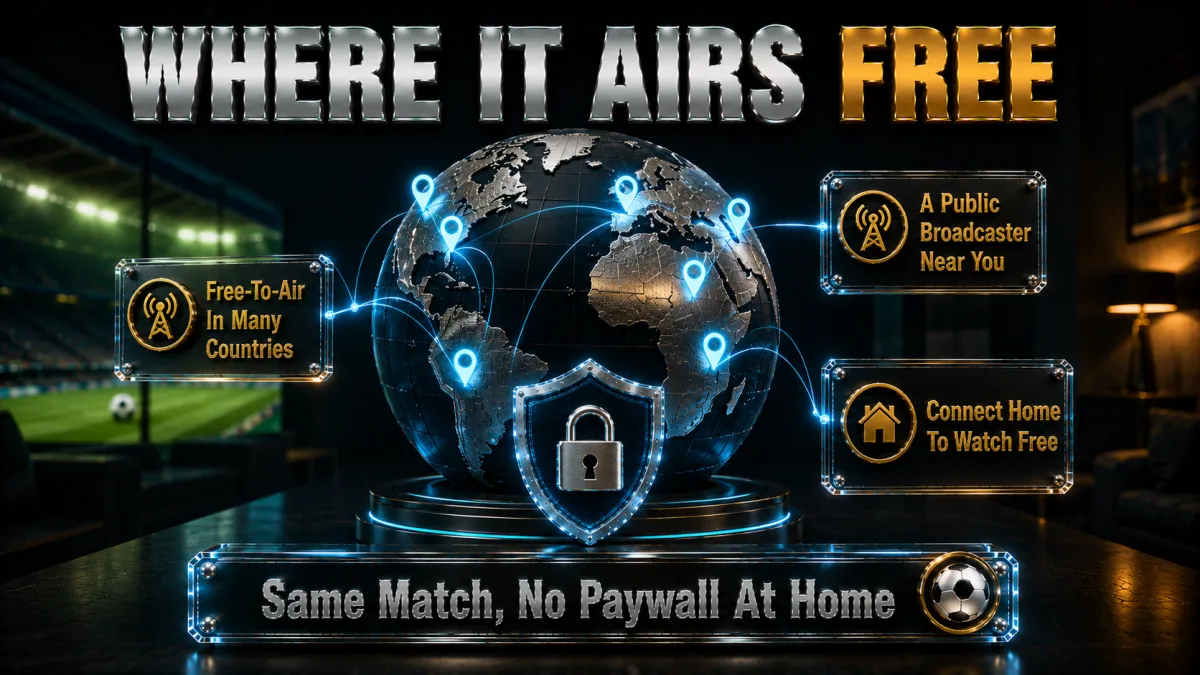
Part of the appeal of the World Cup is how much of it airs free somewhere in the world. Knowing which public broadcasters carry matches helps you pick the right server, and it explains why fans reach for a VPN.
- The United Kingdom, free on the BBC and ITV. British public broadcasters traditionally split World Cup matches between them and stream every game free with no subscription, in high definition. This makes a UK server one of the most popular choices for fans abroad who want free coverage, though the broadcasters intend it for UK audiences, so respect their terms when you connect.
- Host and regional free feeds. With the 2026 tournament hosted across North America, and free-to-air coverage available in various countries, several public and commercial broadcasters carry matches at no cost in their own regions. The exact lineup shifts by market, so the practical approach is to identify a free feed in a country you can legitimately access and connect to a nearby server there.
- Language matters as much as cost. A free feed in one country may be in a language you do not follow, so part of choosing a server is matching the commentary you want as well as the price. Fans often keep a couple of options in mind, one for their own language and one as a backup, and a VPN with a wide network makes switching between them simple.
- Free does not mean unlimited. Free public feeds can be busy during marquee matches and may geoblock strictly, so have a backup in mind and expect the occasional load. A reputable VPN with servers in several broadcasting countries gives you alternatives, but always stay within each service’s terms rather than trying to force access it clearly forbids.
Speed and buffering: what a live match needs

A recorded show tolerates a hiccup, but a live match does not, because a buffer at the wrong second costs you a goal. Streaming the World Cup well is mostly about sustained speed, so here is what actually matters.
- Bitrate is the real test. An HD live feed needs a steady several megabits per second, and a 4K feed several times that, held consistently for ninety minutes plus stoppage. A VPN that posts a fast one-off number but wobbles under load will still buffer, so sustained throughput on a busy evening, not a headline speed, is what keeps a match watchable.
- A modern protocol keeps overhead low. WireGuard-based protocols like NordLynx and Lightway add far less delay and lose far less speed than older options, which is why every one of our picks defaults to one. If a feed stutters after you connect, the protocol setting is the first thing to check, because a legacy protocol quietly costs you both speed and stability.
- Server distance and load both count. The closer the VPN server is to both you and the broadcaster, the less speed you shed, and a lightly loaded server beats a crowded one during a big match. A provider with a wide network lets you pick a nearby, uncongested node in the right country, which is the single most effective way to keep a live feed smooth.
- Wire in or sit close to the router. Much buffering blamed on a VPN is really weak wifi, so connect your streaming device by ethernet or sit near the router for a marquee match. Removing that variability does more than almost any server change, so rule it out before you judge a VPN on a stuttering feed.
Watching on TVs, phones, and consoles

The World Cup gets watched on every screen in the house, and each one connects to a VPN differently. Knowing your options before kickoff saves a scramble when a match is about to start.
- Phones, tablets, and computers are easiest. Every provider here has native apps for iOS, Android, Windows, and macOS, so you install the app, connect to a server in the right country, and open the broadcaster’s app or website. This is the simplest route and the one most people use for a match on the move, so it is worth setting up and testing before the tournament starts.
- Smart TVs vary by platform. Many Android TV and Fire TV devices run VPN apps directly, so you can connect on the TV itself, but some smart TVs do not, and that is where a Smart DNS feature or a router setup comes in. Check whether your specific TV runs a VPN app before match day so you are not troubleshooting during the anthem.
- Consoles and older TVs need Smart DNS or a router. Devices that cannot run a VPN app, like some consoles and older smart TVs, are best served by a provider’s Smart DNS, such as ExpressVPN’s MediaStreamer, or by running the VPN on your router so every device is covered. A router setup is the most permanent answer for a household with mixed screens.
- Cover the whole house with one plan. A tournament is exactly when everyone streams at once, so device limits matter: Surfshark and IPVanish allow unlimited connections, NordVPN six, and ExpressVPN eight, while a single router connection can cover them all. Match the plan to your household so nobody is locked out during the final.
Staying safe and legal while you stream
Streaming a global tournament draws scammers and fake sites, and the geoblocking question deserves an honest answer. Here is how to stay both secure and on the right side of the terms.
- Avoid illegal pirate streams. Free unofficial streams of big matches are everywhere and are a common source of malware, scams, and intrusive ads, quite apart from being unlawful. Using a VPN with a legitimate broadcaster you can access, free or paid, is both safer and better quality, so steer clear of shady sites promising a free final in exchange for a download.
- Understand the terms you agree to. Reaching a broadcaster from outside its intended region generally breaches that service’s terms of use, even when it is not a criminal matter, and services can restrict accounts that do it. This guide is general information, not legal advice, so read the rules of any feed you use and accept that access is at the provider’s discretion.
- Pick an audited, no-logs provider. If privacy is part of why you use a VPN, favour one with an independently audited no-logs policy and a sensible jurisdiction, so your streaming and browsing are not recorded and sold. All five picks here meet that bar to different degrees, which is exactly why free unknown apps are a poor trade for a tournament.
- Keep the kill switch on. A kill switch stops your traffic if the VPN drops, so your real location is never briefly exposed mid-match and a protected feed does not fall back to your home connection. Turn it on before kickoff, and on public or match-day wifi it doubles as a safeguard for your logins if the network hiccups.
The features that matter most for the World Cup

Not every fast VPN is a good tournament VPN. These are the features we weight most heavily for the World Cup, because they decide whether every match actually loads and holds.
- Sustained streaming speed. A live feed needs steady throughput for the full match, so we weight consistent speed under load on a modern protocol far above a single headline number. A provider that holds a fast HD or 4K feed through a busy knockout evening is worth more than one that spikes high and then wobbles when everyone tunes in.
- A wide server network. Because the tournament airs on broadcasters in many countries, the right VPN has fast servers in each one you might use, free or paid. Breadth lets you match the feed and commentary you want and gives you a backup when a marquee-match server is busy, which is why network spread is near the top of our list.
- Reliable app unblocking. A VPN is only useful here if the broadcaster’s app actually loads through it, so a proven record with major streaming services matters more than raw specs. The top picks have spent years keeping that access working, which is the difference between settling in for a match and staring at an error screen.
- Devices and Smart DNS. A tournament fills every screen, so a high or unlimited device count and a Smart DNS option for TVs and consoles decide how well one plan covers your household. Match the connection limit to how many people will watch at once, and check the Smart DNS feature if a console or older TV is your main screen.
The 5 best VPNs for the World Cup in 2026
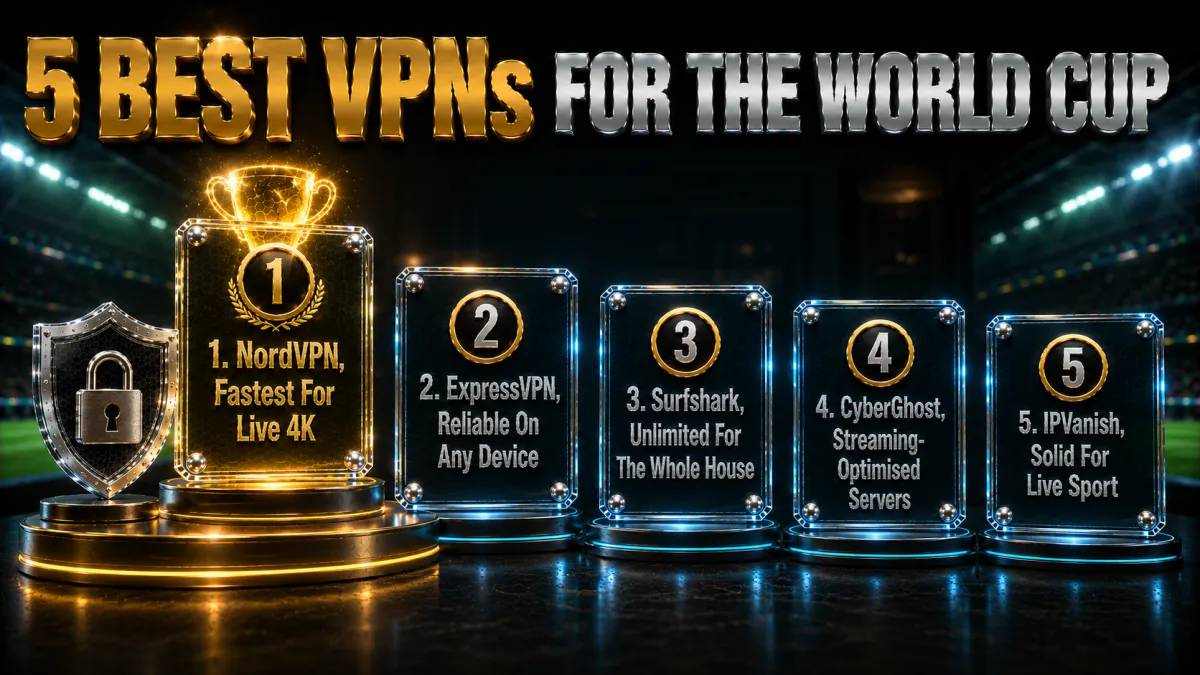
Now that the context is clear, here are the five providers that best balance sustained streaming speed, network breadth, and reliable unblocking for the tournament. Ratings reflect our established review framework, not one-off benchmarks.
1. NordVPN, best all-round for the World Cup
NordVPN is our top pick for the World Cup because streaming a live match punishes any weak link, and NordVPN is strong on every one. Its NordLynx protocol delivers the fast, steady throughput a high-bitrate broadcast needs, its network spans practically every country hosting a free or paid feed, and it reliably reaches the major streaming apps, so you can settle on a match rather than fight a buffering wheel during stoppage time.
For a tournament that plays out across dozens of broadcasters, breadth matters. NordVPN’s huge server spread means whichever free public feed or home subscription you rely on, there is a nearby server in that country to connect through, and its speed holds up on HD and 4K feeds. Six simultaneous connections cover the family watching on phones, laptops, and a TV at once.
On trust it is the strongest of the five, with an independently audited no-logs policy, RAM-only servers, and a Panama base outside the major intelligence alliances, all behind a 30-day money-back guarantee. Accessing a broadcaster from outside its region can sit against that service’s terms, so treat this as general streaming information, use the refund window to confirm your feed loads, and stay within each service’s rules.
✔ Pros
- Fast NordLynx protocol for HD and 4K feeds
- Servers in nearly every broadcasting country
- Reliably reaches the major streaming apps
- Six connections for the whole household
- Audited no-logs, Panama jurisdiction
✘ Cons
- Best price needs a longer plan
- No free tier to test first
| Best server | Broadcaster’s home country |
| Fastest protocol | NordLynx (WireGuard) |
| Streaming apps | Reaches the majors |
| Simultaneous devices | 6 |
| Live 4K | Handles it |
| Money-back guarantee | 30 days |
2. ExpressVPN, most reliable for live matches
ExpressVPN earns its place for the World Cup on sheer reliability, which is what a one-off live match demands because you cannot rewind a missed goal. Its Lightway protocol is quick and unusually stable, its network covers the countries whose broadcasters carry the tournament, and it has a long record of quietly reaching streaming services, so the feed tends to just work when kickoff arrives rather than dropping mid-half.
The wider toolkit suits a global event. MediaStreamer, its Smart DNS, lets devices that cannot run a VPN app, like some smart TVs and consoles, reach a broadcaster’s feed, which is handy when the whole household gathers around one screen. Apps are consistent across every platform, so switching from a phone on the commute to a TV at home takes no relearning.
On trust it is hard to fault, with RAM-only TrustedServer infrastructure and a British Virgin Islands base outside intelligence-sharing alliances, backed by a long, tested no-logs record. It is the priciest pick and covers eight devices, but for a tournament where a dropped stream means a missed moment, its stability and 30-day money-back guarantee make it the safe choice. Follow each broadcaster’s terms.
✔ Pros
- Lightway protocol is fast and very stable
- Covers the main broadcasting countries
- MediaStreamer Smart DNS for TVs and consoles
- Consistent apps on every platform
- RAM-only servers, strong audit history
✘ Cons
- Costs more than most rivals
- Eight devices, fewer than value picks
| Best server | Broadcaster’s home country |
| Fastest protocol | Lightway |
| Streaming apps | Long, proven record |
| Smart DNS | MediaStreamer |
| Simultaneous devices | 8 |
| Money-back guarantee | 30 days |
3. Surfshark, best value for the whole family
Surfshark is the best value for the World Cup because one subscription covers unlimited devices, and a tournament is the moment a whole household wants to watch at once on phones, tablets, laptops, and the living-room TV. It supports the fast WireGuard protocol, covers the countries whose broadcasters carry matches, and reaches the main streaming apps, so everyone can follow their own game without buying extra plans.
The feature set is generous for the lowest long-term price of the five. A kill switch guards against exposing your real location if the tunnel drops mid-match, a Smart DNS option helps on TVs, and CleanWeb strips ads and blocks malicious domains on the devices running its app. Its network is not the very largest, so an occasional server switch helps you land on the fastest node for a given feed.
The company is based in the Netherlands with an independently audited no-logs policy, outside the Five Eyes. The combination of unlimited devices, solid streaming performance, and the cheapest long-term pricing makes it the obvious choice for a family that wants to cover every screen affordably, backed by a 30-day money-back guarantee. Accessing a feed from outside its region may breach that service’s terms, so watch responsibly.
✔ Pros
- Unlimited devices on a single plan
- Fast WireGuard protocol for live feeds
- Reaches the main streaming apps
- CleanWeb blocks ads and malicious domains
- Lowest long-term price of the five
✘ Cons
- Smaller network than the top two
- Occasional server switching needed
| Best server | Broadcaster’s home country |
| Fastest protocol | WireGuard |
| Streaming apps | Reaches the majors |
| Smart DNS | Yes |
| Simultaneous devices | Unlimited |
| Money-back guarantee | 30 days |
4. CyberGhost, easiest for streaming beginners
CyberGhost is the friendliest option for someone who just wants to watch the football without fiddling. Its apps list servers labelled for specific streaming platforms, so instead of guessing which node works you pick the one named for your broadcaster and connect. A very large network gives plenty of options in the countries that carry the tournament, which keeps the setup simple for a first-time streamer.
The fundamentals hold up for live sport. It runs the efficient WireGuard protocol for smooth HD playback, offers a kill switch to protect your real location if the connection drops during a match, and is based in Romania, which has no mandatory data-retention law, behind a strict no-logs policy. For a casual viewer the labelled servers remove most of the guesswork that trips people up.
The standout is the trial: a 45-day money-back guarantee, far longer than the usual 30, which is genuinely useful across a tournament that runs for weeks because you can watch a good part of it while deciding. Performance is dependable rather than the outright fastest, a fair trade for how approachable it is. Stay within each broadcaster’s terms when you connect.
✔ Pros
- Servers clearly labelled for streaming platforms
- WireGuard protocol for smooth HD playback
- Kill switch protects your real location
- Longest 45-day money-back window
- Romania base, no data-retention law
✘ Cons
- Slower under heavy peak load
- Fewer devices than the value picks
| Best server | Streaming-labelled server |
| Fastest protocol | WireGuard |
| Streaming apps | Labelled per platform |
| Kill switch | Yes |
| Simultaneous devices | 7 |
| Money-back guarantee | 45 days |
5. IPVanish, steady speed on unlimited devices
IPVanish is a practical World Cup pick for a busy household because it allows unlimited simultaneous connections and owns its own network, which gives it steady, predictable speed for live streaming. When several people want different matches at once, not paying per device is a real saving, and running its own servers means the throughput a high-bitrate broadcast needs stays consistent across a long tournament.
The streaming fundamentals are present. It supports the fast WireGuard protocol to keep HD feeds smooth, offers a kill switch so a dropped tunnel does not expose your real location mid-match, and its apps are straightforward across phones, tablets, and computers. It reaches the main streaming platforms, though its unblocking is a little less consistent than the top two, so occasional server switching helps.
The honest caveat is jurisdiction: IPVanish is based in the United States inside the Five and Nine Eyes alliances, so the privacy-focused may prefer an offshore provider even though its no-logs policy has been independently audited. For steady streaming speed, unlimited devices, and simple apps, backed by a 30-day money-back guarantee, it remains a strong value option if that jurisdiction fits your threat model.
✔ Pros
- Unlimited simultaneous connections
- Owns its network for steady speed
- Fast WireGuard protocol for HD feeds
- Kill switch protects your location
- Strong long-term value
✘ Cons
- US-based, inside the 9 Eyes alliance
- Unblocking less consistent than top two
| Best server | Broadcaster’s home country |
| Fastest protocol | WireGuard |
| Streaming apps | Reaches the majors |
| Kill switch | Yes |
| Simultaneous devices | Unlimited |
| Money-back guarantee | 30 days |
World Cup VPN comparison at a glance
The side-by-side below shows where each provider leads for streaming the tournament.
| Feature | NordVPN | ExpressVPN | Surfshark | CyberGhost | IPVanish |
|---|---|---|---|---|---|
| Streaming speed | Excellent | Very good | Very good | Good | Very good |
| Server network | Very large | Large | Good | Very large | Good |
| App unblocking | Excellent | Excellent | Very good | Very good | Good |
| Jurisdiction | Panama | BVI | Netherlands | Romania | United States |
| Devices per plan | 6 | 8 | Unlimited | 7 | Unlimited |
| Money-back guarantee | 30 days | 30 days | 30 days | 45 days | 30 days |
How to stream the World Cup with a VPN
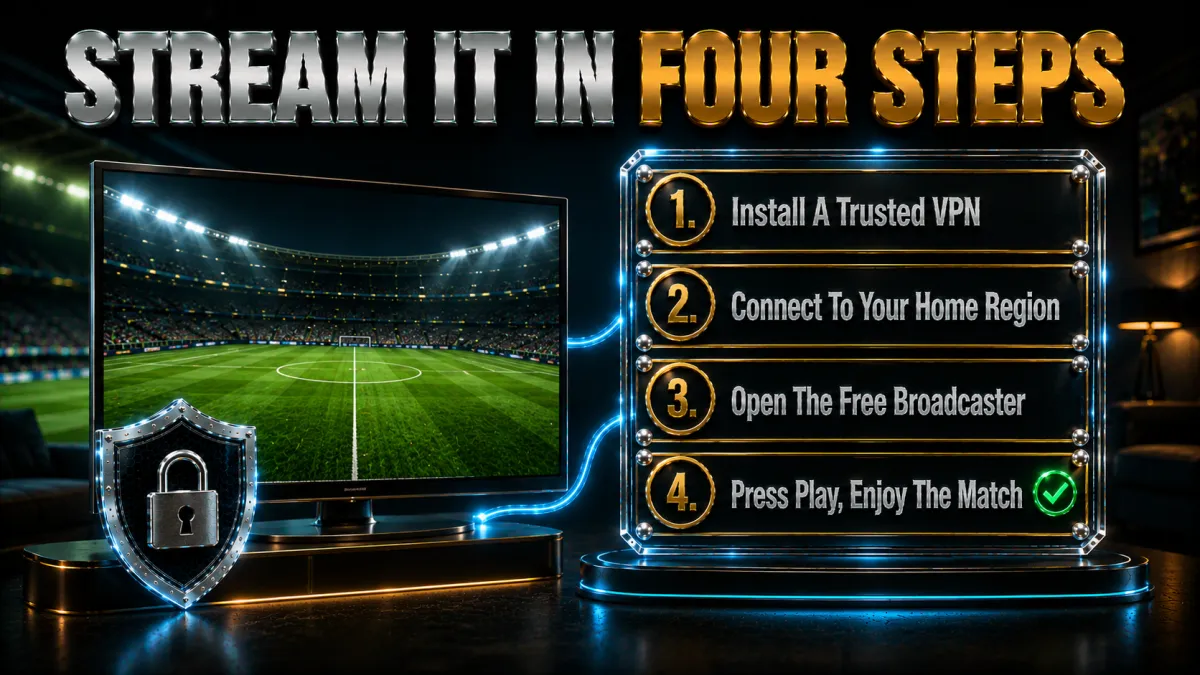
Getting set up is quick, and it is worth doing before the tournament so match day is stress-free. Here is the whole process, start to finish.
- Choose and install a VPN. Pick one of the providers above, subscribe, and install its app on the device you will watch on, whether a phone, computer, or supported TV.
- Connect to the right country. Choose a server in the country whose broadcaster you can legitimately access, ideally a nearby, lightly loaded one for the best speed.
- Open the broadcaster’s app or site. Launch the streaming service and sign in if it needs an account; a free public feed may just play, while a subscription feed needs your login.
- Turn on the kill switch and test early. Enable the kill switch, then run a test stream before match day so you can switch servers if a feed is slow, rather than during kickoff.
- Switch servers if a feed struggles. If a match buffers, disconnect and pick another server in the same country, since a fresh, less crowded node usually fixes it quickly.
Free and paid ways to watch
There is more than one legitimate way to follow the tournament, and the right mix depends on your budget and where you are. Here is how the options compare.
- Free public broadcasters. Some countries show matches free through public broadcasters in high definition, which is why fans travel to a server in one of those countries. It costs nothing beyond the VPN, but free feeds can be busy for marquee matches and are intended for local audiences, so respect the terms and keep a backup option in mind.
- Your existing home subscription. If you already pay for a broadcaster or a sports package that carries the World Cup, a VPN simply lets you use it while travelling by connecting back to your home country. This is often the cleanest route because it uses a service you legitimately subscribe to, and it keeps the commentary and layout you already know.
- A local paid streaming pass. Some broadcasters sell a short streaming pass for the tournament rather than a long contract, which can be good value for a few weeks of football. Compare the cost against a free feed and your existing subscriptions, and factor in the picture quality and number of screens each option allows for your household.
- Mix and match with a wide-network VPN. Many fans combine these, using a home subscription as the default and a free public feed as a backup when a server is busy or a match is on a different channel. A VPN with servers in several broadcasting countries makes switching between them simple, which is why network breadth is worth paying for during a tournament.
Fixing buffering and blocked feeds
Even a good setup hits the occasional snag, and almost all of them have a quick fix. Work through these in order and most problems clear in seconds.
- Switch to a different server. The most common fix for both buffering and a blocked feed is disconnecting and choosing another server in the same country, since a fresh node is often less crowded and not flagged by the service. Keep two or three servers in mind before a big match so you are not searching while the game is on.
- Check your protocol and connection. Make sure you are on a WireGuard-based protocol for the lowest overhead, and wire your device in or sit close to the router, because weak wifi causes a lot of stutter wrongly blamed on the VPN. These two checks resolve most speed complaints on a live feed.
- Clear the app cache or reinstall. If a broadcaster’s app shows a location error even on a working server, clearing its cache or reinstalling it often forces it to recheck your location cleanly. Old location data cached on the device, not the VPN, is a frequent and easily fixed cause of a stubborn block.
- Lower the quality if your line is slow. If your base internet is the limit rather than the VPN, dropping the feed from 4K to HD, or HD to standard, keeps the match playing smoothly instead of buffering. A steady standard-definition stream of a live goal beats a stuttering 4K one every time.
Should you use a free VPN for the World Cup?

A free VPN is tempting for a few weeks of football, but for live sport it usually disappoints. Here is the honest picture before you install one.
- Crowded servers buffer live feeds. Free tiers pack users onto a handful of overloaded servers, which is the opposite of the steady throughput a live match needs, so you often get more buffering than with no VPN at all. For a goal you cannot rewind, that unreliability alone rules most free apps out during a big match.
- Data caps end before the match does. Most free plans limit how much data you can use, and an HD football match burns through a typical cap well before full time, leaving you cut off at the worst moment. A tournament of long live streams is exactly the use case free data limits are worst suited to.
- Weak unblocking and few countries. Free VPNs rarely maintain the streaming access the major broadcasters require, and they offer few server locations, so the specific country feed you want often will not load. Reliable unblocking across several broadcasting countries is precisely what free services do not provide.
- Privacy is often the hidden price. Running servers costs money, and free apps frequently recoup it by logging and selling your activity or injecting trackers, which undermines the privacy you wanted. A low-cost paid plan with an audited no-logs policy and a money-back guarantee is the genuinely safe budget choice for the tournament.
How to choose a VPN for the World Cup
With the basics covered by all five picks, the right choice comes down to how you weight these factors for a month of live football.
- Speed and consistency first. A live match rewards steady throughput above all, so prioritise a provider that holds a fast HD or 4K feed under load on a modern protocol. This matters more than any single feature, because everything else is useless if the stream buffers when the ball is in the box.
- Network breadth for every feed. Since the tournament airs on broadcasters in many countries, favour a VPN with fast servers in each one you might use, so you can match the feed, language, and price you want. Breadth also gives you a backup when a popular server is busy during a marquee match.
- Proven streaming access. Choose a provider with a long record of reaching the major streaming apps, because a VPN that cannot open the broadcaster is no use for the tournament. The top picks have kept that access working for years, which is worth more than a longer feature list.
- Devices for your household. A tournament fills every screen, so match the connection limit to how many people will watch at once, and check for a Smart DNS option if a console or older TV is a main screen. Unlimited-device plans and router support let one subscription cover the whole house.
- A real money-back guarantee. A 30 to 45-day refund window lets you confirm your specific feeds load and hold on your own connection before committing, and across a weeks-long tournament that window can cover a good part of the football while you decide.
Related reading:
Frequently Asked Questions
Which is the best VPN for the FIFA World Cup 2026?
NordVPN is our top pick for its fast NordLynx protocol, huge network across the broadcasting countries, and reliable app unblocking. ExpressVPN is the most dependable for must-see live matches, Surfshark is the best value with unlimited devices, CyberGhost is the friendliest for beginners with the longest refund, and IPVanish offers steady speed on unlimited devices.
Can I watch the World Cup for free with a VPN?
Some countries show matches free through public broadcasters, and fans connect to a server in one of those countries to reach the feed. This sits against each broadcaster’s terms, so treat it as general information rather than advice, use a reputable provider, and read the rules of any service before relying on it for a match.
Is it legal to use a VPN to watch the World Cup?
Using a VPN is legal in most countries, but reaching a broadcaster from outside its intended region generally breaches that service’s terms of use, even when it is not a criminal matter. This guide is general streaming information, not legal advice, so follow the terms of any feed you access and accept that access is at the provider’s discretion.
Will a VPN slow my World Cup stream?
A good VPN on a nearby server and a WireGuard-based protocol adds only a little overhead, usually small enough that an HD or 4K feed stays smooth. Speed loss grows with distant servers or old protocols, so pick a close server, use a modern protocol, and wire your device in for the steadiest live feed.
What internet speed do I need to stream a match?
An HD live feed needs a steady several megabits per second, and a 4K feed several times that, held for the full match. Sustained speed matters more than a headline number, so a VPN that holds a fast feed under load on a busy evening is what keeps a match watchable, which is why we weight consistency heavily.
Can I stream the World Cup on my smart TV?
Often yes. Many Android TV and Fire TV devices run VPN apps directly, so you connect on the TV itself. For TVs and consoles that cannot run a VPN app, use a Smart DNS feature like ExpressVPN’s MediaStreamer, or run the VPN on your router so every device on the network is covered at once.
How many devices can watch at the same time?
It depends on the plan: Surfshark and IPVanish allow unlimited simultaneous connections, ExpressVPN eight, and NordVPN six, while a single router connection can cover every device on the network. A tournament fills every screen, so match the connection limit to how many people in your household will watch at once.
Which server should I connect to for the World Cup?
Connect to a server in the country whose broadcaster you can legitimately access, choosing a nearby, lightly loaded one for the best speed. If a feed buffers or is blocked, switch to another server in the same country, since a fresh, less crowded node usually fixes both problems quickly.
Do free VPNs work for streaming the World Cup?
Rarely well. Free VPNs crowd users onto slow servers that buffer live feeds, cap data that an HD match burns through fast, offer few countries, and often log your activity. A low-cost paid plan with proven streaming access and a money-back guarantee is a far safer and more reliable choice for the tournament.
Can a VPN protect me on public wifi during matches?
Yes. A VPN encrypts your traffic, so streaming from a hotel, cafe, or stadium concourse on open wifi keeps your logins and activity private from snoopers on the same network. During a global event that draws crowded networks and scammers, that encryption is a genuine everyday safeguard beyond just reaching a feed.
Should I use my home subscription or a free feed?
If you already pay for a broadcaster that carries the World Cup, a VPN lets you use it while travelling by connecting home, which is often the cleanest route. A free public feed is a good backup, and many fans keep both in mind, using a wide-network VPN to switch when a server is busy or a match is on another channel.
Is a paid VPN worth it just for the World Cup?
If you want reliable, high-quality streaming for a weeks-long tournament across your household, yes, because speed, unblocking, and device coverage all have real value. A 30 to 45-day money-back guarantee lets you confirm your feeds load and hold on your own connection, and can cover a good part of the football while you decide.
The Bottom Line
Choosing a VPN for the World Cup comes down to two things above all, because a live match is unforgiving: sustained speed that holds a feed through ninety minutes plus stoppage, and a wide enough network to reach whichever broadcaster carries the game you want. All five picks stream the tournament well, so the right one depends on whether you value all-round reliability, the best value across a full household, or the longest window to test it.
Whichever you choose, the winning routine is the same: install the app before the tournament, connect to a server in a country whose broadcaster you can legitimately access, turn on the kill switch, and test a feed early so match day is smooth.
- NordVPN is the safest all-round choice, with fast speeds, the widest useful network, and reliable unblocking.
- ExpressVPN is the most dependable for must-see live matches, with very stable streams and Smart DNS for TVs.
- Surfshark is the value winner, covering every screen in the house for the lowest long-term price.
- CyberGhost is the friendliest for beginners, with streaming-labelled servers and the longest 45-day refund.
- IPVanish is the unlimited-device pick, with steady speed for a busy household on one plan.
Here is the practical move: pick your provider for the priority that matters most, install it before the tournament starts, connect to a server in a broadcasting country you can legitimately access, and test your feeds during the refund window. If your matches load in the quality you want and hold steady through the busy evening slots, you have found your World Cup VPN, and the money-back window means it cost you nothing to be sure. Treat this as general streaming information, not legal advice, and follow each broadcaster’s terms.
Jyoti VPN Expert leads VPN testing at VPN Expert Guide, covering streaming and regional access, speed and latency testing, and leak checks on Windows, Android and router-level setups. Our guides are built from vendor documentation, provider terms and our own connection testing on a residential line in India, and we publish those measurements in full so readers can check them. Every guide is reviewed before publication and dated so you can see how current it is.
Meet our testing team →Last updated: August 24, 2026