
Best VPN for Saudi Arabia in 2026: What Is Actually Blocked, What Works, and What to Use
Saudi Arabia is not the UAE. WhatsApp calling was officially unblocked in 2017. But ISP throttling is real, content filtering covers 90+ categories, streaming libraries are restricted, and 29 percent of Saudi internet users reach for a VPN every month. Here is the complete picture and which VPN actually handles the Saudi network environment.
The real internet situation in Saudi Arabia in 2026

Most guides about internet restrictions in Saudi Arabia are either outdated or written for maximum alarm. The actual situation in 2026 is more nuanced than either everything is blocked or it is basically open. Here is an honest breakdown.
- What works without any VPN. Google, Gmail, YouTube, Instagram, X (Twitter), Snapchat, TikTok, Facebook, WhatsApp messaging and voice and video calls (officially since 2017), Zoom, Google Meet, Microsoft Teams, and the vast majority of apps that expats and travellers use daily all work without restriction.
- What is blocked without a VPN. Gambling and betting sites, pornography, content deemed politically sensitive or critical of the government or religion, alcohol retail sites, some VPN provider websites, and certain content on otherwise accessible platforms.
- The WhatsApp calling reality. Official VoIP restrictions were lifted in September 2017. WhatsApp calling works in Saudi Arabia. However, STC, Mobily, and Zain apply silent throttling to VoIP traffic at peak hours on specific networks, meaning calls connect but quality is poor or drops frequently. A VPN in obfuscation mode bypasses this throttling.
- The internet infrastructure. Saudi Arabia has some of the fastest mobile internet in the Middle East. Zain delivers average mobile download speeds of 86.4 Mbps, STC achieves 63.8 Mbps with the most consistent nationwide coverage. The speed is not the problem. The filtering is.
- Content filtering scale. The Communications, Space and Technology Commission (CST, formerly CITC) maintains filtering infrastructure across more than 90 classification categories. Freedom House’s Freedom on the Net 2025 report scored Saudi Arabia 25 out of 100, classifying it as Not Free.
What is actually blocked in Saudi Arabia

Understanding exactly what is and is not blocked removes the uncertainty that leads people to either over-prepare or under-prepare for internet access. The CST’s filtering covers more than 90 categories, but the ones that affect daily life for expats and visitors are more specific.
- Gambling and betting. All gambling sites, sports betting platforms, and online casino services are blocked. The block is comprehensive and consistently enforced across all Saudi ISPs.
- Pornography. All adult content sites are blocked at the network level. This is one of the oldest and most consistently maintained categories of filtering.
- Politically sensitive content. Sites critical of the Saudi government, the royal family, or Islam are blocked. This category is broadly defined and includes certain international news articles, blogs, and social media content that has been individually flagged.
- Alcohol retail and related content. Sites selling alcohol, brewing guides, and alcohol-related content are blocked. This reflects national law rather than just internet policy.
- Some VPN provider websites. The websites of certain VPN providers are blocked on Saudi networks. This means you cannot sign up or download the app once you are in Saudi Arabia if you did not prepare in advance. Apps already installed and configured before arrival are not affected.
- Certain streaming content. Individual content items on otherwise accessible platforms are sometimes blocked. Netflix Saudi Arabia is accessible but with a local catalogue that excludes content conflicting with local standards.
Is using a VPN legal in Saudi Arabia?
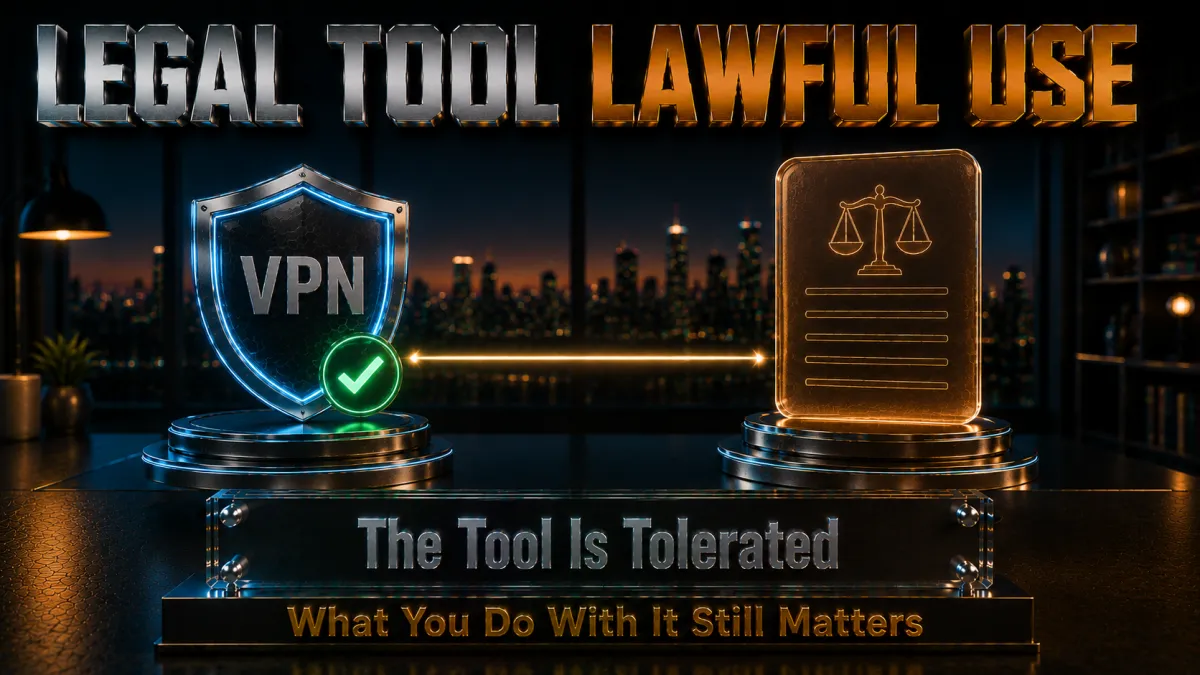
The legal status of VPNs in Saudi Arabia is more nuanced than most guides present. Getting it wrong in either direction is unhelpful. Here is the accurate picture as of 2026.
- VPN software on your device is not illegal. The Saudi government does not criminalise having VPN software installed. The CST has explicitly listed VPN use for business, banking, and privacy-related activities as lawful. An estimated 29 percent of Saudi internet users used a VPN in the past month.
- Using a VPN to access prohibited content is illegal. The Anti-Cyber Crime Law prohibits using any tool, including a VPN, to access content illegal under Saudi law. Using a VPN to visit gambling sites, access pornography, or reach politically prohibited content crosses the legal line. Penalties can reach SAR 500,000.
- Legal VPN use cases. Business remote access, protecting privacy on public Wi-Fi, securing banking connections, bypassing ISP throttling on VoIP calls for personal communication, accessing international streaming libraries, and general privacy protection are all legally tolerated.
- Enforcement focuses on content, not the tool. No widespread cases exist of arrests solely for using a VPN for legitimate purposes. Enforcement actions have been documented where VPN use was combined with accessing explicitly prohibited content, particularly political content or activism.
- The practical approach. Use a VPN with an audited no-logs policy from a provider outside Saudi jurisdiction. All three picks in this guide meet this standard.
Why Saudi ISPs are the real challenge: DPI explained

Most VPN guides for Saudi Arabia skip the most important technical detail: Saudi ISPs actively detect VPN traffic using deep packet inspection and throttle or block connections they identify as VPN tunnels. This is why a VPN that works in most countries may not work reliably in Saudi Arabia.
- What deep packet inspection does. DPI analyses internet traffic packets as they pass through the ISP’s network. Unlike basic IP blocking, DPI can identify VPN traffic by its characteristic patterns even when encrypted, because the encryption pattern itself leaves recognisable signatures in standard VPN protocols.
- Which protocols are detectable. OpenVPN and IKEv2 are commonly detected by Saudi DPI. Their traffic patterns are well-known and ISPs maintain updated detection signatures. Standard VPN connections using these protocols may connect briefly then get throttled or cut.
- What obfuscation does. Obfuscation disguises VPN traffic as regular HTTPS web traffic. From the ISP’s perspective, an obfuscated VPN connection is indistinguishable from someone visiting a website. STC, Mobily, and Zain cannot throttle it without throttling all web browsing.
- Which providers handle Saudi DPI. NordVPN’s Obfuscated Servers mode, ExpressVPN’s Lightway protocol with automatic mode, and Surfshark’s NoBorders mode all specifically address DPI detection. Standard VPN apps without these features will be inconsistent on Saudi networks regardless of server quality.
5 best VPNs for Saudi Arabia in 2026

These three were assessed specifically on DPI bypass capability, privacy assurance in the Saudi legal context, and performance on Saudi ISP infrastructure.
1. NordVPN – Best overall for Saudi Arabia
NordVPN leads for Saudi Arabia on two features that matter specifically in this network environment. Obfuscated Servers disguise VPN traffic as regular HTTPS, bypassing the deep packet inspection used by STC, Mobily, and Zain. Without obfuscation, a standard VPN on Saudi ISPs is identifiable and gets throttled. With obfuscated servers active, the ISP sees encrypted web traffic indistinguishable from any HTTPS connection.
The privacy assurance is equally important in the Saudi context. NordVPN’s no-logs policy has been audited multiple times by PricewaterhouseCoopers and Deloitte. Panama jurisdiction means no mandatory data retention and no legal compulsion to cooperate with Saudi regulatory requests. NordLynx keeps speeds high enough for HD streaming even on networks that throttle standard protocols.
✔ Pros
- Obfuscated Servers bypass Saudi ISP deep packet inspection specifically
- No-logs policy audited by PwC and Deloitte, Panama jurisdiction outside Saudi legal reach
- NordLynx delivers strong speeds despite ISP throttling environment
- Saudi Arabia servers for accessing Saudi-only banking and services from abroad
- 10 simultaneous connections covers all household devices
✘ Cons
- Obfuscation must be manually enabled in Settings before connecting
- Monthly plan expensive without long-term commitment
| Jurisdiction | Panama (outside 14 Eyes) |
| No-logs audit | PwC + Deloitte, multiple audits |
| Saudi DPI bypass | Obfuscated Servers mode |
| Price from | ~$3/mo (long-term plan) |
| Simultaneous devices | 10 |
| Money-back guarantee | 30 days |
2. ExpressVPN – Most proven through Saudi enforcement cycles
ExpressVPN’s primary advantage in Saudi Arabia is its sustained track record through multiple CST enforcement cycles. Saudi Arabia’s filtering infrastructure updates periodically, and providers who have maintained access through these updates have proven something newer alternatives have not: they adapt fast enough to stay functional when the rules change. ExpressVPN has maintained consistent performance in Saudi Arabia longer than most competitors.
Lightway protocol’s automatic mode selects the optimal configuration for current Saudi network conditions without requiring the user to understand which protocol works best on which ISP. RAM-only servers provide the strongest possible technical no-logs implementation: server data is wiped completely on each reboot, making it physically impossible for logs to exist even during a server seizure.
✔ Pros
- Longest sustained track record of consistent performance in Saudi Arabia
- Lightway automatic mode selects the best configuration for Saudi network conditions
- RAM-only servers: no data physically persists after a reboot
- British Virgin Islands jurisdiction, outside Saudi legal reach
- Dedicated router app for household-wide protection on all devices
✘ Cons
- Most expensive of the three picks on long-term plans
- Only 8 simultaneous connections
| Jurisdiction | British Virgin Islands |
| No-logs audit | Independent audit + RAM-only servers |
| Saudi DPI bypass | Lightway automatic mode |
| Price from | ~$5/mo (long-term plan) |
| Simultaneous devices | 8 |
| Money-back guarantee | 30 days |
3. Surfshark – Best value with NoBorders mode
Surfshark’s NoBorders mode activates automatically when the app detects that a network is blocking or throttling standard VPN protocols. On Saudi ISP networks where STC or Mobily are applying DPI throttling, NoBorders switches configuration to one that looks like HTTPS without requiring the user to manually change settings.
Unlimited simultaneous connections mean an entire household, a family in a compound, or a team at an office can all be covered under one Surfshark subscription. At the lowest long-term price of the three picks with a Cure53-audited no-logs policy, Surfshark is the obvious choice for families and cost-conscious expats.
✔ Pros
- NoBorders mode automatically adapts when Saudi ISPs throttle VPN traffic
- Unlimited simultaneous device connections on one subscription
- Lowest long-term price of the three picks
- No-logs policy independently audited by Cure53
- CleanWeb blocks malicious sites and tracking on Saudi networks
✘ Cons
- Netherlands jurisdiction is within the EU, less protective than Panama or BVI
- Speeds on very distant servers can drop during peak hours
| Jurisdiction | Netherlands (EU) |
| No-logs audit | Cure53 independent audit |
| Saudi DPI bypass | NoBorders mode, automatic |
| Price from | ~$2.50/mo (long-term plan) |
| Simultaneous devices | Unlimited |
| Money-back guarantee | 30 days |
4. CyberGhost, easiest for beginners
CyberGhost is the easiest VPN to get running in Saudi Arabia for someone who does not want to fiddle with settings. The apps are one-tap, servers are clearly labeled, and connecting to a nearby location for everyday privacy or to reach home-country services is quick and painless. For a first VPN, that approachability is its strongest card.
The underlying technology is sound: WireGuard for speed, a kill switch and DNS-leak protection built in, and a Romania base with no data-retention law behind a strict no-logs policy. Those are exactly the protections that justify installing a VPN when privacy is the goal.
Be aware of two things. On heavily filtered connections, the top picks with dedicated obfuscation can connect more dependably than CyberGhost, so it fits best where blocking is moderate; and VPN use in Saudi Arabia falls in a legal grey area, so use one responsibly and never for anything unlawful locally. The 45-day money-back guarantee, the longest of the five, gives you ample time to confirm it holds a stable connection on your network.
✔ Pros
- Beginner-friendly apps and setup
- Romania-based, no data-retention law
- 45-day window to test on Saudi networks
- Large server network
- Decent everyday speeds
✘ Cons
- Obfuscation less consistent through heavy DPI
- Fewer devices than the value picks
| Saudi DPI bypass | Decent |
| Jurisdiction | Romania |
| No-logs | Independently audited |
| Price from | ~$2 to $3/mo (long-term plan) |
| Simultaneous devices | 7 |
| Money-back guarantee | 45 days |
5. IPVanish, best for many devices
IPVanish appeals in Saudi Arabia to users who put speed and device coverage first. Because it owns its server network, throughput stays consistent, and unlimited simultaneous connections let a household run it on every phone, tablet, and laptop under a single account without logouts.
The apps are clean and functional, with WireGuard, a kill switch, and split tunneling, so once connected it works quietly in the background as an everyday privacy tool. For people who mainly want fast, secure browsing and access to services from back home, it covers the essentials.
The caveats are the same ones to weigh in any heavily censored region: IPVanish does not emphasize dedicated obfuscation, so it may struggle on the most aggressively filtered networks, and it is US-based inside the Five and Nine Eyes alliances. It offsets that with an independently audited no-logs policy and a 30-day money-back guarantee, and as with any VPN here, use it responsibly and within local law.
✔ Pros
- Fast owned network
- Unlimited simultaneous devices
- Simple, uncluttered apps
- Strong long-term value
- Good for lighter networks
✘ Cons
- Weakest DPI bypass of the five
- US-based, inside the 9 Eyes alliance
| Saudi DPI bypass | Basic |
| Jurisdiction | United States |
| No-logs | Claimed |
| Price from | ~$3 to $4/mo (long-term plan) |
| Simultaneous devices | Unlimited |
| Money-back guarantee | 30 days |
| Feature | NordVPN | ExpressVPN | Surfshark | CyberGhost | IPVanish |
|---|---|---|---|---|---|
| Saudi DPI bypass | Obfuscated Servers | Lightway auto | NoBorders auto | Decent | Basic |
| Jurisdiction | Panama | British Virgin Islands | Netherlands (EU) | Romania | United States |
| No-logs audit | PwC + Deloitte | Yes + RAM-only | Cure53 | Independently audited | Claimed |
| Saudi servers | Yes | Yes | Yes | Yes | Yes |
| Simultaneous devices | 10 | 8 | Unlimited | 7 | Unlimited |
| Price from | ~$3/mo | ~$5/mo | ~$2.50/mo | ~$2.50/mo | ~$3.50/mo |
| Money-back | 30 days | 30 days | 30 days | 45 days | 30 days |
How to set up a VPN in Saudi Arabia: exact configuration
Standard VPN setup instructions do not account for Saudi Arabia’s DPI environment. These steps are specific to getting a VPN working reliably on STC, Mobily, or Zain networks.
- Install before arriving in Saudi Arabia. Some VPN provider websites are blocked on Saudi networks. Download and install the app at home before travel. Sign in and save your credentials. This one step prevents hours of frustration on arrival.
- Enable obfuscation before your first connection attempt. On NordVPN: Settings, then Advanced, enable Obfuscated Servers. On Surfshark: Settings, enable NoBorders mode. On ExpressVPN: automatic protocol selection handles this. Without obfuscation, a standard VPN connection on Saudi ISPs may be detected and throttled immediately.
- Choose a nearby server for best speeds. For general use, Turkey, Egypt, or India servers give the lowest latency from Saudi Arabia. For European streaming like BBC iPlayer, use a UK server. For US Netflix, use a US server.
- Test on mobile data first. VPN performance varies between STC, Mobily, and Zain and can vary by city and time of day. Test your VPN on the network you will use most before a critical call or streaming session.
- Enable the kill switch. If the VPN connection drops, the kill switch prevents your real Saudi IP from being exposed. Find it in Settings on all three apps and keep it permanently enabled.
- For WhatsApp call quality issues. Connect to any nearby VPN server in obfuscation mode before opening WhatsApp. The VPN encrypts traffic so the ISP cannot identify it as VoIP and cannot apply throttling. The call routes through the VPN server rather than directly through Saudi telecom infrastructure.
Streaming in Saudi Arabia: what a VPN unlocks
Saudi Arabia has functional access to major streaming platforms but with meaningful library restrictions and no access to services geo-locked to other countries. A VPN addresses both simultaneously.
- Netflix Saudi Arabia vs international libraries. Netflix operates with a local catalogue. Content conflicting with local standards is absent or edited. A US or UK VPN server opens fuller catalogues with complete, unedited libraries significantly larger than the Saudi version.
- BBC iPlayer for British expats. BBC iPlayer is geo-locked to the UK and refuses all Saudi IP addresses. British professionals in Riyadh and Jeddah consistently cite iPlayer as their top VPN use case. A UK VPN server restores full access immediately.
- JioHotstar for Indian expats. Saudi Arabia hosts one of the world’s largest Indian diaspora communities. JioHotstar is geo-locked to India. A VPN with a virtual India IP restores access to live IPL cricket, ICC tournaments, Bollywood, and regional Indian content unavailable from any Saudi network.
- Disney+ content gaps. Disney+ is available in Saudi Arabia but certain content is absent. A US or UK server opens the complete catalogue including content not on the Saudi-market library.
- Sports streaming. DAZN, certain Premier League coverage, and sports content from other markets require a VPN with the appropriate country server. Saudi Arabia’s SSC Sports platform is accessible domestically without a VPN.
- Pakistani and Arabic streaming. ARY Digital, GEO TV, and similar Pakistani streaming services are geo-restricted. Pakistani expats use India or Pakistan VPN servers to access this content. Arabic content from Egyptian and Lebanese platforms with geo-restrictions similarly requires a regional server.
VoIP and calling apps in Saudi Arabia

The VoIP situation in Saudi Arabia is frequently misunderstood because it changed significantly in 2017 and many guides have not been updated since. Here is the accurate 2026 status.
- WhatsApp calling is officially allowed since 2017. The Saudi government lifted VoIP restrictions in September 2017. WhatsApp voice and video calls are officially permitted. FaceTime, Skype, and other major VoIP apps are also officially available. This is a fundamental difference from the UAE, where hard blocks remain in place.
- Why calls still have quality problems. Despite official permission, STC, Mobily, and Zain apply silent throttling to VoIP traffic on certain networks at peak times. Calls connect but audio quality is poor, video drops frames, or the call disconnects. This is traffic management driven by the same commercial incentives as VoIP bans in other Gulf countries.
- A VPN solves the quality problem. When a VPN is active, the ISP cannot identify traffic as VoIP and cannot apply VoIP-specific throttling. Calls route through the VPN server rather than directly through Saudi ISP infrastructure. This consistently resolves the quality degradation users experience without a VPN.
- Business conferencing apps are unrestricted. Zoom, Microsoft Teams, Google Meet, Cisco Webex, and other enterprise conferencing tools work without restriction in Saudi Arabia. The throttling that affects consumer VoIP apps does not typically affect enterprise platforms, which are in a different regulatory category.
What the 13 million expats in Saudi Arabia use VPNs for

Saudi Arabia has more than 13 million expatriates, over 40 percent of the total population. Understanding what these communities actually use VPNs for gives a more honest picture than abstract censorship discussions.
- Indian and South Asian expats: cricket above everything. The largest expat community is Indian, followed by Pakistani and Bangladeshi workers across construction, domestic services, healthcare, and retail. Live IPL cricket on JioHotstar, family calls without quality issues, and ARY/GEO content for Pakistani expats are the primary VPN drivers.
- British and Western expats: streaming and privacy. UK and European professionals in the oil, financial, and consulting sectors primarily use VPNs for BBC iPlayer, home country Netflix libraries, and general privacy on Saudi corporate and hotel networks.
- Filipino expats: WhatsApp quality and entertainment. The Philippines community, concentrated in domestic work and healthcare, relies on WhatsApp video calls to family in Manila. Call quality on Saudi ISPs without a VPN is unreliable. A VPN is often a genuine necessity for this community, not a convenience.
- Business users: secure remote access. Multinational companies with Saudi operations use VPNs for employee remote access to company intranets, secure communications on public Wi-Fi, and access to internal tools. Business VPN use is explicitly legally approved under the CST framework.
- Travellers and pilgrims. Saudi Arabia receives millions of international visitors annually including Hajj and Umrah pilgrims. Short-term visitors benefit from a VPN for maintaining access to home country apps and streaming services during their stay.
No-logs policies and jurisdiction: why they matter in Saudi Arabia

The legal context in Saudi Arabia makes the VPN provider’s jurisdiction and logging policy more consequential than in most countries.
- Why Saudi jurisdiction matters for VPN choice. Saudi Arabia has a track record of using technology and legal frameworks to monitor online activity, particularly around political content. A VPN provider headquartered in a country that routinely cooperates with Saudi legal requests is a different risk profile than one based in Panama or the British Virgin Islands.
- What a no-logs audit actually proves. An audited no-logs policy means an independent security firm has physically inspected the provider’s server infrastructure and confirmed that the logging systems the policy describes are actually implemented. An unaudited claim is an unverifiable marketing statement.
- RAM-only servers: the strongest technical assurance. ExpressVPN’s TrustedServer technology runs all servers exclusively in RAM. Every reboot wipes everything. There are no logs to produce even under a server seizure, because the data does not persist on disk.
- The practical implication. If a Saudi regulatory authority approached NordVPN, ExpressVPN, or Surfshark with a request for user records, all three have both the legal basis to refuse (non-Saudi jurisdiction) and the technical absence of records to produce (audited no-logs). This is the correct combination for a VPN used in Saudi Arabia.
Public and hotel Wi-Fi safety in Saudi Arabia
Saudi Arabia’s hotel networks, shopping mall Wi-Fi, and other public networks carry the same risks as public networks globally, with some additional considerations specific to the Saudi environment.
- Hotel networks log traffic. Saudi hotels, particularly those operating under local regulations, may log network traffic more comprehensively than hotels in other countries. A VPN encrypts your connection so that the hotel network sees only that you are connected to a VPN server, not what you are accessing.
- Airport and mall Wi-Fi requires mobile registration. Saudi airports and shopping malls typically require mobile number registration to access their Wi-Fi. This links your internet activity to your registered identity. A VPN active from the moment you connect prevents the network from building a useful activity log even with your identity registered.
- Corporate networks in Saudi Arabia. Business travellers using corporate networks at Saudi client sites should be aware those networks may be monitored under local IT policy. A VPN on your personal device routes personal traffic outside the corporate network, but corporate device traffic remains visible to the IT department regardless.
- The kill switch on public networks. If your VPN connection drops on a public Saudi network and the kill switch is not active, your device immediately connects without protection. Enable the kill switch before connecting to any public Wi-Fi, not after.
Related reading:
Frequently Asked Questions
Is using a VPN legal in Saudi Arabia?
VPN use is legal in Saudi Arabia for legitimate purposes including business, banking, privacy protection, and general internet access. The CST has explicitly approved VPN use for these categories. What is illegal is using a VPN to access content prohibited under Saudi law such as gambling, pornography, or politically restricted content. Enforcement focuses on the content accessed rather than the VPN tool itself. No widespread cases of arrests solely for legitimate VPN use have been reported.
Which VPN works best in Saudi Arabia in 2026?
NordVPN is the best overall pick. Obfuscated Servers bypass Saudi ISP deep packet inspection, NordLynx delivers strong speeds, and the PwC and Deloitte-audited no-logs policy with Panama jurisdiction provides the strongest privacy assurance. ExpressVPN is the most proven for sustained reliability through CST enforcement cycles. Surfshark is the best value with NoBorders mode and unlimited device connections.
Is WhatsApp calling blocked in Saudi Arabia?
No. Official WhatsApp calling restrictions were lifted in September 2017. WhatsApp voice and video calls are officially permitted. However, STC, Mobily, and Zain apply silent throttling to VoIP traffic on certain networks at peak times, causing poor call quality. A VPN in obfuscation mode bypasses this throttling by encrypting traffic so the ISP cannot identify it as VoIP.
What websites and apps are blocked in Saudi Arabia?
Saudi Arabia’s CST blocks content across more than 90 categories. The most relevant for expats and visitors include gambling and betting sites, pornography, politically sensitive content, alcohol retail sites, and some VPN provider websites. Standard social media including Instagram, X, TikTok, Snapchat, and Facebook work normally. WhatsApp messaging and calling both work without restriction.
Do Saudi ISPs block VPNs?
Saudi ISPs use deep packet inspection to identify standard VPN protocols and can throttle connections identified as VPN traffic. Obfuscation is essential on Saudi networks. An obfuscated VPN connection disguises traffic as regular HTTPS, which ISPs cannot throttle without disrupting all web traffic. NordVPN’s Obfuscated Servers, ExpressVPN’s Lightway auto mode, and Surfshark’s NoBorders mode all handle Saudi DPI specifically.
Can I watch Netflix with a VPN in Saudi Arabia?
Yes. Netflix operates in Saudi Arabia with a local catalogue that excludes certain content. Connecting to a US or UK VPN server opens those countries’ full catalogues. Connect to the VPN server before opening the Netflix app, and switch to a different server if you encounter a proxy error.
Can I access BBC iPlayer in Saudi Arabia with a VPN?
Yes. BBC iPlayer is geo-locked to UK IP addresses and refuses all non-UK connections. Connecting to a UK VPN server gives you a UK IP and iPlayer loads with full access to all BBC content. All three picks maintain reliable UK server access. British expats in Riyadh and Jeddah use this regularly for catching up on UK television.
Is it safe to use a VPN on Saudi hotel Wi-Fi?
Yes, and recommended. Saudi hotel networks may log traffic more comprehensively than in other countries. A VPN encrypts your connection so the hotel network sees only that you are connected to a VPN server. For business travellers handling sensitive data, a VPN on hotel Wi-Fi in Saudi Arabia is essentially mandatory.
Can I use a free VPN in Saudi Arabia?
Free VPNs are not recommended for Saudi Arabia. They lack the obfuscation infrastructure required to bypass Saudi ISP deep packet inspection. Many free VPN websites are themselves blocked in Saudi Arabia. Data caps make sustained use impractical. Use a paid VPN’s 30-day money-back guarantee instead for risk-free testing without these problems.
Will a VPN work for the Hajj and Umrah pilgrimage?
Yes. Pilgrims can use a VPN on their devices during their stay. Set up and configure the VPN before arriving in Saudi Arabia, since some VPN provider websites are blocked on Saudi networks. Arriving with the app installed and a working server selected takes this problem completely off the table.
Does a VPN work on Saudi mobile data networks?
Yes, with obfuscation enabled. All three Saudi mobile carriers including STC, Mobily, and Zain employ deep packet inspection on their mobile networks. An obfuscated VPN bypasses this detection. Zain delivers the fastest average mobile speeds at around 86 Mbps, and VPN overhead is manageable for streaming and calling on Zain’s 5G network in major cities.
Can I access JioHotstar for IPL cricket from Saudi Arabia?
Yes. JioHotstar is geo-restricted to India. Connecting to a VPN server with a virtual India IP opens the full JioHotstar catalogue including live IPL cricket. All three picks in this guide offer India servers for this purpose. For the large Indian expat community in Saudi Arabia, this is one of the most immediate and common VPN use cases.
The Bottom Line
Saudi Arabia’s internet situation is often described incorrectly, in both directions. It is not as closed as outdated guides suggest, and it is not as open as travellers sometimes assume. WhatsApp calling works. Standard social media works. But ISP throttling degrades VoIP quality, content filtering is real across 90+ categories, and international streaming libraries are either absent or restricted. The 29 percent of Saudi internet users who use VPNs monthly have figured this out empirically.
The single technical requirement that separates a VPN that works in Saudi Arabia from one that does not is obfuscation. Standard VPN protocols are detectable by Saudi ISP DPI. A VPN without obfuscation will be inconsistent on STC, Mobily, and Zain. This narrows the field considerably.
- NordVPN is the best overall pick. Obfuscated Servers for Saudi DPI, PwC and Deloitte-audited no-logs, Panama jurisdiction, NordLynx for strong speeds, and 10 device connections for the whole household.
- ExpressVPN is the most proven for sustained reliability. The longest track record through Saudi CST enforcement cycles, automatic protocol selection, and RAM-only servers that cannot physically retain logs.
- Surfshark is the best value pick. NoBorders automatic adaptation for Saudi networks, unlimited connections for families and compounds, and the lowest long-term price of the three.
- CyberGhost is the friendliest entry point, Romania-based with a 45-day window to test on your Saudi network first.
- IPVanish adds unlimited devices and strong speed, but has the weakest DPI bypass of the five, so it suits lighter networks.
Set everything up before you land. Some VPN provider websites are blocked on Saudi networks, which makes signing up and downloading difficult once you are already in the country on STC or Mobily. Arriving with the app installed, obfuscation enabled, and a working server confirmed takes a frustrating first-hour problem completely off the table.
Ketan VPN Expert covers privacy and security at VPN Expert Guide: VPN protocols, encryption, leak protection and VPN legality. Our privacy guides are checked against ipleak.net and dnsleaktest.com results, and we publish the date of every check so you can see how current it is.
Meet our testing team →Last updated: August 24, 2026