
Best VPN for India in 2026: Privacy, Streaming, Gaming & UPI Safety
India’s regulatory landscape has shifted dramatically. CERT-In’s logging directive, rising ISP surveillance, and geo-blocked streaming have made choosing the right VPN more important than ever. Here are the services that actually deliver.
What is a VPN and how does it work in India?
A VPN, or Virtual Private Network, creates an encrypted tunnel between your device and the internet. When you connect to a VPN server, your real IP address is hidden and websites or apps only see the VPN server’s IP. In the Indian context that has two immediate practical effects: your Internet Service Provider, whether Jio, Airtel, BSNL or Vi, cannot see which sites you are visiting, and the platform you are accessing cannot determine your real location.
Two things happen simultaneously under the hood. First, encryption converts your data into unreadable ciphertext before it leaves your device. Second, tunneling sends that encrypted data securely from your device to the VPN server and then out to the open internet. Modern VPNs combine both into a seamless process that runs in the background.
- Encryption standard. Top providers use AES-256, the same cipher banks and militaries rely on. There is no practical shortcut through it with today’s computing power.
- Modern protocols. WireGuard-based protocols, NordVPN’s NordLynx, ExpressVPN’s Lightway, and Surfshark’s WireGuard implementation, are faster and more battery-efficient than older options. OpenVPN remains a solid fallback when you need maximum compatibility.
- IP masking. You get a new IP address from whichever server location you choose. From India you can pick up a US IP, and from abroad you can pull an India IP to access geo-restricted local content.
- Kill switch. If the VPN connection drops unexpectedly, a kill switch cuts your internet instantly so your real IP never leaks even for a second.
- DNS and IPv6 leak protection. Properly built VPNs route all DNS queries through the encrypted tunnel and block IPv6 traffic that could expose your real identity even when the main tunnel is active.
VPN demand in India has grown far beyond streaming. People now do banking on public Wi-Fi, work remotely across corporate networks, and read daily reports of data breaches and scam operations. A VPN adds a meaningful security layer across all of those scenarios without requiring any technical knowledge to operate. You install the app, connect to a server, and everything else happens automatically.
Why do you need a VPN in India in 2026?
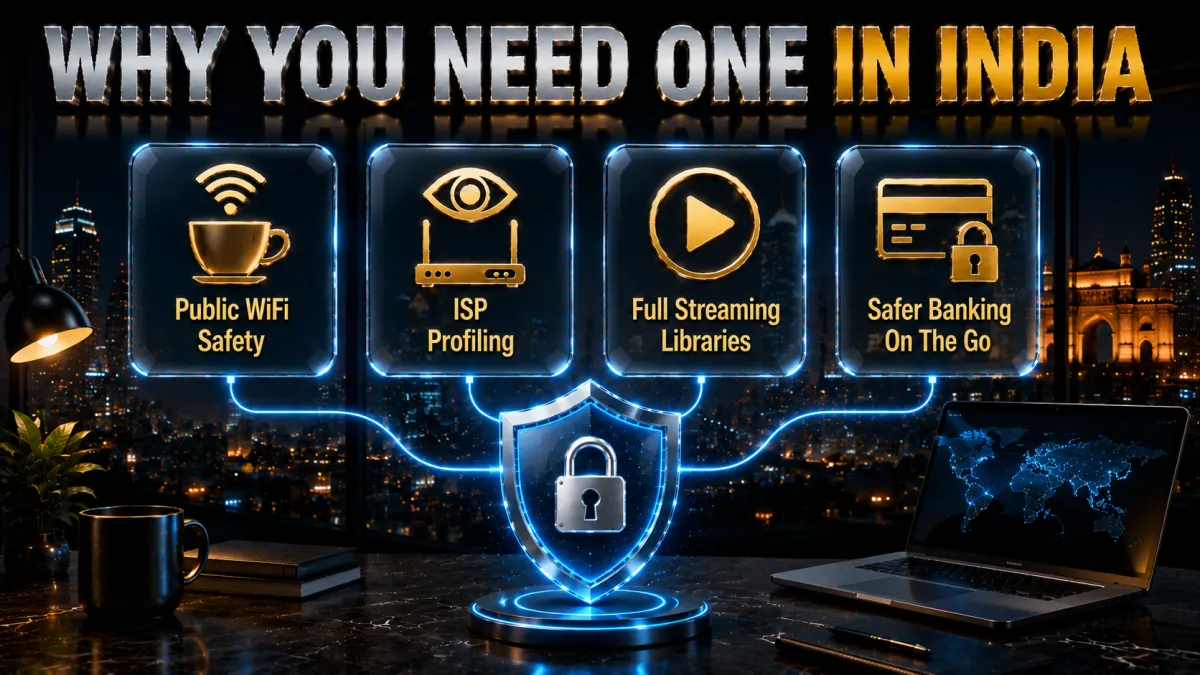
A few years ago most Indians ran a VPN primarily to access blocked content. The picture has changed considerably. Digital payments have exploded, remote work is mainstream, scam operations targeting Indian users have become more sophisticated, and the regulatory environment around internet privacy has tightened. Below are the real reasons people are running VPNs in India right now.
For gaming-specific setup, compare our gaming VPN low-ping tests, BGMI VPN guide, and PUBG VPN warning guide.
- ISP tracking and surveillance. Your ISP can see every unencrypted request you make by default. A VPN closes that window completely. Your browsing activity stays between you and the VPN provider rather than sitting in a telecom company’s logs where it can be accessed, sold, or subpoenaed.
- Public Wi-Fi security. The free Wi-Fi at cafes, airports, metro stations, and malls is often unencrypted. Those networks are straightforward targets for man-in-the-middle attacks where someone intercepts traffic between your device and the access point. A VPN encrypts your connection at the device level, making that interception useless.
- Banking and UPI safety. India leads the world in digital payments volume. That success has made Indian users a prime target for phishing, fake payment portals, and the so-called digital arrest scams that have cost victims significant amounts. While a VPN does not stop you from clicking a phishing link, it does protect the actual connection when you use legitimate banking portals on untrusted networks.
- Streaming and geo-restricted content. Netflix, Amazon Prime Video, and JioHotstar all serve different catalogues by region. A VPN lets you access other regions’ libraries from India and, crucially, lets you access your Indian subscriptions when you travel abroad. Without an Indian IP, JioHotstar simply refuses to load.
- Occasional website and app blocks. India uses Section 69A of the IT Act to block specific URLs, apps, and services when authorities deem it necessary on grounds including national security and public order. The Telegram block in June 2026 was a recent example. A VPN can route around those blocks provided you are using the platform for lawful purposes.
- NRI and travel use. Indians studying or working abroad lose access to JioHotstar, certain Indian bank portals, and regional streaming services the moment they connect from a foreign IP. A VPN with a virtual India server restores that access without you needing to be physically in the country.
- Corporate remote access. Many companies in India and internationally require employees to use a VPN to connect to internal systems. Consumer VPNs handle this differently from enterprise solutions, but the underlying technology is the same.
A VPN is not a magic fix for every threat. It will not protect you from malware, weak passwords, or the social engineering tactics that underpin most successful scams. But combined with good digital hygiene, a reputable VPN meaningfully reduces your exposure, and in India’s current regulatory and threat environment that reduction is worth having.
Is using a VPN legal in India?

Yes, using a VPN is legal for ordinary users in India. There is no law that criminalises the act of running a VPN on your device. Millions of people use them daily for privacy, security, remote work, and legitimate content access, and that use is entirely lawful.
The confusion arises because in 2022 India’s regulator CERT-In imposed new rules on VPN providers, not on VPN users. That distinction is important. The rules govern companies operating VPN services, not the individuals who use them.
- For users: you can download, install, and run a VPN freely. The act of using one is not illegal.
- For your activity: whatever is illegal without a VPN remains illegal with one. Using a VPN does not legalise piracy, fraud, or accessing content that is banned for substantive legal reasons. The tool does not change the nature of what you do through it.
- For providers: companies that operate VPN servers physically located in India face data-retention obligations under the CERT-In directive. More on this in the next section.
There is also an important distinction between blocking and banning. Under Section 69A of the IT Act, the government can order the blocking of specific websites, apps, or URLs on defined grounds. That is targeted content restriction, not a blanket ban on VPN technology itself. The software remains lawful even when certain content accessible through it is not.
What the CERT-In directive means for your privacy

In April 2022, CERT-In, India’s national cybersecurity agency operating under the Ministry of Electronics and Information Technology, issued a sweeping directive. Under its terms, any VPN provider operating physical servers in India must retain detailed subscriber data for a minimum of five years, even after a user cancels their subscription.
The data that must be retained includes real names, assigned IP addresses, usage timestamps, email addresses used at registration, the stated reason for using the service, and validated contact information. For a no-logs VPN, that requirement directly contradicts the core privacy promise the service is built around.
- Five-year retention window. Records must be kept for at least five years and handed over to government authorities on request. That timeframe is unusually long by global standards.
- April 2026 escalation. Enforcement pressure increased in April 2026 when MeitY additionally directed VPN providers to actively block access to certain banned gambling and prediction-market platforms, extending provider obligations beyond data retention into content enforcement.
- How major providers responded. ExpressVPN, NordVPN, Surfshark, and Private Internet Access all removed their physical India servers rather than comply with the logging requirement. Keeping logs would have meant having something to hand over, which violates the no-logs model entirely.
The practical consequence for you as a user is straightforward. If you want an India IP address, top providers now give you that through virtual India servers. These servers assign you a genuine Indian IP address but their actual hardware sits outside India, typically in Singapore, the UK, or another nearby jurisdiction. You get the benefit of an India location without your data falling under Indian retention jurisdiction.
- Why virtual servers are the right answer here. You get streaming access and Indian IP functionality while the provider’s actual logs, or rather their absence of logs, remain outside the reach of the CERT-In directive.
- Why audited no-logs matters. A provider that genuinely keeps no logs has nothing to hand over regardless of what order arrives. An independent audit that verifies that claim is the strongest evidence available that the policy is real rather than just marketing copy.
- What to avoid. Any provider that still operates physical servers in India is subject to the retention requirement for traffic passing through those servers. Check before you sign up.
Every pick in this guide either uses virtual Indian servers with hardware based outside India, or has undergone an independent no-logs audit, or both. In the post-CERT-In environment those are the two things that matter most.
How to choose the best VPN for India
Every VPN’s marketing claims the fastest speeds and the strongest security. In India’s specific context some factors matter considerably more than others. Below is the framework we apply when evaluating providers for Indian users.
- Independently audited no-logs policy. A self-declared no-logs policy is not enough. Look for a provider whose policy has been verified by a reputable third-party auditor. In the CERT-In environment this is the single most important filter to apply before anything else.
- Virtual India servers with offshore hardware. Confirm that the provider offers virtual Indian IP addresses served from hardware located outside India. This gives you access to Indian content without the data-retention exposure that comes with physical in-country infrastructure.
- Streaming performance. The VPN must reliably unblock JioHotstar, Netflix’s Indian and international libraries, Amazon Prime Video, and ideally SonyLIV. Streaming platforms continuously update their VPN detection, so a provider that worked six months ago may not work today without ongoing maintenance on their end.
- Speed and modern protocols. WireGuard-based protocols are generally the fastest available. For 4K streaming and online gaming, the difference between a fast and a slow VPN is visible. Look for NordLynx, Lightway, or WireGuard as the default protocol option.
- Server network size and spread. More servers across more countries means less congestion and more choices when a specific server is overloaded or blocked. For Indian users, nearby servers in Singapore, Hong Kong, or the UAE are useful fallbacks.
- Device compatibility. You need Windows, macOS, Android, and iOS covered as a minimum. Router support and Smart TV apps extend the value significantly. Check how many simultaneous connections the plan allows.
- Kill switch and leak protection. A reliable kill switch with DNS and IPv6 leak protection is non-negotiable. Test any VPN you try using a leak-testing site before committing to a subscription.
- Value and money-back guarantee. Long-term plans offer the best per-month pricing across all three picks. Every reputable provider offers a 30-day money-back guarantee that lets you test the service thoroughly without financial risk.
- Customer support. 24/7 live chat is the practical standard. When a streaming server stops working on a Friday evening you want a response in minutes, not the next business day.
One practical tip before you commit: test whichever VPN you choose within its money-back window using your actual use cases. Connect from India, open JioHotstar, try a foreign Netflix library, run a speed test, check for leaks. If everything works, keep it. If not, get a refund and try the next pick. That is exactly how this shortlist was built.
5 best VPNs for India in 2026
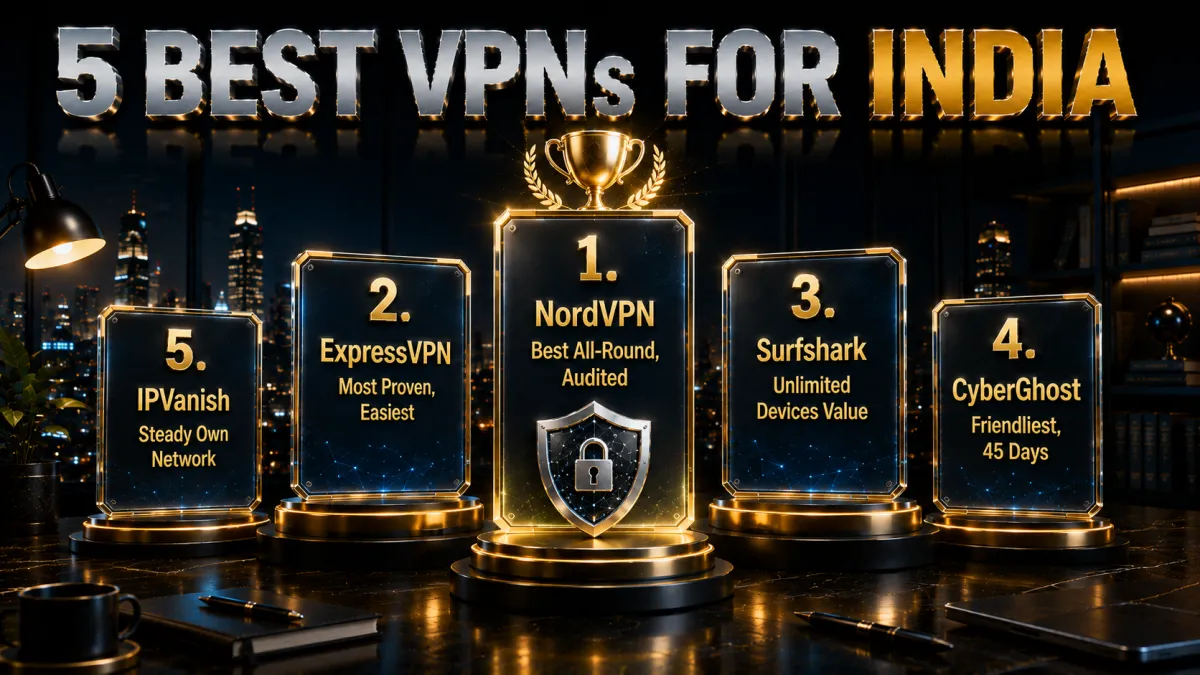
After testing multiple providers against India-specific criteria, three consistently came out ahead. Each has a different primary strength, so the right choice depends on what you value most. Detailed scorecards are below, followed by a side-by-side comparison.
1. NordVPN – Best overall VPN for India
NordVPN is the most balanced choice for Indian users across every metric that matters. Its NordLynx protocol, built on WireGuard, delivers consistently fast speeds that hold up well for 4K streaming and gaming. SmartPlay technology handles streaming platform detection quietly in the background so you do not need to fiddle with settings every time a service updates its VPN blocklist. The provider operates virtual India servers so you get an Indian IP address without any exposure to the five-year data retention requirement. Critically, its no-logs policy has passed independent audits, giving that claim a level of verification that marketing copy alone cannot provide.
✔ Pros
- NordLynx protocol delivers excellent speeds for 4K and gaming
- No-logs policy independently audited multiple times
- Reliably unblocks JioHotstar, Netflix, and Prime Video
- 10 simultaneous device connections per subscription
- Threat Protection blocks ads, trackers, and malicious domains
- Large server network with strong nearby options for Indian users
✘ Cons
- India servers are virtual, not physical in-country hardware
- Monthly plan is expensive relative to the long-term price
- App interface changes with updates can disorient returning users
| Price from | ~$3/mo (long-term plan) |
| Servers | 7,000+ across 110+ countries |
| India access | Virtual India servers |
| Simultaneous devices | 10 |
| Money-back guarantee | 30 days |
2. ExpressVPN – Most proven and easiest to use
ExpressVPN was among the first providers to pull its physical India servers after the CERT-In directive landed in 2022, a move that demonstrated a genuine commitment to its no-logs position rather than just stating it in a policy document. It still offers virtual Indian IP addresses so access to JioHotstar and Indian content abroad is unaffected. The Lightway protocol is fast and battery-efficient, and the apps across every platform are clean enough that a first-time VPN user can be up and running within a few minutes of downloading. If your priority is reliability over time rather than raw feature count, this is the most consistently proven pick in the market.
✔ Pros
- Pulled physical India servers in direct response to CERT-In, demonstrating privacy commitment
- Lightway protocol is fast and easy on battery life
- Streaming reliability is consistently high across major platforms
- RAM-only servers mean no data persists on disk after a reboot
- Beginner-friendly apps across all major platforms
✘ Cons
- More expensive than rivals on long-term plans
- Only 8 simultaneous connections, the lowest of the three picks
- No physical India servers, virtual only
| Price from | ~$5/mo (long-term plan) |
| Servers | Across 105 countries |
| India access | Virtual India servers and nearby locations |
| Simultaneous devices | 8 |
| Money-back guarantee | 30 days |
3. Surfshark – Best value with unlimited devices
Surfshark’s defining feature is unlimited simultaneous device connections on a single subscription. For a household with multiple phones, laptops, tablets, and a Smart TV, that directly translates to meaningful savings compared to a provider that caps connections at eight or ten. The pricing on long-term plans is the most affordable of the three picks while still delivering virtual India servers, solid streaming performance, and a CleanWeb feature that blocks ads, trackers, and malicious sites at the network level. Independent security audits have verified the infrastructure. For Indian users who need to cover an entire family without paying per device, it is the clear value choice.
✔ Pros
- Unlimited simultaneous device connections on one subscription
- Most affordable long-term pricing of the three picks
- Virtual India servers for streaming and Indian IP access
- CleanWeb blocks ads, malware, and phishing domains
- Independent infrastructure security audits completed
✘ Cons
- Speeds on distant servers can dip more than the other two picks
- Some advanced features are locked to higher-tier plans
- No physical India servers
| Price from | ~$2.50/mo (long-term plan) |
| Servers | 3,200+ across 100 countries |
| India access | Virtual India servers |
| Simultaneous devices | Unlimited |
| Money-back guarantee | 30 days |
4. CyberGhost, easiest for beginners
CyberGhost suits Indian users who want an easy, do-everything VPN. The apps are one-tap with servers labeled by purpose, so streaming, general privacy, or connecting to a specific country all take seconds. Following India data-retention directives, its physical India servers were removed like most no-logs providers, and it now offers virtual India locations so you can still get an Indian IP while your data is handled under stricter jurisdictions.
It runs WireGuard for good speeds, includes a kill switch and DNS-leak protection, and is based in Romania with no data-retention law and a strict independently audited no-logs policy. That combination keeps everyday browsing, streaming, and public-Wi-Fi use protected without any configuration.
The 45-day money-back guarantee is the longest of the five, giving new users generous time to confirm speeds and access work on their own connection before paying. For a first VPN in India that balances simplicity with genuine privacy credentials, it is an easy recommendation.
✔ Pros
- Beginner-friendly labelled servers
- Romania-based, no data-retention law
- Longest 45-day money-back window
- Virtual India servers for streaming
- Reliable speeds on nearby servers
✘ Cons
- Slower under heavy peak load
- Fewer devices than the value picks
| India streaming | Yes |
| Privacy base | Romania |
| Speed | Good |
| Price from | ~$2 to $3/mo (long-term plan) |
| Simultaneous devices | 7 |
| Money-back guarantee | 45 days |
5. IPVanish, best for many devices
IPVanish is a speed-first option for Indian users who want one account to cover the whole household. Owning its own network keeps throughput steady for streaming and downloads, and unlimited simultaneous connections mean every phone, laptop, and TV device runs on a single plan. Like other no-logs providers it offers virtual India locations rather than physical ones following the country data-retention rules, so you keep an Indian IP with data handled under a privacy-friendlier jurisdiction.
The apps are clean and practical, with WireGuard, a kill switch, and split tunneling, making it a dependable everyday tool once connected. For people who prioritize fast, reliable performance over bundled extras, it delivers.
The honest caveat is that IPVanish is US-based inside the Five and Nine Eyes alliances, which the privacy-focused should weigh. It offsets that with an independently audited no-logs policy and a 30-day money-back guarantee, and for stable speed across unlimited devices at a competitive price, it is strong value in India.
✔ Pros
- Owns its network for steady speed
- Unlimited simultaneous devices
- Reliable India streaming
- Simple, uncluttered apps
- Strong long-term value
✘ Cons
- US-based, inside the 9 Eyes alliance
- Smaller server network than the top picks
| India streaming | Yes |
| Privacy base | United States |
| Speed | Very good |
| Price from | ~$3 to $4/mo (long-term plan) |
| Simultaneous devices | Unlimited |
| Money-back guarantee | 30 days |
With the individual scorecards covered, here is how the three providers compare directly on the factors that matter most for India.
| Feature | NordVPN | ExpressVPN | Surfshark | CyberGhost | IPVanish |
|---|---|---|---|---|---|
| Best for | Overall balance | Proven reliability | Value | Beginners | Many devices |
| Speed | Excellent | Excellent | Very good | Good | Very good |
| India streaming | Excellent | Excellent | Very good | Very good | Very good |
| Simultaneous devices | 10 | 8 | Unlimited | 7 | Unlimited |
| India servers | Virtual | Virtual | Virtual | Virtual | Virtual |
| Audited no-logs | Yes | Yes | Yes | Yes | Yes |
| Price from (long-term) | ~$3/mo | ~$5/mo | ~$2.50/mo | ~$2.50/mo | ~$3.50/mo |
| Money-back | 30 days | 30 days | 30 days | 45 days | 30 days |
Best VPN for streaming in India (JioHotstar, Netflix, Prime)

Streaming is the most common reason Indian users reach for a VPN, and the landscape in 2026 revolves around three major platforms plus a set of regional services. Each platform handles geo-restriction differently, and each requires a different approach from VPN providers to stay ahead of detection updates.
- JioHotstar. The merged entity of JioCinema and Disney+ Hotstar is largely India-focused. If this is your main use case, read our dedicated Best VPN for JioHotstar guide before choosing a provider. Travel abroad and the platform refuses to load without an Indian IP. A virtual India server from any of the three picks resolves this immediately. IPL cricket, Bollywood content, and international sports rights make it the highest-priority streaming target for most Indian VPN users.
- Netflix. Netflix operates country-specific catalogues enforced by your IP address at viewing time. From India you can open US, UK, or Japanese libraries that contain different film and series selections. Conversely, if you hold an Indian Netflix subscription and travel abroad, a virtual India server restores your home catalogue. Netflix is the most aggressive VPN blocker of the three major platforms; NordVPN and ExpressVPN both maintain servers specifically tuned to stay ahead of its detection.
- Amazon Prime Video. Prime’s geo-model is somewhat more flexible than Netflix’s because Amazon has made many of its Indian original productions available across multiple regions. That said, the deepest catalogue of regional Indian content, covering Tamil, Telugu, Malayalam, Kannada, Bengali, Punjabi, and Marathi libraries, is exclusive to the Indian-region platform. An India IP from a virtual server unlocks that full depth.
- SonyLIV and ZEE5. These regional platforms enforce Indian-IP requirements strictly. For NRIs or travellers trying to access Indian TV content abroad they are among the most common frustrations, and all three VPN picks handle them reliably.
- Geo-restricted sports. Cricket rights in India are complex, with different tournaments split across JioHotstar, FanCode, and SonyLIV depending on the series. A VPN with a working India server gives you access to whichever platform holds the rights for the match you want to watch.
When choosing a VPN specifically for streaming, prioritise providers that actively maintain their server pool against platform detection updates. All three picks do this, but if streaming is your absolute top priority NordVPN and ExpressVPN have the strongest track records for consistency across platform updates.
What speeds can you expect from a VPN in India?

Speed is the factor most users worry about when considering a VPN, especially for 4K streaming, gaming, and large file downloads. The good news is that modern VPNs using WireGuard-based protocols have reduced the overhead enough that for everyday tasks the difference is barely perceptible if you are using the right settings.
- Protocol choice determines most of your speed outcome. WireGuard-based protocols, NordLynx, Lightway, and Surfshark’s WireGuard implementation, are consistently faster than older options like OpenVPN or IKEv2. If speed matters, confirm that your preferred protocol is set as the default in your VPN app settings.
- Virtual India server latency. Because virtual India servers run hardware outside India, there is some additional round-trip latency compared to connecting to a physically local server. For streaming and general browsing this is typically imperceptible. For competitive online gaming where every millisecond counts, it is worth testing explicitly before settling on a server.
- Server distance and load. The further you are from the VPN server and the more users it is serving simultaneously, the more your speed will dip. For non-India browsing, picking a server in Singapore or the UAE rather than one in Europe or the US will deliver noticeably better speeds for Indian users.
- Your base connection quality. A VPN cannot add bandwidth that your ISP does not provide. If your underlying connection is fast and stable, the VPN overhead is minimal. If your connection is already limited, that constraint does not change with a VPN.
We do not publish fabricated speed numbers in this guide because your results depend entirely on your ISP, your location in India, your device, and the time of day. The honest approach is to measure your baseline speed without a VPN, then measure again on the closest fast server your chosen provider offers. A well-configured VPN using WireGuard will typically show only a small reduction for streaming and browsing tasks.
How to set up a VPN in India: step-by-step
Setting up any of the three recommended VPNs is straightforward and takes only a few minutes. The process is identical in structure across Android, iOS, Windows, and macOS, with minor differences in where you find specific settings on each platform.
- Choose your provider. Pick based on your priority: NordVPN for the best all-round balance, ExpressVPN for simplicity, Surfshark if you want unlimited devices, CyberGhost if you want a beginner-friendly app, or IPVanish for everyday privacy. Then test it on your own Jio, Airtel, Vi, or home WiFi connection before keeping it.
- Sign up and create your account. Long-term plans offer the best per-month price. Complete your registration and confirm your email address before moving to the next step.
- Download the official app. Get the app from the Apple App Store, Google Play Store, or directly from the provider’s website. Never install VPN apps from unofficial third-party sources. Fake VPN apps are one of the most common malware delivery mechanisms in circulation.
- Log in and grant permissions. The app will prompt you to add a VPN configuration profile to your device. This is standard behaviour and how the encrypted tunnel is created. Grant the permission when asked.
- Set your protocol. Go into settings and confirm the protocol is set to the fastest WireGuard-based option available: NordLynx for NordVPN, Lightway for ExpressVPN, or WireGuard for Surfshark. Use OpenVPN as a fallback only if you experience connection issues on certain networks.
- Enable the kill switch. Find the kill switch option in your app’s settings and turn it on. This ensures your real IP address is never exposed if the VPN connection drops unexpectedly.
- Enable DNS and IPv6 leak protection. Most providers have this on by default, but confirm it is active in the privacy or security settings section of the app.
- Connect to the right server. For general privacy use, connect to the fastest available nearby server. For Indian content while abroad, connect to a virtual India server. For foreign streaming libraries, connect to a server in the target country.
- Run a leak test. Visit a DNS and IP leak testing site after connecting and verify that the IP shown is the VPN server’s address, not your real IP, and that no DNS queries are leaking outside the tunnel.
Once the initial setup is complete, daily use is as simple as opening the app and tapping connect. Most apps include a quick connect button that automatically selects the fastest available server based on your current location. You rarely need to go into settings again after the first configuration.
Are free VPNs safe to use in India?
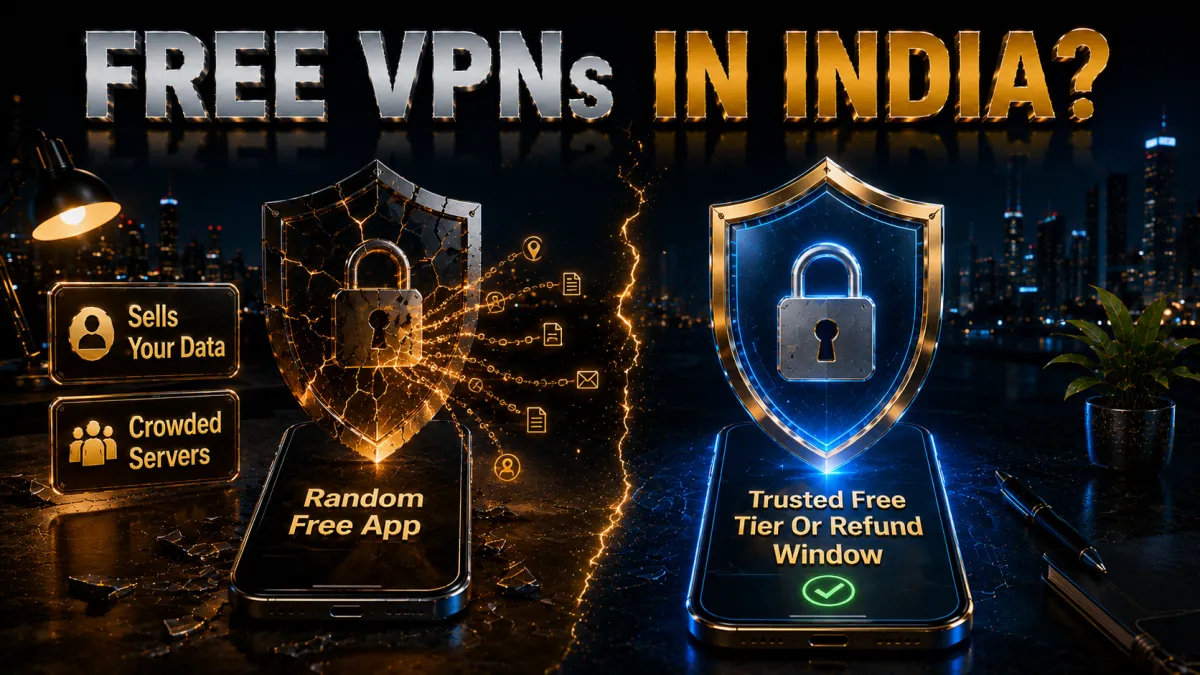
Free VPNs are tempting when you just want to test whether a VPN improves your situation. But in India’s specific context, where data privacy is already a concern under the CERT-In framework, the risks associated with most free VPN products are meaningful and worth understanding before you install one.
- Data monetisation. Operating a VPN service requires significant infrastructure, servers, bandwidth, and engineering resources. When there is no subscription fee, that cost has to be recovered somewhere. Some free VPN providers log and sell user browsing data to third-party advertisers, which is the opposite of what you are trying to achieve by running a VPN in the first place.
- Weaker encryption and outdated protocols. Not every free service implements AES-256 or offers WireGuard. Some use weaker ciphers or older protocols that have known vulnerabilities. That reduces the actual security benefit significantly.
- Data and speed caps. Most free plans impose bandwidth limits that make them impractical for anything beyond occasional light browsing. Streaming a JioHotstar match in HD will exhaust a typical free plan’s monthly allowance in under an hour.
- No independent audits. Reputable paid providers submit to third-party audits to verify their no-logs claims. The majority of free VPNs have no such verification, meaning you have only their word for what happens to your traffic.
- IP blacklisting. Free VPN IP addresses cycle through a smaller pool of servers shared by a large number of users. Streaming platforms identify and blacklist these addresses quickly. JioHotstar and Netflix will rarely work reliably on a free VPN.
- Malware risk. Fake VPN apps embedded with spyware or adware are disproportionately common in the free VPN category. Sticking to apps from known providers distributed through official app stores significantly reduces but does not completely eliminate this risk.
If you genuinely want to try a VPN without financial commitment, the most sensible approach is to sign up for one of the paid picks above and test it thoroughly within the 30-day money-back window. You get full access to the real service, all features active, no data caps, and a complete refund if it does not meet your needs. That is functionally equivalent to a free trial without any of the risks that come with actual free VPN products.
Related reading:
Frequently Asked Questions
Is using a VPN legal in India in 2026?
Yes. Using a VPN is legal for ordinary users in India. No law criminalises running a VPN on your personal device. The CERT-In 2022 directive imposes obligations on VPN providers, not on individual users. Whatever is illegal to do without a VPN remains illegal to do with one. The tool itself is lawful.
Which is the best VPN for India overall?
NordVPN is the best all-round VPN for India in 2026. It leads on speed, reliably unblocks JioHotstar and Netflix, and holds an independently audited no-logs policy. ExpressVPN is the most reliable and beginner-friendly alternative. Surfshark offers the best value if you need unlimited simultaneous device connections.
Do top VPNs still have servers in India?
Not physical ones. Major providers including NordVPN, ExpressVPN, and Surfshark removed their physical India hardware after the CERT-In directive required providers to retain user logs for five years. They now offer virtual India servers instead. These assign you a genuine Indian IP address while the actual hardware sits outside India, keeping your data away from the retention requirement.
What is the CERT-In VPN rule and does it affect me as a user?
The April 2022 CERT-In directive requires VPN providers with physical servers in India to store subscriber data for a minimum of five years and hand it over to authorities on request. It does not ban VPN use for individual users. Its practical effect on you is that you should choose a provider with an audited no-logs policy and virtual India servers, rather than one that still operates physical in-country infrastructure.
Does a VPN work with JioHotstar and Netflix in India?
Yes, when you use a reputable provider. A virtual India server gives you an Indian IP to access JioHotstar from abroad. From within India, connecting to a server in another country opens that country’s Netflix library. All three picks in this guide handle both use cases reliably.
Are free VPNs safe to use in India?
Generally no. Most free VPNs recover their infrastructure costs by selling user data, impose bandwidth caps that make streaming impractical, skip independent security audits, and use IP addresses that streaming platforms blacklist quickly. The better approach is to test a paid VPN within its 30-day money-back window rather than accepting the risks that come with a genuinely free product.
Will a VPN slow down my internet in India?
Slightly, but the impact is small when you use a WireGuard-based protocol and a nearby server. For HD and 4K streaming, gaming, and general browsing the reduction is typically imperceptible. If speeds feel slow, switching to a WireGuard-based protocol and selecting a geographically closer server resolves most cases.
Can I use one VPN subscription for all my devices?
It depends on the provider. NordVPN covers 10 simultaneous connections per subscription and ExpressVPN covers 8. Surfshark allows unlimited simultaneous connections, which makes it the clear choice for households with multiple phones, laptops, tablets, and a Smart TV all needing coverage.
Is a VPN essential on public Wi-Fi in India?
Yes. Public Wi-Fi networks at cafes, airports, metro stations, and shopping malls are frequently unencrypted. They are easy targets for interception attacks where someone captures traffic between your device and the access point. A VPN encrypts your connection at the device level before it reaches the access point, making that captured traffic unreadable.
Can a VPN protect me from online scams and fraud in India?
Partially. A VPN encrypts your connection and many providers include tools that block known phishing domains and malicious sites at the DNS level. However, a VPN cannot stop you from voluntarily clicking a fraudulent link, entering your UPI PIN on a fake site, or sharing an OTP with a scammer. It is a layer of protection, not a complete solution. Combine it with general caution around unsolicited messages and payment requests.
Which VPN protocol should I use in India?
Use a WireGuard-based protocol for the best combination of speed and security: NordLynx on NordVPN, Lightway on ExpressVPN, or WireGuard on Surfshark. Switch to OpenVPN only if you encounter a network that blocks the primary protocol, such as certain corporate or university networks that restrict WireGuard traffic.
Can I try a VPN before committing to a paid subscription?
Yes. All three picks offer a 30-day money-back guarantee. Sign up, test the VPN on your actual devices with your real use cases, and claim a full refund within the window if you are not satisfied. That is a risk-free way to evaluate any of the three options without relying on limited free-tier functionality.
The Bottom Line
India in 2026 gives you more reasons to run a VPN than ever: a regulatory environment that has pushed major providers to rethink how they operate in the country, a public Wi-Fi landscape that remains largely unencrypted, streaming services that enforce strict geo-restrictions, and a broader digital threat environment that has become more sophisticated. A good VPN addresses all of those simultaneously without meaningfully disrupting your daily experience.
- NordVPN is the best overall pick. Fast, reliable across streaming platforms, and backed by an audited no-logs policy. The right choice for most Indian users who want a single provider that handles every use case well.
- ExpressVPN is the most proven option over time. If you value consistent reliability above all else and want the simplest possible setup experience, it justifies the premium.
- Surfshark is the best value pick. Unlimited simultaneous connections at the lowest long-term price makes it the obvious choice for households and anyone covering multiple devices on a single budget.
- CyberGhost is the friendliest entry point, Romania-based with labelled servers and the longest 45-day money-back window.
- IPVanish owns its network for steady speed across unlimited devices, though it is US-based rather than in a privacy-friendly jurisdiction.
Whichever provider you choose, prioritise one with a genuinely audited no-logs policy and virtual India servers with hardware based outside the country. Those two criteria matter more in India right now than they do in almost any other market. Test your chosen VPN thoroughly within its 30-day money-back window using your real use cases: open JioHotstar, try a foreign Netflix library, run a speed test, and check for leaks. If it passes, you have found your India VPN. If it does not, claim your refund and try the next pick on the list.
Jyoti VPN Expert leads VPN testing at VPN Expert Guide, covering streaming and regional access, speed and latency testing, and leak checks on Windows, Android and router-level setups. Our guides are built from vendor documentation, provider terms and our own connection testing on a residential line in India, and we publish those measurements in full so readers can check them. Every guide is reviewed before publication and dated so you can see how current it is.
Meet our testing team →Last updated: September 22, 2026