
Best VPN for UAE in 2026: WhatsApp Calls, Streaming and Privacy Explained Honestly
Nine million people live in the UAE. Around eight million of them are expats. Most of them have family abroad they cannot call on WhatsApp. Here is what actually works, what the risks are, and which VPN to use if you decide the trade-off is worth it.
The reality of internet restrictions in the UAE
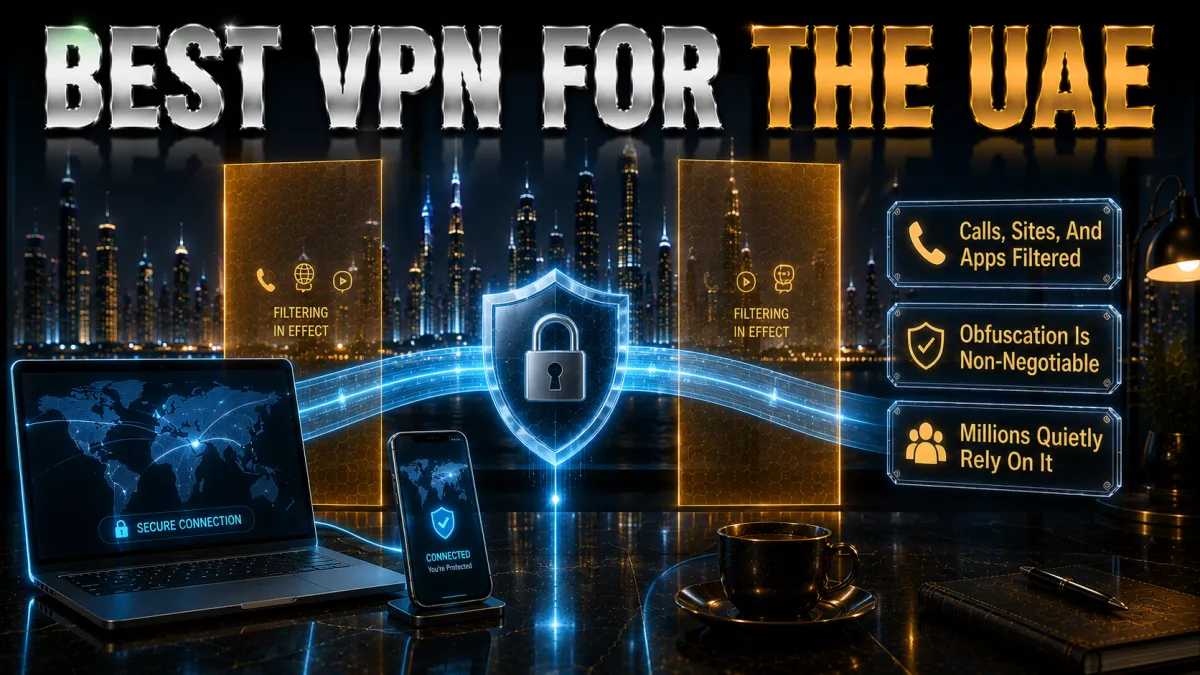
The UAE has one of the most sophisticated internet filtering systems in the world. It is not a crude block list like some countries use. The Telecommunications and Digital Government Regulatory Authority (TDRA) oversees a filtering infrastructure that uses deep packet inspection, meaning the network equipment does not just check which website you are visiting but can analyse the actual content of your connection to identify what type of traffic it is.
This matters because it is the reason ordinary VPNs sometimes fail in the UAE where they work fine elsewhere. A basic VPN changes your IP address. A VPN that UAE residents actually rely on needs to also disguise the fact that it is a VPN connection at all, through obfuscation technology that makes encrypted tunnel traffic look like ordinary HTTPS web browsing.
The restrictions themselves fall into a few categories, and understanding which category each restriction falls into changes the risk calculation significantly.
- VoIP calling: blocked and using a VPN to bypass it is technically illegal. WhatsApp voice and video calls, FaceTime audio and video, Viber, and the consumer version of Skype have all been blocked since 2015. The block is at the network level and applies regardless of whether you are on e& (formerly Etisalat) mobile data, du mobile data, or any Wi-Fi network in the country. It catches tourists and expats equally. The reason is straightforward economics: e& and du generate significant revenue from international call plans. A WhatsApp call to India or the Philippines that costs nothing competes directly with international call rates of AED 2 to 4 per minute through licensed operators.
- Certain streaming content: geo-restricted but VPN use to access it sits in a greyer area. Some streaming platforms and specific content categories are restricted. Accessing geo-restricted entertainment through a VPN is technically in scope of the cybercrime law but has not been a focus of enforcement.
- General privacy and security VPN use: explicitly legal. Businesses, banks, hospitals, and government entities in the UAE use VPNs for secure network access every day. This is explicitly permitted. Using a VPN to encrypt your traffic on public Wi-Fi, protect your data, or access your company’s internal systems is legal and common.
The WhatsApp call ban: why it exists and what it actually blocks

The VoIP restriction in the UAE is one of the most misunderstood internet policies in the Gulf. The confusion comes from two things: the ban is narrower than most people assume, and the reasons for it are more explicitly economic than most governments admit.
Here is what is actually blocked. WhatsApp voice calls. WhatsApp video calls. FaceTime audio. FaceTime video. Viber calls. Skype consumer calls. These fail silently in the UAE: you press call, and it either spins indefinitely or shows Call Failed with no explanation. The person you are calling abroad may see a missed call notification later, but the call is terminated by the network before it reaches your device.
Here is what is not blocked. WhatsApp messaging, photos, voice notes, file sharing, and status updates all work normally. WhatsApp itself is not banned. Only the real-time voice and video calling feature, which uses the VoIP protocol, is blocked. You can use WhatsApp all day in the UAE to send messages. You just cannot make calls.
- Why it still exists in 2026. The UAE has liberalised its digital economy considerably in recent years, approving Zoom and Microsoft Teams for business use and expanding approved applications periodically. WhatsApp calling remains blocked because the licensed telecom operators have not yet had their revenue impact resolved through the regulatory framework. As of August 2026, there has been no TDRA announcement of a change to WhatsApp calling restrictions.
- Why it affects expats most acutely. The UAE has the highest expat proportion of any country in the world, at approximately 90 percent of the total population. Most of those nine million people have families in India, Pakistan, the Philippines, Bangladesh, Egypt, the UK, the US, and dozens of other countries. For many of them, WhatsApp is not just a convenience: it is the primary way they stay connected with parents, spouses, and children they may see only once or twice a year.
- What the legal alternatives are. BOTIM is the TDRA-approved calling app with the largest user base in the UAE. It works for voice and video calls, supports both iOS and Android, and costs roughly AED 50 per month for an Internet Calling Plan activated through your telecom provider. GoChat is free for e& customers. Zoom and Microsoft Teams are approved for business communications. The friction is that these apps only work if the person you are calling also has them installed.
5 best VPNs for UAE in 2026

UAE’s deep packet inspection means not every VPN works. The ones that do need to have obfuscation technology that disguises VPN traffic as regular encrypted web traffic. The three below have maintained reliable UAE access through years of regulatory changes and infrastructure updates.
1. NordVPN – Best overall VPN for UAE
NordVPN’s obfuscated servers are the reason it leads this list for UAE. When you enable obfuscation in the settings, the VPN traffic is disguised to look like ordinary HTTPS traffic to the deep packet inspection systems that e& and du run. This is not a feature that every VPN provider has built properly, and in the UAE specifically it is the difference between a VPN that works and one that gets blocked at the network level before the tunnel is even established.
Beyond obfuscation, NordVPN’s NordLynx protocol keeps speeds fast enough for video calls and HD streaming even when connecting through an additional obfuscation layer. The no-logs policy has been independently audited multiple times, which matters specifically in the UAE where telecom operators have an economic incentive to cooperate with authorities on network monitoring. Ten simultaneous connections means your phone, your partner’s phone, and the family tablet can all run through a single subscription.
✔ Pros
- Obfuscated servers bypass UAE deep packet inspection reliably
- NordLynx keeps speeds high even through obfuscation layer
- Independently audited no-logs policy, no data to hand over
- 10 simultaneous device connections per subscription
- Threat Protection blocks ads and trackers
- Strong nearby server coverage including Singapore, India, and Europe
✘ Cons
- Obfuscated servers slightly slower than standard servers due to extra processing
- Monthly plan expensive without a long-term commitment
| Obfuscation | Yes, dedicated obfuscated servers |
| Price from | ~$3/mo (long-term plan) |
| Servers | 7,000+ across 110+ countries |
| Simultaneous devices | 10 |
| Money-back guarantee | 30 days |
2. ExpressVPN – Most proven for UAE, years of consistent access
If NordVPN gets the best overall title, ExpressVPN gets the most-proven-in-UAE title, and the distinction matters. ExpressVPN has been operating in the UAE market longer than almost any other provider and has been specifically tested and maintained against UAE’s regulatory infrastructure through multiple years of network upgrades. Its Lightway protocol handles obfuscation natively rather than requiring a separate server mode, and the RAM-only server architecture means that even if a server were somehow accessed by authorities, there is no connection data to retrieve because nothing is written to disk.
For expats who work in sensitive industries, finance, healthcare, or government contracting, where the provenance of their VPN provider matters alongside the technical performance, ExpressVPN’s track record and server architecture tend to be the deciding factors.
✔ Pros
- Longest proven track record of UAE access through regulatory changes
- Lightway handles obfuscation natively, no separate mode needed
- RAM-only servers, zero connection data persists after reboot
- Works on every platform including dedicated router app
- 24/7 live chat that understands UAE-specific server questions
✘ Cons
- Most expensive of the three picks, especially on long-term plans
- Only 8 simultaneous connections
| Obfuscation | Yes, built into Lightway protocol |
| Price from | ~$5/mo (long-term plan) |
| Servers | Across 105 countries |
| Simultaneous devices | 8 |
| Money-back guarantee | 30 days |
3. Surfshark – Best value for UAE, NoBorders mode for DPI
Surfshark’s NoBorders mode is specifically designed for restrictive networks, and UAE is one of its primary use cases. When NoBorders detects that the network is blocking VPN traffic (which e& and du both do at the DPI level), it automatically switches to servers and connection methods that are harder to fingerprint and block. The result is that Surfshark often connects in UAE without requiring manual configuration, which matters for users who just want to open the app and have it work.
The unlimited simultaneous connections model is particularly relevant for UAE households. A family of four in Dubai, each with their own phone, can all run through a single Surfshark subscription with no cap. At the lowest long-term price of the three picks, this makes Surfshark the most practical choice for expat households where multiple people need the same access.
✔ Pros
- NoBorders mode automatically adapts to UAE’s restrictive network environment
- Unlimited simultaneous device connections on one subscription
- Lowest long-term price of the three picks
- CleanWeb blocks ads and malicious domains at network level
- Works on Android, iOS, Windows, macOS, Fire TV, and routers
✘ Cons
- UAE reliability slightly less consistent than NordVPN and ExpressVPN under heavy DPI
- Speeds on distant servers can dip more than NordVPN under load
| Obfuscation | Yes, NoBorders mode |
| Price from | ~$2.50/mo (long-term plan) |
| Servers | 3,200+ across 100 countries |
| Simultaneous devices | Unlimited |
| Money-back guarantee | 30 days |
4. CyberGhost, easiest for beginners
CyberGhost is the most approachable option here for anyone who wants a VPN running on their phone or laptop in the UAE without a technical setup. Its apps are genuinely one-tap, servers are labeled clearly, and connecting to a nearby European location for everyday privacy and access to home services takes seconds. For a first-time user, that simplicity is the main appeal.
It runs WireGuard for good speeds, includes a kill switch and DNS-leak protection, and is based in Romania with no data-retention law and a strict no-logs policy. Those are the fundamentals you want when privacy is the point of installing a VPN in the first place.
Two honest notes: in heavily filtered networks the top picks with dedicated obfuscation sometimes connect more reliably than CyberGhost, so it works best where blocking is moderate; and VPN use in the UAE sits in a legal grey area, so use one responsibly and never for activity that is illegal locally. The 45-day money-back guarantee lets you test whether it connects dependably on your own network first.
✔ Pros
- Beginner-friendly apps and setup
- Romania-based privacy
- 45-day window to test on UAE networks
- Large server network
- Decent everyday speeds
✘ Cons
- Obfuscation less consistent through heavy DPI
- Fewer devices than the value picks
| UAE DPI bypass | Decent |
| Jurisdiction | Romania |
| Speed | Good |
| Price from | ~$2 to $3/mo (long-term plan) |
| Simultaneous devices | 7 |
| Money-back guarantee | 45 days |
5. IPVanish, best for many devices
IPVanish is worth a look in the UAE for travelers and residents who prioritize speed and want one account to cover every device. Owning its own server network gives it steady throughput, and unlimited simultaneous connections mean phones, laptops, and tablets can all run it together without juggling seats.
The apps are straightforward, with WireGuard, a kill switch, and split tunneling, making it a practical everyday tool once it is connected. For users whose main aim is fast, private browsing and access to their home-country services, the fundamentals are all present.
There are real caveats to weigh, though. IPVanish does not lean on dedicated obfuscation the way the top picks do, so on the most aggressively filtered networks it may connect less reliably; and it is US-based inside the Five and Nine Eyes alliances, which the privacy-focused will want to factor in. An audited no-logs policy and a 30-day money-back guarantee help, but as always, use a VPN responsibly and within local law.
✔ Pros
- Fast owned network
- Unlimited simultaneous devices
- Simple, uncluttered apps
- Strong long-term value
- Good for lighter networks
✘ Cons
- Weakest DPI bypass of the five
- US-based, inside the 9 Eyes alliance
| UAE DPI bypass | Basic |
| Jurisdiction | United States |
| Speed | Very good |
| Price from | ~$3 to $4/mo (long-term plan) |
| Simultaneous devices | Unlimited |
| Money-back guarantee | 30 days |
Here is the direct comparison of all three picks on UAE-specific criteria.
| Feature | NordVPN | ExpressVPN | Surfshark | CyberGhost | IPVanish |
|---|---|---|---|---|---|
| UAE DPI bypass | Obfuscated servers | Lightway native | NoBorders mode | Decent | Basic |
| UAE track record | Excellent | Longest proven | Very good | Good | Limited |
| Speed through obfuscation | Excellent | Excellent | Very good | Good | Very good |
| No-logs audit | Yes | Yes | Yes | Yes | Yes |
| Simultaneous devices | 10 | 8 | Unlimited | 7 | Unlimited |
| Price from | ~$3/mo | ~$5/mo | ~$2.50/mo | ~$2.50/mo | ~$3.50/mo |
| Money-back | 30 days | 30 days | 30 days | 45 days | 30 days |
Is using a VPN legal in UAE? The honest answer

This is the question most guides avoid answering directly, either because they want to sell you a VPN without the friction of legal caveats, or because the answer is genuinely nuanced. The honest answer is: it depends on what you use it for, and the legal framework is designed to be deliberately ambiguous in ways that give authorities discretion.
Here are the facts as they stand in August 2026, without spin in either direction.
- VPN technology itself is not banned. Businesses, banks, hospitals, law firms, and government contractors in the UAE use VPNs every day for secure remote access to internal networks. The TDRA has explicitly permitted this. If you use a VPN to access your company’s internal systems, encrypt your connection on public Wi-Fi, or protect your data while working remotely, you are operating within the law.
- Using a VPN to commit a crime is illegal, and the law is written broadly. Article 10 of the UAE Cybercrime Law prohibits using a VPN (or any tool) to access blocked content or commit crimes. The VoIP calling restriction means that WhatsApp calls are blocked, and the law can be read to mean that using a VPN to make those calls is itself illegal. The potential penalties cited in the law are serious: fines from AED 500,000 to AED 2,000,000, plus potential imprisonment.
- Enforcement has focused on large-scale commercial circumvention, not personal use. As of the date of this guide, there are no widely reported cases of tourists or residents being prosecuted, fined, or arrested specifically for making personal WhatsApp calls via VPN. The enforcement pattern has targeted commercial operators who sell VPN access or bypass services for profit, not individuals making calls home.
- The risk is real but the practical probability is low for personal use. This is not a reason to be cavalier about it. The law exists, it applies, and the potential consequences are severe if you were in the wrong situation at the wrong time. It is a reason to make an informed decision rather than an uninformed one.
Legal alternatives to VPN for calling in UAE
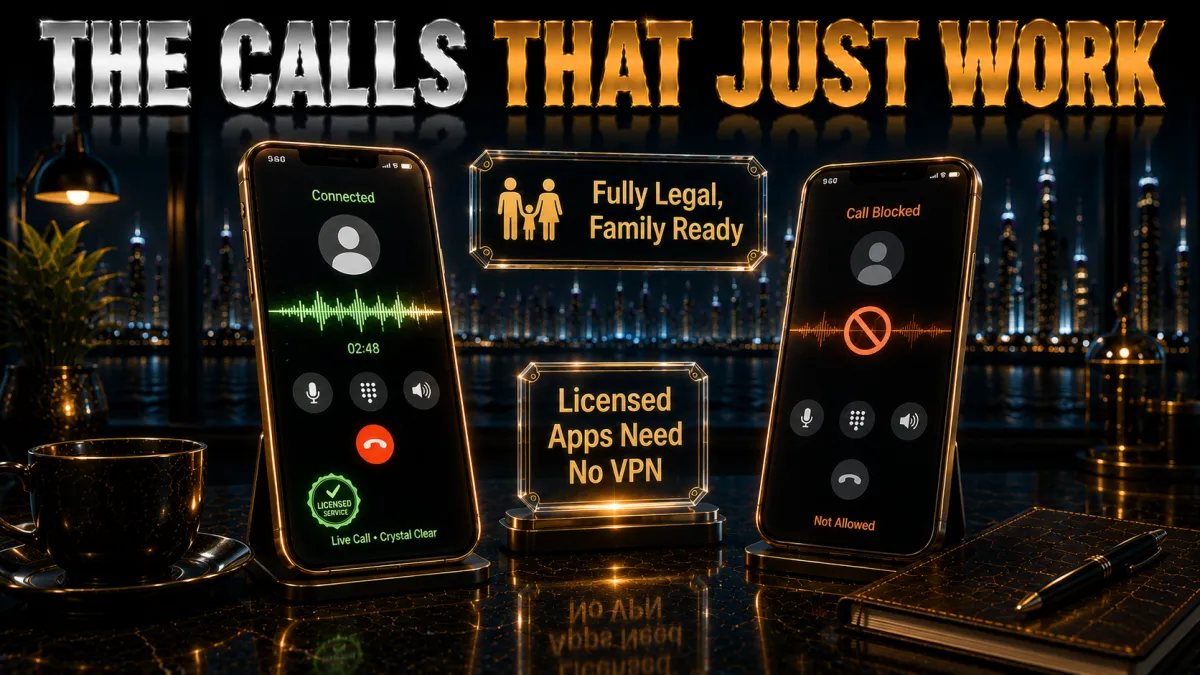
If you want to make voice and video calls in UAE without using a VPN, there are approved options. They work reliably and are entirely within UAE law. The trade-off is practical: they cost more than free apps like WhatsApp, they require the person you are calling to also use the same app, and they do not have the same global user base that makes WhatsApp so convenient. But they are worth knowing, especially if you are travelling to UAE temporarily and do not want to set up a VPN just for a short trip.
- BOTIM. BOTIM is the most widely used TRA-approved VoIP app in the UAE, with around 40 million registered users globally. It supports voice calls, video calls, group calls, and messaging. BOTIM requires a subscription in the UAE context: the standalone plan costs roughly AED 50 per month (around USD 14), and it is bundled into various Etisalat and du telecom packages, sometimes at a significantly lower effective cost. Quality is generally good, and it works well for regular family calls. The limitation is that the person you are calling also needs BOTIM installed, which is a friction point if your contacts are predominantly WhatsApp users.
- C’Me. C’Me is another TRA-approved calling app available in the UAE. It functions similarly to BOTIM and is available on both iOS and Android. The user base is smaller than BOTIM, making it less useful if your contacts are not already using it. Primarily used by users who find BOTIM’s pricing or interface less appealing.
- HiU Messenger. HiU is du telecom’s approved messaging and calling app. It is included with certain du postpaid plans without an additional charge, making it effectively free for du subscribers. Call quality is adequate for regular use. The limitation is the same as the other approved apps: limited user base and the requirement that both parties use the same app.
- Zoom, Teams, and Webex for work calls. Business-to-business video conferencing tools including Zoom, Microsoft Teams, and Cisco Webex operate in the UAE under business licences and work without restriction for professional use. If your primary calling need is work-related, you may not need a VPN or an approved consumer VoIP app at all. The restriction targets consumer VoIP like WhatsApp and FaceTime specifically; enterprise conferencing tools are a different regulatory category.
The honest comparison: BOTIM works and is legal, but it costs money, requires your contacts to install another app, and adds friction to communication that used to be free and instant. For short visits to the UAE, the approved apps are a reasonable solution. For expats living in the UAE long-term who make frequent calls to family back home on WhatsApp, the combination of cost and friction makes a VPN the more practical choice for most people, even accounting for the legal grey area involved.
How to set up a VPN in UAE: the settings that matter

Setting up a VPN in UAE requires one additional step compared to most other countries: enabling the obfuscation or stealth mode that disguises your VPN traffic. Without this, UAE’s deep packet inspection will identify and block the connection before the tunnel is established.
- Choose your provider and download the official app. NordVPN, ExpressVPN, or Surfshark from the App Store or Google Play. If you are already in the UAE and the app is unavailable in your regional app store, use a hotel or airport Wi-Fi to download it first, or use the provider’s direct website APK for Android.
- Enable obfuscation before connecting. In NordVPN, go to Settings and enable Obfuscated Servers under Advanced. In ExpressVPN, Lightway handles obfuscation automatically. In Surfshark, go to Settings, select VPN Protocol, and enable NoBorders mode. This step is not optional in UAE. Standard VPN connections without obfuscation are detected and blocked by the TDRA’s filtering infrastructure.
- Choose your server location based on your purpose. For best speed on general browsing, pick a nearby server: India, Singapore, or a European location depending on your home market. For streaming specific content, pick the country whose library you want. For WhatsApp calls, any server outside the UAE establishes the connection as long as it gets through obfuscation.
- Enable the kill switch. In UAE specifically, a dropped VPN connection without a kill switch exposes your traffic as unencrypted at exactly the wrong moment. Enable it in settings so your internet cuts entirely if the VPN drops rather than reverting to an unprotected connection.
- Test the connection before you need it urgently. Do not wait until you are about to call home on an important occasion to find out whether the VPN is working. Connect, test a call or streaming service, confirm it is working, and then you know you can rely on it.
- Keep the app updated. UAE’s DPI infrastructure is updated periodically, and VPN providers respond with their own updates. Outdated apps sometimes lose the obfuscation effectiveness that newer builds maintain. Enable automatic updates or check for new versions regularly.
Streaming in UAE: what is restricted and what VPNs unlock

Most people associate UAE internet restrictions with the VoIP ban, and that is where the frustration is most acute. But streaming is also affected, in ways that are less total than the calling ban but still meaningful for anyone trying to watch content from their home country or access a full international streaming catalogue.
Netflix operates in the UAE with a local catalogue. The library is functional but smaller than the US, UK, or Indian libraries, and certain content is absent due to UAE content regulations. Films and series with themes that conflict with local standards: specific political content, LGBTQ-related storylines, or material deemed culturally inappropriate , are either absent or carry edited versions. A VPN server in the US, UK, or India gives you access to those libraries instead, with their full unedited catalogues.
- Netflix UAE vs other libraries. The UAE Netflix library is a reasonable starting point but noticeably smaller than the US (roughly 6,700 titles) or UK (roughly 6,400 titles) libraries. Connecting to a US or UK VPN server opens those fuller catalogues, including content that is simply missing from the UAE version due to regional licensing or content decisions.
- Disney+ in UAE. Disney+ is available in the UAE and carries the core catalogue including Marvel and Pixar content. Some titles remain absent due to content regulations. A VPN to the US or UK opens the full catalogue without those gaps.
- BBC iPlayer. One of the most common streaming frustrations for British expats in the UAE. iPlayer is geo-locked to the UK and refuses connections from UAE IP addresses. A UK VPN server restores access immediately and reliably with all three picks in this guide.
- Indian streaming services. JioHotstar, SonyLIV, and ZEE5 are all geo-restricted to India. For the enormous Indian expat community in the UAE, easily the largest single nationality group in the country , accessing live cricket on JioHotstar from Dubai requires an Indian IP. A VPN with virtual India servers, which all three picks offer, solves this cleanly.
- YouTube. YouTube itself is accessible in the UAE, but certain videos are blocked at the country level based on content decisions by Google in response to UAE regulatory requirements. A VPN bypasses these specific blocks while keeping the rest of YouTube accessible normally.
- Twitch and gaming streams. Twitch is accessible in the UAE without restriction, but certain live streams and content categories are intermittently blocked. Gamers in the UAE report that a VPN provides a more consistent experience for competitive gaming streams and tournament coverage.
The streaming situation in UAE is not as severe as the VoIP ban, but it is meaningful for anyone who watches international content regularly. British expats miss iPlayer. Indian expats want JioHotstar for IPL. Everyone with a Netflix subscription wants access to a fuller library than the UAE catalogue offers. A VPN that handles multiple server locations gives you all of this on demand from one subscription.
The expat experience: what nine million people actually use VPNs for

The UAE is home to nine million people, around 90 percent of whom were born elsewhere. No other country on earth has an expat population this large proportionally. What those communities actually use VPNs for tells a more honest story than any abstract debate about internet freedom.
- Indian expats: IPL cricket above everything. For the Indian community in Dubai and Abu Dhabi, the single biggest VPN driver is live IPL on JioHotstar. A construction worker in Dubai, an IT professional in Abu Dhabi, a nurse in Sharjah: the use case is identical across income levels. JioHotstar now requires a paid subscription, but without an Indian IP that subscription is useless from abroad. All three picks in this guide provide virtual India servers specifically for this.
- Filipino expats: WhatsApp calls home. The Philippines has one of the UAE’s largest diaspora communities, concentrated in domestic work, healthcare, and hospitality. WhatsApp video calls to family in Manila are not a luxury for these workers. They are the primary way families stay connected across years of separation. The approved BOTIM alternative costs money that feels significant when you are already sending remittances home. A working WhatsApp VPN is, for this community, a genuine necessity.
- British and Western expats: streaming frustration. For professionals from the UK, US, and Europe working in Dubai’s finance, real estate, and consulting sectors, the frustration is almost always streaming rather than calling. BBC iPlayer refusing to load. US Netflix showing the wrong catalogue. Sports coverage geo-locked to home markets. These users prioritise speed and reliability above all else.
- Pakistani and Bangladeshi expats: cricket and family calls. Similar to the Indian community in motivation, with PSL and ICC events alongside WhatsApp calling as the primary drivers. ARY Digital and GEO TV streaming content is also commonly sought through a VPN connection to a Pakistani server.
- Arab expats from restricted countries. Many expats arriving from Egypt, Jordan, and other countries with their own internet restrictions are already comfortable using VPNs before they arrive in the UAE. For them, maintaining access to home-country content and communication is the primary motivation.
- Business users. Professionals at multinationals use VPNs to access company intranets, use tools blocked in the UAE, and maintain a consistent working environment. Business VPN use sits in a different regulatory category from personal use and is broadly understood to be acceptable for legitimate commercial purposes.
What all of these use cases share is that none of them involve illegal content or evading legitimate law enforcement. They are about staying connected to family, home, and the routines of daily life in a country where those connections have been deliberately restricted, largely for commercial reasons that benefit the licensed telecom operators. That context is worth keeping in mind when choosing which VPN to use and how.
Related reading:
Frequently Asked Questions
Is using a VPN illegal in UAE?
VPN technology is not banned in UAE. Businesses use VPNs legally every day. What the UAE Cybercrime Law prohibits is using a VPN to access content that is blocked under UAE law, including VoIP calling services. The potential penalties are serious: fines from AED 500,000 to AED 2,000,000. In practice, enforcement has focused on commercial circumvention operations rather than individual personal use, but the legal risk is real and should not be dismissed.
Can I use WhatsApp calls in UAE with a VPN?
Yes, technically. A VPN with obfuscation routes your connection outside UAE’s network, bypassing the VoIP block. However, using a VPN specifically to bypass UAE’s VoIP restrictions is technically illegal under the UAE Cybercrime Law. Individual personal use has rarely been prosecuted, but the legal risk exists. The decision is yours to make with full information.
Which VPN works best in UAE in 2026?
NordVPN is the best overall pick for UAE. Its obfuscated servers bypass UAE’s deep packet inspection reliably and NordLynx keeps speeds fast through the extra processing layer. ExpressVPN has the longest proven track record specifically in UAE. Surfshark’s NoBorders mode handles restrictive networks automatically and offers unlimited device connections at the lowest price.
Why are WhatsApp calls blocked in UAE?
WhatsApp voice and video calls use VoIP (Voice over Internet Protocol), which transmits calls over the internet. UAE’s licensed telecom operators e& and du generate significant revenue from international call plans. An unlicensed VoIP call that costs nothing competes directly with international call rates of AED 2 to 4 per minute. The TDRA enforces the restriction under a regulatory framework that requires real-time voice and video services to be provided only by licensed operators.
Does FaceTime work in UAE?
No. FaceTime uses VoIP and is blocked under the same UAE network restrictions as WhatsApp calling. FaceTime over Wi-Fi or mobile data does not work. FaceTime Audio over the cellular phone network may work on specific international carrier plans, but FaceTime VoIP calling is blocked.
What are the legal alternatives to WhatsApp calling in UAE?
BOTIM is the most widely used TDRA-approved calling app, costing roughly AED 50 per month through your telecom provider. GoChat is free for e& postpaid customers on eligible plans. Zoom and Microsoft Teams are fully approved for both business and personal use. Google Meet works through the browser. The practical limitation is that the person you are calling also needs to use the same app.
Will a regular VPN work in UAE or does it need special settings?
UAE uses deep packet inspection to identify and block VPN traffic. A standard VPN connection without obfuscation will often be detected and blocked at the network level before the tunnel is established. You need to enable obfuscated servers in NordVPN, use ExpressVPN’s Lightway protocol which handles this automatically, or enable NoBorders mode in Surfshark. This extra step is essential in UAE.
Can tourists use VPNs in UAE?
The same legal framework applies to tourists as to residents. VPN technology is not banned. Using it to bypass VoIP restrictions is technically illegal for everyone regardless of residency status. In practice, UAE’s enforcement has not focused on tourist VPN use. Many tourists use VPNs throughout their stay without incident.
Is Netflix available in UAE?
Yes. Netflix operates in UAE with a local catalogue. The UAE library does not include all content available on Netflix globally due to UAE content regulations. A VPN connecting to US, UK, or other Netflix libraries gives access to titles not available on the UAE platform.
What does BOTIM cost in UAE?
BOTIM requires activating an Internet Calling Plan through your telecom operator. Through e& this costs approximately AED 50 per month. GoChat is free for e& postpaid customers on eligible plans. Both require the person you are calling to also install the same app, which is the primary practical limitation for users whose families and contacts use WhatsApp.
Can I use Skype in UAE?
Skype consumer calling is blocked under the same VoIP restrictions as WhatsApp. Skype for Business and Microsoft Teams are approved and work normally. If you need Skype-like functionality for personal calls, Zoom is the most practical fully approved alternative.
Which VPN server should I connect to in UAE for best speed?
For general browsing and streaming, connect to the nearest fast server: India, Singapore, or a European location depending on what you are accessing. Enable obfuscated mode specifically when you need to bypass DPI filtering rather than leaving it on all the time, as it adds a small speed overhead that is unnecessary when just browsing or streaming.
The Bottom Line
The UAE is a remarkable place in many ways, and its internet restrictions are among the most consequential for the daily lives of its residents. Nine million people, most of them far from home, navigating a system designed to protect telecom revenue at the cost of one of the most basic human needs: talking to the people you love in the way they are already set up to receive calls.
The practical situation in 2026 is this. WhatsApp calls remain blocked. The legal alternatives work but require friction that many people find impractical. VPN use for personal calling is widespread, technically illegal under a broadly written law, rarely enforced against individuals, and a decision that millions of UAE residents make every day after weighing the trade-offs for themselves.
- NordVPN is the best technical choice. Obfuscated servers, audited no-logs, fast speeds through the extra processing layer. If you want the most reliable connection through UAE’s DPI infrastructure, this is it.
- ExpressVPN is the most proven over time in UAE specifically. If you want the provider with the longest track record of working through every UAE network update, and you are willing to pay the premium, this is the one.
- Surfshark is the best value for expat households. Unlimited simultaneous connections at the lowest price, with NoBorders mode that handles restrictive networks automatically.
- CyberGhost is the friendliest starting point, Romania-based with a 45-day window to test on your UAE network before committing.
- IPVanish adds unlimited devices and strong speed, but has the weakest DPI bypass of the five, so it suits lighter networks.
Whichever you choose, test it with the 30-day money-back guarantee before committing. Enable obfuscation on first setup. Keep the app updated. And make the decision about what you use it for with clear eyes about what the law says and what the realistic enforcement pattern has been. That is all anyone can honestly tell you.
Jyoti VPN Expert leads VPN testing at VPN Expert Guide, covering streaming and regional access, speed and latency testing, and leak checks on Windows, Android and router-level setups. Our guides are built from vendor documentation, provider terms and our own connection testing on a residential line in India, and we publish those measurements in full so readers can check them. Every guide is reviewed before publication and dated so you can see how current it is.
Meet our testing team →Last updated: August 24, 2026